Hello, this is Merry Plastic Surgery Clinic, where meeting you is always a pleasure.
Happy New Year to all Merry members!
With the long Lunar New Year holiday, many people took the opportunity to have the nose surgery they had been wanting to do.
You may be wondering how to take care of yourself after rhinoplasty for a better recovery!
Let’s also look at the dressing materials used for better results.

"After rhinoplasty, the splint and tape... when on earth do they come off?"
After rhinoplasty, many people worry because bruising and swelling can last longer than expected.
When you look in the mirror right after surgery and see splints, taping, and cotton padding all over your nose, it can feel a little overwhelming.
"So when does all of this come off?"
But in fact,
did you know this process plays a very important role in completing a beautiful nose line?
Today, let’s look at the “dressing materials” that help recovery after rhinoplasty
and make the surgical results more stable.
The ‘dressing process’ is just as important as the surgery
Why is it necessary?
After rhinoplasty, to minimize swelling and bleeding and maintain the desired shape,
it is essential not to simply finish with sutures, but to go through the proper dressing process.
🔹 Silicone sheet for septal protection
If cartilage from the septum was harvested or if surgery for rhinitis was performed at the same time, it is important to prevent bleeding and hematoma.
If a hematoma forms in the septum, nasal congestion can become severe, and in severe cases it can even lead to mucosal necrosis.
To prevent this, a “silicone sheet” is placed inside the nose to protect the septum and prevent bleeding.
Silicone sheets are usually removed together with the sutures one week after surgery.

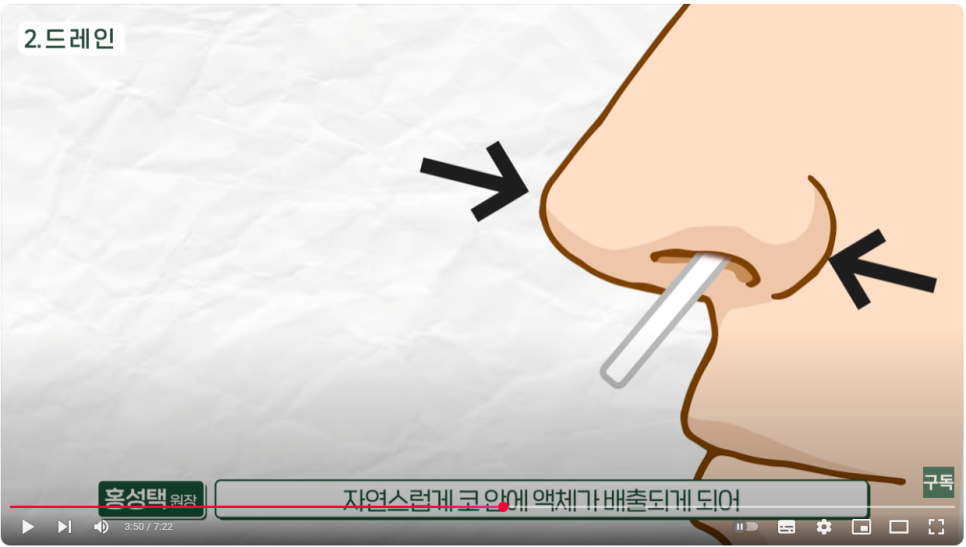
🔹 “Drain” to prevent bleeding
If bleeding occurs after surgery, it is not just a matter of blood coming out;
hematoma can also accumulate inside and cause contracture or inflammation.
To prevent this, a small plastic tube called a “drain” is inserted
so that blood and fluid collected inside can be naturally discharged.
If a drain is kept in place for too long, it can instead cause infection, so it needs to be removed at the appropriate time after examination.
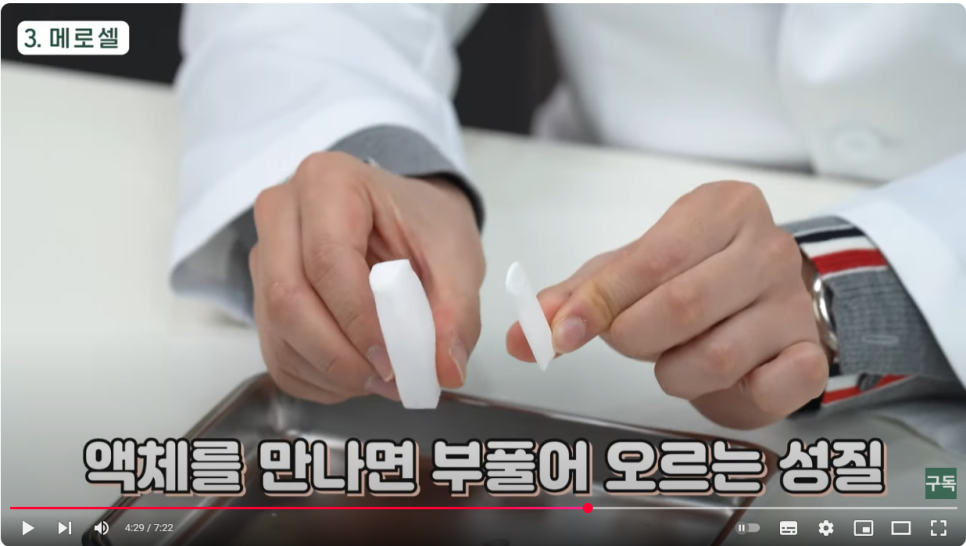
🔹 The key to controlling bleeding and swelling, “Merocele”
The most uncomfortable moment after rhinoplasty!
It’s when your nose feels completely blocked and it becomes hard to breathe.
The special hemostatic cotton used at this time is called “Merocele.”
It absorbs water and blood, expands, blocks the inside of the nose, helps prevent bleeding, and reduces swelling.
It is usually removed after 2 to 3 days, and many people feel relieved at that time.
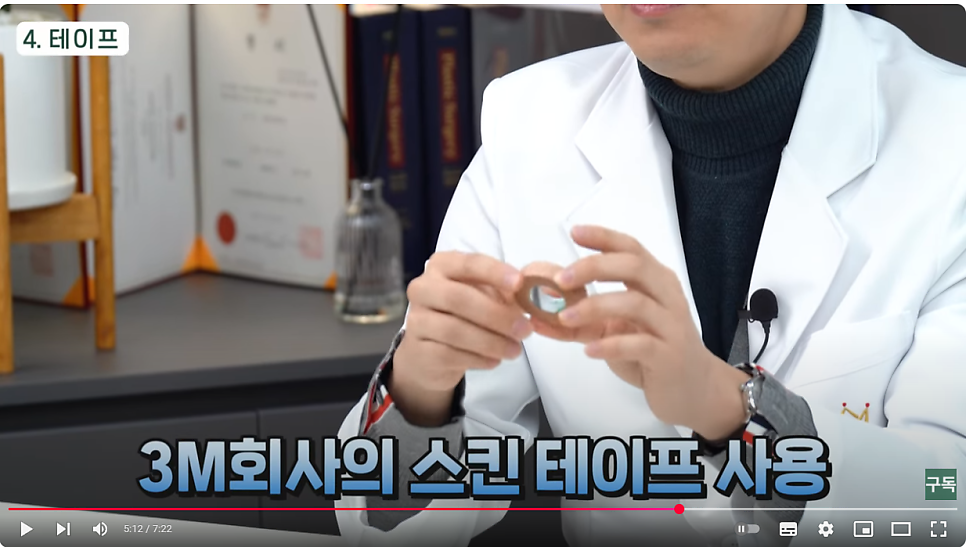
🔹 “Skin tape” that helps shape the nose
You may have been surprised to see a lot of skin-colored tape on after surgery.
This is “skin tape,” used to prevent movement of the external implant and reduce swelling and bleeding.
In particular, special tape from 3M is often used after rhinoplasty because it causes less skin irritation and has strong adhesion.
It is usually kept on for about a week.
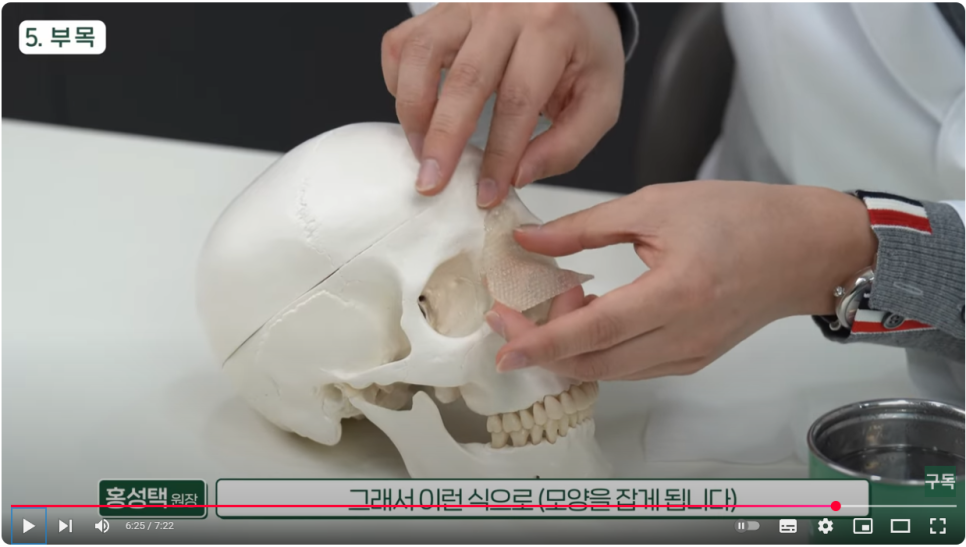
🔹 “Aqua splint” that protects against impact
A splint is used to stably maintain the shape of the nose and protect it from external impact.
Among splints, the “Aqua Splint” can be custom-shaped in response to heat,
so it has the advantage of being adjustable to each person’s nasal shape.
Studies on the importance of dressing
The reason the dressing process is important has also been confirmed in several studies.
Using appropriate dressing materials after rhinoplasty
has been shown to help reduce swelling and bleeding, and prevent scarring and contracture.
According to a study titled Journal of Plastic, Reconstructive & Aesthetic Surgery,
if proper compression and hemostasis are not achieved, hematoma can build up and increase the risk of tissue necrosis or infection.
On the other hand, the study reported that using silicone sheets, drains, and proper taping
helps minimize bleeding and swelling and speeds up recovery.
In other words, after rhinoplasty, post-operative care is just as important as the surgery itself!
You probably already know that without us having to stress it any further, right?
When should the dressing be removed?
The dressing can feel uncomfortable,
and you may be looking forward to seeing your nose after everything has been removed.
Most dressing materials are removed at set times, so let’s review them again.
✅ Days 2–3: Remove Merocele & drain
✅ Day 7: Remove silicone sheet, tape, and splint
However, recovery speed can differ from person to person,
so it is best to consult the attending medical staff and have it removed after examination.
Rhinoplasty: what determines the result is ‘aftercare’!
Post-rhinoplasty care is not simply about “enduring the pain.”
Only when proper dressing and care are provided can the surgical result look more beautiful and natural.
It may be uncomfortable right after surgery because of the splint and cotton,
but if you think of this process as helping create a more perfect nose line, it may be a little easier to bear.
If you have any more questions, leave them in the comments! Adding us as mutual neighbors/friends is also welcome💙
The most accurate information can be obtained by consulting a specialist at a nearby hospital.
This has been Merry Plastic Surgery Clinic, where meeting you is always a pleasure.
#Rhinoplasty #RhinoplastySwelling #RhinoplastyRecovery #Merocele #DressingMaterials #PostSurgeryCare #RhinoplastySplint #RhinoplastyTape #NasalDrain #BestRhinoplastyClinic #MerryPlasticSurgeryClinic #GangnamStationPlasticSurgery #ApgujeongStationPlasticSurgery #SinsaStationPlasticSurgery