Hello, this is Merry Plastic Surgery Clinic, where it’s always a pleasure to meet you.
I often buy various things on Wadiz, and then I came across a product with a shocking name.
It was called Thermacera—ta-da!
I thought, “Could this be a machine that combines Thermage and Ulthera?” and found myself drawn into reading the product page.
Then I was watching TV and saw singer Eugene advertising the Dualsonic device while doing elegant ballet movements.
Hmm... so many devices have come out.
While seeing these kinds of things,
some of you occasionally ask during consultations, “Should I buy a home beauty device and use that?”
(It’s not just one or two people asking this;;)
While treating patients, I directly use HIFU (ultrasound, Ulthera) and RF (radiofrequency, Density).
From a specialist’s perspective, I’d like to compare them once.
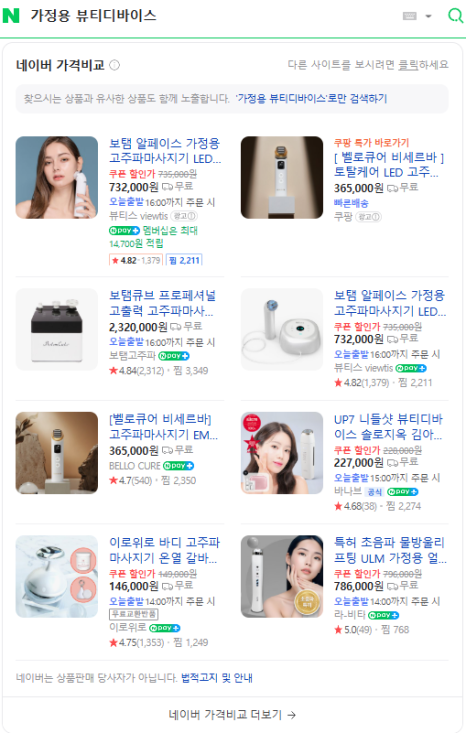
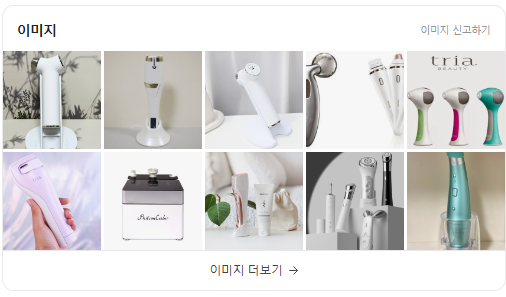
Naver search results for home beauty devices

Wadiz
Medical devices vs. home beauty devices
Machines used in hospitals are medical devices,
and the ones you can try using yourself at home are home beauty devices.
Let’s first look at the essential difference between medical devices and home beauty devices.
First of all,
the biggest differences between home beauty devices and the medical devices used in plastic surgery clinics and dermatology clinics are
output (energy intensity), depth of skin penetration, and the way energy is delivered evenly.
First, let’s summarize it simply in a table.
| Medical lifting device | Home beauty device |
|---|
| Output (energy intensity) | High output | Low output |
| Penetration depth | Deep: dermis + SMAS layer (up to 4.5 mm) | Shallow: epidermis-dermis layer (up to 1.5 mm) |
| Energy delivery method | Even heat delivery & strong coagulation point formation | Distributed low-energy delivery |
| Duration of effect | 6–12 months (induces collagen production) | Short-term and temporary effect |
| FDA-approved based on clinical research & supported by numerous clinical studies | Insufficient clinical data, difficult to prove effectiveness |
| Professional procedure required | Requires precise treatment by a doctor | Can be used directly by the general public |
** Lately, many home beauty devices claiming to be HIFU have been released, so I compared them with HIFU equipment.
Because HIFU (high-intensity focused ultrasound) medical devices are trending these days, various home beauty devices have also been released.
Products launched as medical devices deliver high-output energy of 50–90 J (joules) or more in a consistent way,
inducing skin regeneration effects through collagen denaturation and remodeling.
By the nature of HIFU,
it does not work based on frequency, but rather by focused ultrasound energy that creates thermal coagulation points (TCPs) at a specific depth.
It also accurately delivers energy to the layers of the skin that can induce lifting and tightening effects among the various layers that make up the skin.
To do that,
- An experienced doctor directly designs the treatment to distinguish where energy is needed and where it should not be delivered.
- Various tips are used to target the layer appropriate for the intended purpose.
- Ulthera has ultrasound imaging, so you can think of it as performing the procedure while directly seeing inside the skin.
And both an advantage and a disadvantage—those who have had the procedure know this well...
Ulthera hurts a lot.
Sometimes even doctors who do self-treatments do so with their teeth clenched, I’m sure^^:;;
Because high-output energy is delivered, it is unavoidable that it can hurt to some degreeㅜㅜ
I looked at the product page for the home beauty device.
There was an image showing dots being formed, and these dots are supposed to create thermal coagulation points inside the skin.
This seems to be depicting the thermal coagulation points (TCP) of HIFU,
but if you look at the detailed product description table, it lists a frequency.
Hmm, then does it work like RF devices by heating the skin tissue overall?
What I found interesting while reading the description was the mention of unlimited shot provision,
and the fact that one cartridge can reach 1.5 mm, 3.0 mm, and 4.5 mm.
HIFU devices have separate 1.5 mm / 3.0 mm / 4.5 mm tips,
and they are swapped out during the procedure.
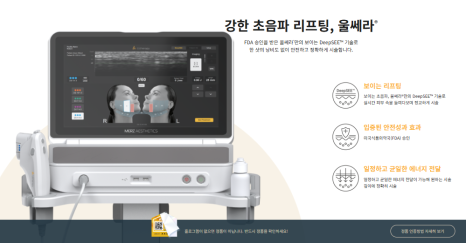
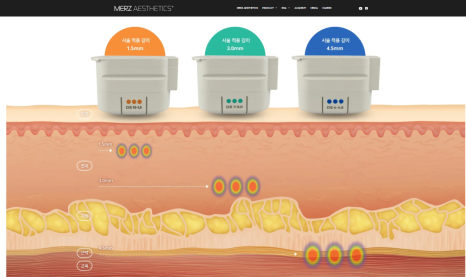
Source: MERZ. Ulthera has three tips like this.
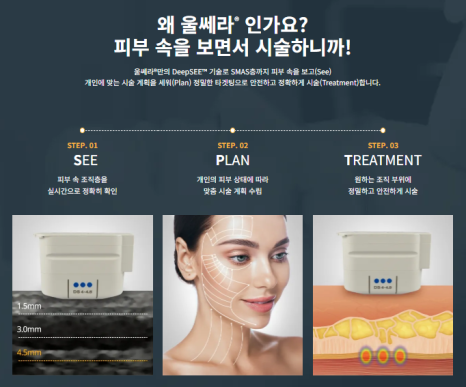

Source: MERZ, advantages of Ulthera
There was no more detailed technical information, so this is about as far as I could look into it.
The machine price differs by more than 100 times.
And the tips that are replaced each time are more expensive than home beauty devices...
Do you get the sense of it?
In my opinion (since I have not personally experienced a beauty device, this is a theoretical inference)
✔ Home devices may create a temporary improvement on the skin surface,
but their energy is insufficient to act deeply in the skin and induce lifting and tightening.
✔ In particular, I wonder whether they can deliver energy all the way to the currently popular SMAS (fascia) layer.
Even experienced doctors, while looking at the patient’s skin thickness and elasticity and measuring with ultrasound during treatment,
sometimes encounter cases where the energy is too high and the patient complains of indentations, suffers burns, or feels symptoms of nerve paralysis.
That’s because high-output energy is a double-edged sword.
In such a situation, I think they would not have allowed high-output energy devices to be used at home.
The fact that you can manage yourself frequently at home is a positive point,
but it would be good to consider the time and labor involved, the economic cost, and above all, the “effect.”
As procedures using machines have increased recently, I think misunderstandings are also slowly appearing.
A lifting procedure is not simply the concept of “using a machine.”
The most important thing is judging, based on experience, which skin needs what depth and how much energy should be delivered.
No matter how good the machine is, adjusting the output and treating the exact right area requires the experience of skilled medical staff,
so there are inevitably limitations to using it at home as an individual.
For anything you need, please consult a specialist at a nearby clinic~!
That has been Merry Plastic Surgery Clinic’s Slow Aging Clinic.
#Thermage #Ulthera #Thermacera #lifting procedure #medical device #beauty device #elasticity improvement #RF lifting #HIFU lifting #skin elasticity