The Two Front Teeth Always Appear as a “Pair”
Hello. I’m dentist Hosan Park.
When a person smiles, the gaze is drawn first to the two central front teeth. Their brightness, width, length, the line where they begin at the gums, the translucency at the edges, and the way light settles on their surfaces are compared almost simultaneously. This is why even small differences that might go unnoticed elsewhere quickly stand out at the very center of the smile.
That was also what made this case particularly challenging. Under the FDI tooth numbering system, #11—the maxillary right central incisor—was a natural tooth that had undergone root canal treatment long ago and had internal discoloration. The opposite tooth, #21, the maxillary left central incisor, was an implant that had already been placed at another dental clinic.
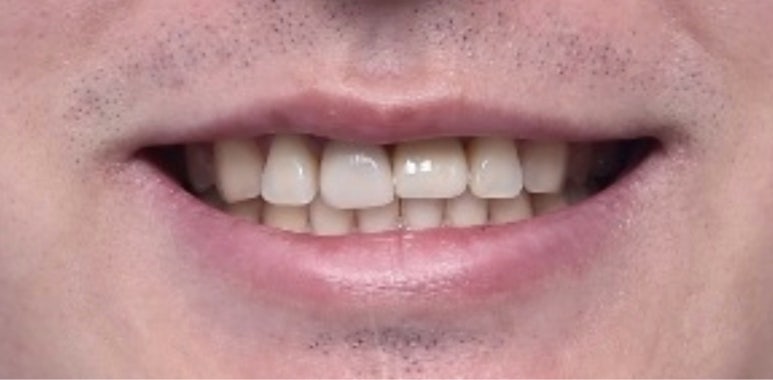
One side had the foundation of a darkened natural tooth, while the other had an implant abutment structure that interacted with natural teeth and light in an entirely different way. Although their starting points were different, the two neighboring teeth ultimately needed to appear as one natural pair.
This was not about making the two restorations identical. It was about integrating two different foundations into a single smile so that their differences would not show.
The phrase “an implant from another dental clinic” is not intended to evaluate or compare the previous treatment. It means that the treatment had to be planned with the implant’s position, abutment structure, relationship with the gums, and available space already determined. This was not a case that could be designed from a blank slate; it was a case in which we had to respect the existing conditions while finding the best possible harmony.
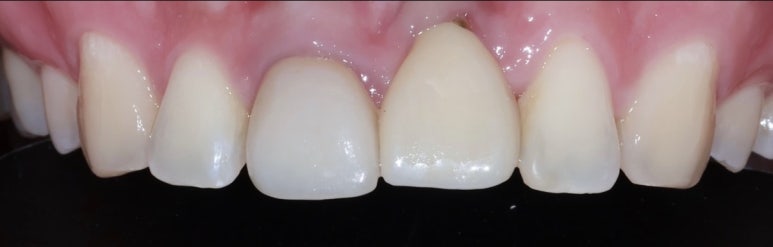
Pre-treatment close-up
Due to the position and angulation of the existing implant restoration, the gumline around the patient’s right central incisor had risen considerably, while the gumline around the patient’s left central incisor had receded.
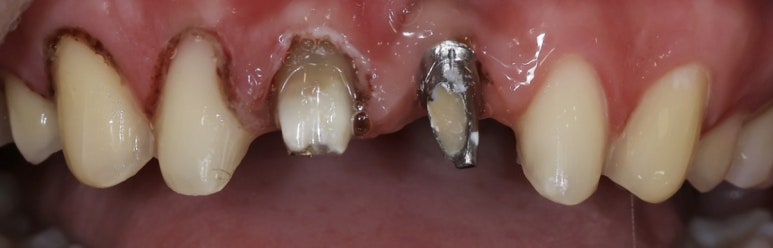
After crown removal, preparation of the adjacent-tooth veneers, and gum contouring
After removing the crown, the discolored central incisor and the implant abutment became visible. The gumline was also refined slightly.
The patient had previously undergone orthodontic treatment, and the alignment of the other teeth was relatively good. Since the patient wanted not only to improve the alignment and shade of the two front teeth but also to achieve an overall change in appearance and smile, we planned Seramel Premium veneer treatment for the remaining teeth with minimal reduction.
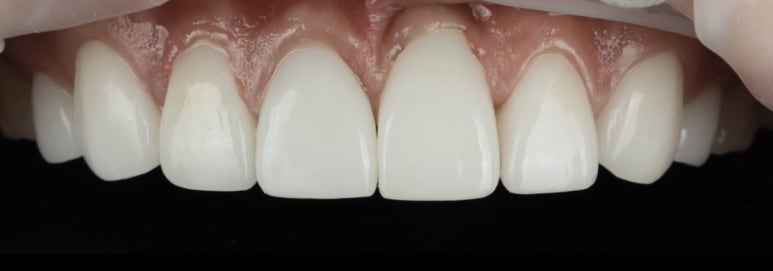
The day treatment was completed
Choosing the same shade does not make two teeth the same
The color of a restoration is not determined solely by the color of the porcelain itself. The final impression is created by how much light enters the restoration, how it reflects from the foundation beneath it, and how it returns from the surface. Therefore, applying the same thickness and translucency to two teeth with different foundations can actually make them appear to be different colors.
-
#11, a discolored natural tooth. The dark foundation may pull the restoration toward a grayish or dull appearance. However, covering it with an overly opaque material can make it look like a lifeless white block, while making it too translucent may allow the internal discoloration to show through.
-
#21, an implant. Because it lacks the depth of light created by natural dentin and is influenced by the abutment structure, approaching it in the same way as a natural tooth makes it difficult to reach the same result.
-
The relationship between the two central teeth. Even if each tooth appears to have an acceptable color, the two will not read as a pair if their line angles, surface texture, cervical contours, incisal translucency, and the positions of their reflected light differ.
So the question in this case was not, “Which shade should we use for both?” The key question was, “What role should each restoration play, given its different starting point, so that both can reach the same sense of naturalness?”
Beyond matching color, matching light
In aesthetic dentistry, the naturalness a patient perceives is not created by a single factor. In this case, the following conditions worked together.
-
Value: Coordinating the overall brightness of the two front teeth so that neither side appears noticeably lighter or darker
-
Masking and translucency: Covering each different foundation only as much as necessary while preserving tooth-like depth
-
Form and line angles: Subtle contours that determine the visible width, symmetry, and direction of reflected light
-
Surface texture and gloss: A surface that breaks up light finely, so the restoration does not look excessively smooth and artificial
-
The character of the incisal edge: Coordinating the length and translucency of the front-tooth edges, as well as the spaces between them, with the movement of the lips
-
The gingival frame: The cervical relationship that makes the teeth appear to emerge naturally from the gums
These elements do not work independently. Changing the opacity changes the value, and even a slight change in contour alters the reflected light. Refining the incisal edges changes the rhythm of the entire smile. Ultimately, this is not work that can be solved with a shade guide alone; it is the simultaneous design of light and form.
Craftsmanship begins after “good enough”
The craftsmanship I associate with aesthetic dentistry is not a flashy slogan. It is closer to the attitude of looking one more time, even when the result already appears acceptable. It means looking not only at close-up photographs but also from conversational distance; looking not only at stationary teeth but at the smile as it moves with the lips; and observing where the gaze stops before the awkwardness can even be explained in words.
In this case, everything was connected like a single equation: how far to control the dark foundation of #11, how the implant foundation of #21 would affect value and translucency, how the two central incisors would divide their width, contact points, and incisal-edge positions, and how the surrounding teeth and lips would frame the result.
Craftsmanship is not the technique of making more visible. It is the persistence to erase, to the very end, the dark foundation of discoloration, the opacity of the implant, and the small clues that say, “This looks like a restoration.”
Sometimes the result is changed by a very subtle difference in contour, a quieter reflection of light, a surface that needs less gloss rather than more shine, or the position of the incisal edge, which must be judged in the overall smile rather than in a close-up photograph. These small decisions accumulate to produce a result that required considerable effort but shows no obvious sign of having been forced.
Result: Different, but not visibly different
In the final photographs, #11 and #21 read not as “an implant restoration beside a natural tooth,” but as a pair of central incisors. Their biological starting points have not become the same. It is more accurate to say that their different foundations were managed optically and morphologically so they would not affect the final impression.
The brightness and reflected light of the two front teeth move together, the central axis feels stable, and the gaze naturally follows the entire smile instead of stopping on a particular restoration. Rather than creating a restoration that stands out, the goal is to make people forget that a restoration is there. That was the standard I did not want to lose sight of throughout this case.
We did not try to make the difficult conditions of a discolored #11 and an existing implant at #21 sound simple. We controlled the foundation of the discolored natural tooth, respected the conditions of the existing implant, and invested all of my experience and concentration in diagnosis, design, material decisions, communication, and fine adjustments so that the difference in materials would not become a difference in the appearance of the two front teeth.
I believe craftsmanship is not a phrase used to exaggerate the result, but an attitude of refusing to compromise throughout the process. Paradoxically, the trace of that persistence remains in how quietly the restorations disappear within the final smile.
The case was not easy, but we put all of our clinic’s capabilities and experience into it. We went through multiple rounds of handwork and staining so that the new veneers would differ as little as possible from the surrounding teeth in both appearance and shade.
To be honest, cases like this are not completed in a single day. The result reflects our determination and commitment to provide a natural smile that would not look artificial, through multiple visits and even a provisional-tooth stage lasting about a month. The process was probably not easy for the patient either, but fortunately, the patient was satisfied in the end.
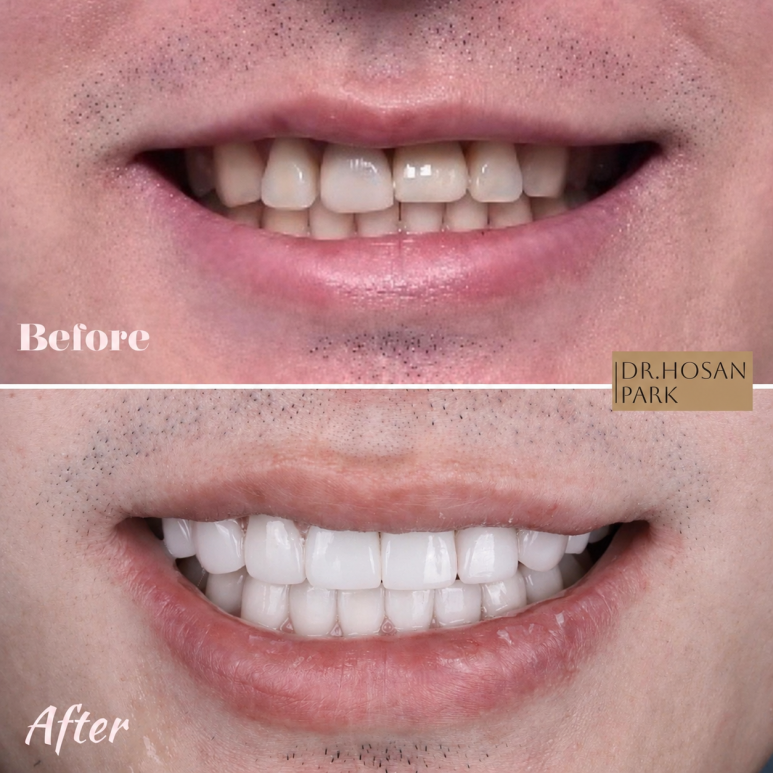
Before and after treatment, treatment period: 4 weeks
Honestly, when I perform this kind of aesthetic treatment, I do not think of our work as simply cutting and attaching teeth.
I feel a sense of responsibility as I think about the life the patient will live going forward and the day when they will smile confidently with their new smile.
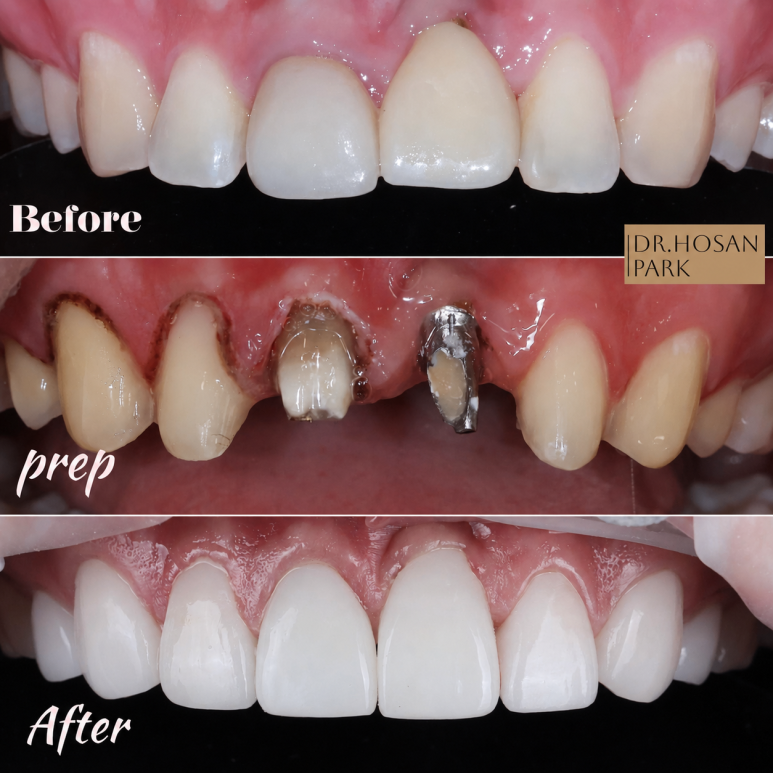
Before and after treatment, treatment period: 4 weeks
Looking back, the time that has passed feels like a series of images flashing by, haha.
If there is one thing I regret slightly, it is that I wanted to perform a gum graft over the implant. However, I felt that it would put the patient through too much, so I could not bring myself to insist on it further.
Sera Dental Clinic’s Seramel Premium treatment is not simply about differences in material and warranty. Our value lies in the persistence and determination not to give up until the desired result is achieved.
I hope that a new connection will come to the patient’s new smile, and that the years ahead will be filled with more days of laughter and happiness.
#SamseongdongLaminates #SeramelPremium #DrHosanPark #ImplantRetreatment
For those considering treatment
The possibilities and maintenance period of aesthetic restorations vary depending on the implant position, gum condition, remaining tooth structure, occlusion, restorative space, oral hygiene, and habits such as tooth grinding or clenching.
The before-and-after photographs above show the individual treatment result of one patient and do not guarantee the same result for other patients. An intraoral examination and an individualized treatment plan are necessary for an accurate assessment. This case was posted with the patient’s consent.