Hello, I’m Dr. Park Ho-san, director of 하나치과 in Changwon.
> “Rather than having teeth that are white like new ones, I want them to look like my original teeth.”
This is something patients often say when visiting us because they are considering retreatment of anterior crowns in Changwon. Front teeth do not look natural simply because they are bright. The way they receive and reflect light, the slightly different translucency and surface texture of each tooth, and the proportions visible between the lips and gums must all work together to feel comfortable within one person’s smile.
This post introduces an actual clinical case from 하나치과 with the patient’s consent. Treatment methods and results may vary depending on the individual’s teeth, gums, and bite.
Retreatment of anterior crowns does not simply mean replacing old restorations with new ones. It is a process that first examines the teeth and roots beneath the existing restorations, the gum margins, and the bite, and then redesigns the restorations to match the color, translucency, contours, and surface texture of the surrounding natural teeth.
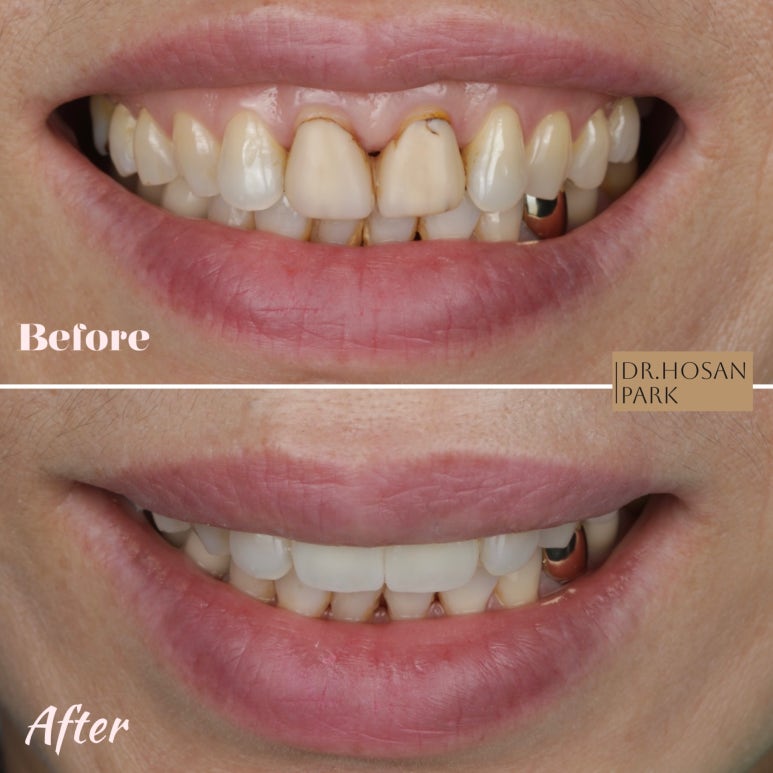
These are the patient’s smile before and after retreatment of anterior crowns. We assessed whether the two front teeth would not appear as separate restorations first, but instead would be perceived together with the surrounding natural teeth as one person’s smile.
Why Old Anterior Crowns Can Stand Out So Much
In this case, the existing restorations on the two front teeth appeared one shade darker than the surrounding natural teeth, with reduced luster and diminished esthetics. A change in color along the boundary where the teeth and gums meet was also noticeable. From the front, the proportions and contours of the two front teeth stood out first, and the difference became even clearer across the entire smile.
In situations like this, the first question in retreatment is: “How can we make them blend in so they are not distinguishable from the natural teeth beside them?”
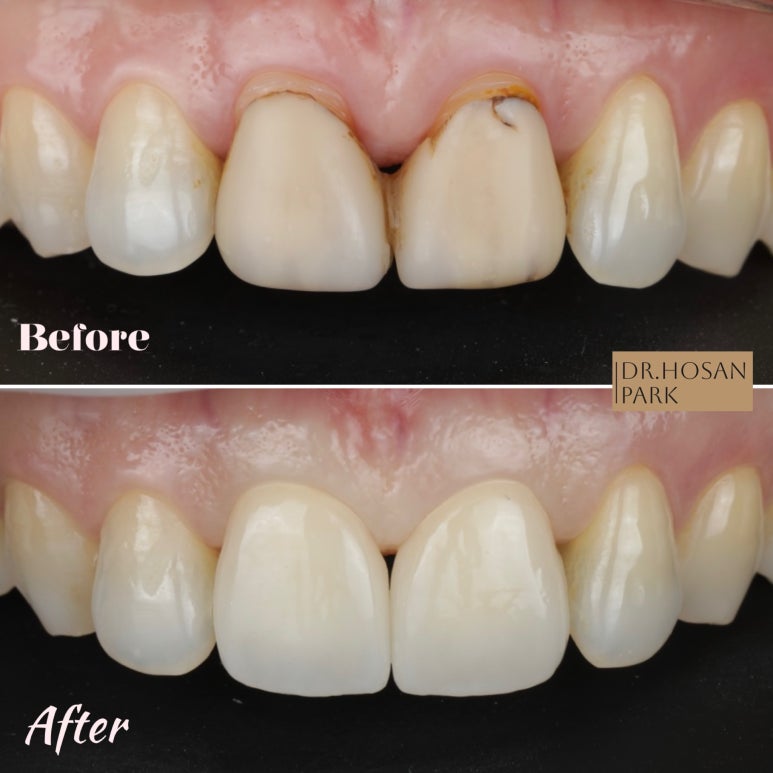
These are the anterior crowns before and after retreatment, viewed inside the mouth. We observe not only the color, but also the proportions and contours of the two front teeth, the way their surfaces reflect light, and the harmony of the gum margins.
The Beauty of Natural Teeth Lies Not in “Whiteness,” but in Layers of Light
Natural teeth are not solid, single-color white objects. The areas near the gums, the centers of the teeth, and the edges reflect light differently, and their brightness and translucency vary slightly depending on the viewing angle and lighting.
For this reason, matching a single shade on a color guide is not enough for esthetic restorations in the anterior region. The material’s translucency, the transmission and scattering of light, and its ability to mask internal color must be assessed in relation to the color of the remaining tooth structure and the thickness of the restoration.
When I examine front teeth, I look closely at four aspects:
-
Contours and proportions — whether they look too wide or too long within the face and lips
-
Lines of light reflection — whether the teeth look flat or excessively prominent
-
Fine surface texture — whether they look overly smooth and artificial
-
Relationship with the surrounding teeth — whether the two front teeth appear like perfect replicas on their own, rather than being perceived as part of one smile
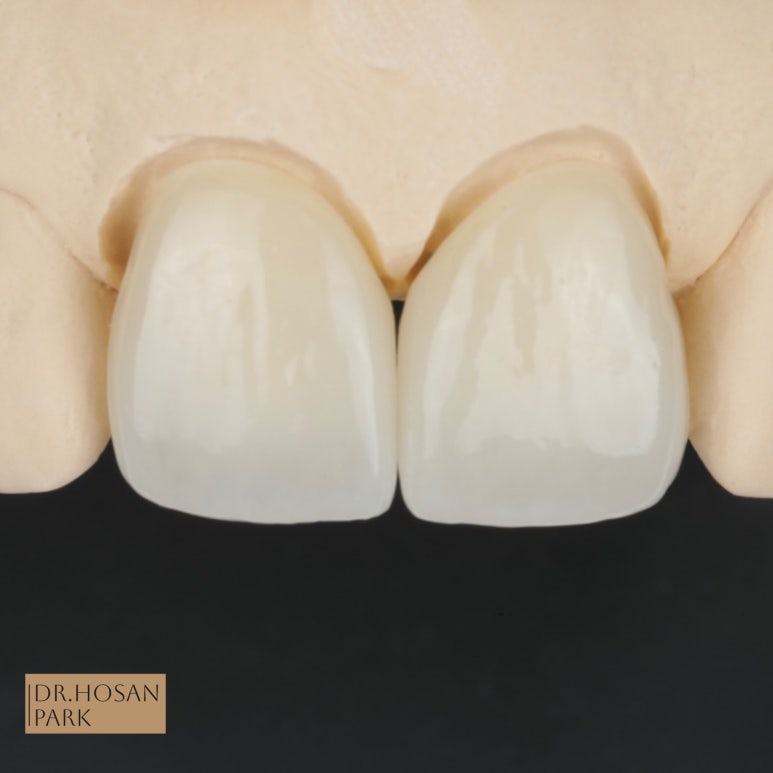
This is an enlarged frontal view of the completed restorations on the two front teeth. We aimed to create contours that were similar but not mechanically identical, along with natural surface reflection.
Craftsmanship Is Not About Making One Restoration Stand Out
The quality of an esthetic restoration is reflected not in creating the most noticeable restoration, but in achieving a result where it is difficult to tell which tooth has a restoration.
To achieve this, the dentist must assess lip movement, the gum line, tooth alignment, and the bite to establish an overall direction, and then share that information in specific terms with the dental technician. This is also why small differences are checked repeatedly while establishing the form and applying the color, translucency, and surface texture.
Not all front teeth are treated in the same way. The material used and the treatment sequence may vary depending on the condition of the tooth revealed after removing the existing crown, the amount of remaining tooth structure, the degree of discoloration, the health of the gums and root, and the way the teeth come together. Before choosing a good material, what is needed is a diagnosis and design suited to that particular tooth.
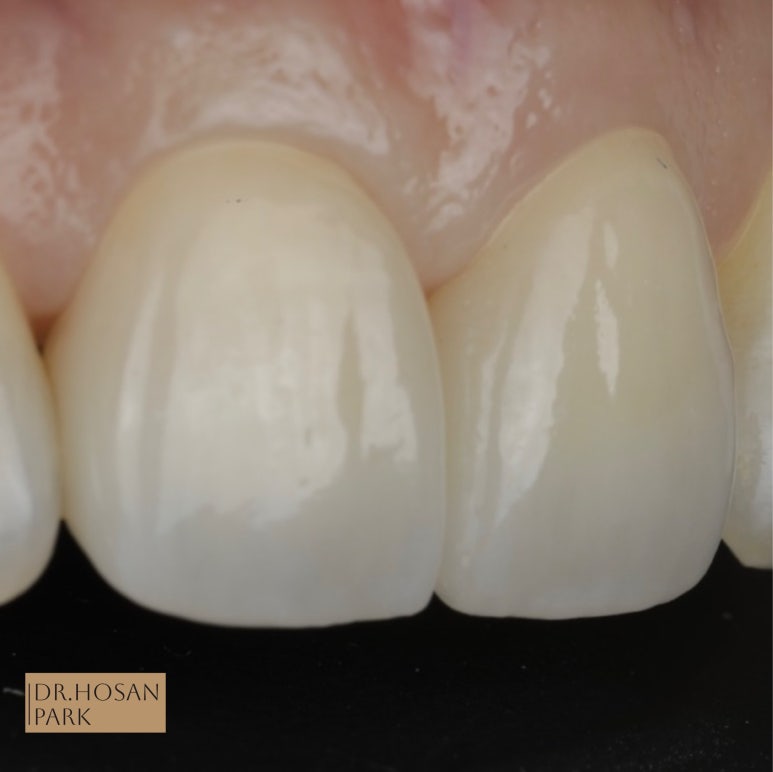
This shows the surface texture and flow of light across the front tooth, viewed from the side. Naturalness is created through harmony between form and optical properties, rather than through color alone.
What I Want to Restore Is Not Two Crowns, but One Person’s Smile
Front teeth are the first to show when we speak, smile, or meet someone face-to-face. So when patients tell me that old anterior restorations have made them conscious of the moment they smile, I do not think of the process as simply replacing worn-out restorations.
Ensuring that the new restorations fit comfortably in the mouth is fundamental. Beyond that, I hope that when patients look in the mirror, they see “my smile” before they see “the teeth I had treated.”
I cannot easily claim that natural teeth can be perfectly replicated. However, I can continue to carefully observe what makes natural teeth beautiful and honestly reproduce their light and texture as far as possible. My desire to become a clinician who is sincere about restoring smiles also begins from that point.
Retreatment of Anterior Crowns: Frequently Asked Questions
Not every crown needs to be replaced simply because it is old. An examination is recommended not only when there is breakage or loss of the crown, but also when there is discoloration around the margins, gum inflammation, suspected decay, a mismatch in shape or color, or discomfort when biting. After checking the existing restoration and the condition of the teeth and gums, we must determine whether maintenance or retreatment is more appropriate.
A whiter crown is not always more natural. The saturation and translucency of the surrounding teeth, surface texture, tooth length and width, and the amount visible between the lips must all be coordinated. In addition, there is no single material that is best for every case. The choice should consider the color and amount of remaining tooth structure, the required thickness, biting forces, and the esthetic goal.
If You Are Considering Anterior Crown Retreatment in Changwon
Photo consultations can help us discuss your current concerns and how to prepare before visiting, but they cannot replace a definitive diagnosis. At 하나치과, we do not examine only the existing crowns. We evaluate the teeth and roots, gums, bite, and the smile as a whole, then explain the necessary scope of treatment and the available options.
FAQ: Retreatment of Anterior Crowns
1. When should I consider retreatment for old anterior crowns?
An examination is recommended not only when there is an obvious problem such as breakage or loss of the crown, but also when there is discoloration around the margins, gum inflammation, suspected decay, a mismatch in shape or color, or discomfort when biting. However, not every crown needs to be replaced simply because it is old. After checking the existing restoration and the condition of the teeth and gums, we must determine whether maintenance or retreatment is more appropriate.
2. Will making the front teeth whiter make them look natural?
Brightness is an important factor, but it is not everything. For a natural appearance, the saturation and translucency of the surrounding teeth, surface texture, tooth length and width, and the amount visible between the lips must all be coordinated. When necessary, we may also plan the timing of whitening for the surrounding natural teeth together with the shade of the restorations.
3. Will retreatment require removing more tooth structure?
This depends on the condition of the remaining tooth after the existing crown is removed. The principle is to minimize additional removal, but treatment may be necessary to address decay, fractures, discoloration, or problems with the existing shape. The amount of tooth reduction cannot be determined before an examination.
4. Which crown material looks the most natural?
There is no single material that is best for every case. The choice should take into account the color of the remaining tooth structure, the required thickness, biting forces, the optical properties of the adjacent teeth, and the esthetic goal. Diagnosis and design come before the material name. In general, zirconia crowns are often preferred when a tooth has undergone root canal treatment and has severe internal discoloration. When a tooth has not undergone root canal treatment and the internal discoloration is not severe, a lithium disilicate crown, also called an all-ceramic crown or an e.max crown, may be selected. As in the case shown above, a PFZ approach using both materials in combination may also be chosen.
5. How long does treatment take?
The duration varies depending on the condition beneath the existing restoration, whether gum treatment is needed, the time required to evaluate the shape using temporary teeth, and the laboratory process. Because the appearance of the front teeth must be checked not only during function but also while speaking and smiling, it is best to plan sufficient time for diagnosis and adjustments. The minimum treatment period we allow is seven days.
하나치과의원
Address: 2nd floor, Sangnam Officetel, 648 Woni-daero, Seongsan-gu, Changwon-si, Gyeongsangnam-do
Phone: 055-266-2833
Original website post: https://hanadental.co.kr/changwon-front-crown-retreatment/
Directions: https://hanadental.co.kr/location/
※ This post provides general medical information based on an actual clinical case. The photographs are posted with the patient’s consent, and treatment methods and results may vary depending on each individual’s teeth, gums, and bite, even for the same treatment. A dental examination is necessary for an accurate diagnosis and treatment plan.
#ChangwonAnteriorCrownRetreatment #ChangwonAnteriorCrowns #AnteriorProstheticRetreatment #AnteriorEstheticRestorations #ChangwonEstheticDentistry #ChangwonDentist #HanaDental #DrParkHo-san