| * This post is informational content intended to provide accurate information * |
Hyperhidrosis Surgery Hospital: Treatment Methods for Sweaty Hands and Feet Can Help You Regain Confidence
Kim Heon-gon Plastic Surgery Bromhidrosis Clinic
Hello, everyone^^
This is Kim Heon-gon Plastic Surgery Bromhidrosis Clinic, staffed by a plastic surgery specialist with 20 years of experience in treating bromhidrosis and hyperhidrosis.
Do you experience discomfort in daily life because of excessive sweating in your hands and feet? In particular, if you are still having the same discomfort even during the winter, it can be an even bigger concern.
In such cases, hyperhidrosis may be suspected. Today, at our hyperhidrosis surgery hospital, we would like to introduce SIT surgery, a surgical treatment among various hyperhidrosis treatment methods.

| Kim Heon-gon Plastic Surgery Bromhidrosis Clinic (bromhidrosis/hyperhidrosis treatment) |
|---|
| The know-how and technical skill gained over many years of practice cannot be ignored by anyone. We promise responsible care so that patients can remain comfortable from the first consultation when we first meet to the final follow-up visit. |
| Plastic Surgery SpecialistGraduated from Seoul National University College of MedicineGraduated from Seoul National University Graduate SchoolCompleted specialist training at Samsung Medical Center (Samsung Seoul Hospital)Former visiting professor in the Department of Plastic Surgery, Samsung Medical CenterFull member of the Korean Society of Plastic and Reconstructive SurgeonsFull member of the Korean Society for Aesthetic Plastic SurgeryFull member of the International Society of Aesthetic Plastic SurgeryMember of the Japanese Society of Aesthetic Plastic SurgeryMember of the American facial plastic surgery society |
| ▶ Main phone: 080-080-3080▶ KakaoTalk ID: Kim Heon-gon Plastic Surgery Bromhidrosis Clinic▶ Clinic address: Room 201, Boramae Nasan Suite, 24 Boramae-ro 5ga-gil, Dongjak-gu, Seoul |

The main cause of sweaty hands and feet is excessive activation of the sympathetic nervous system. When the sympathetic nervous system becomes overactive, the nerve endings secrete an excessive amount of the neurotransmitter acetylcholine, which stimulates the sweat glands and causes excessive sweating.
The symptoms of hand and foot hyperhidrosis are excessive sweating in the hands and feet. It occurs regardless of the season, and the symptoms become worse when you are tense, stressed, or concentrating.

This often causes inconvenience in daily life, and can make ordinary activities such as shaking hands or writing difficult. It may also lead to avoiding contact with others and interfere with social life.
Most cases of localized hyperhidrosis occur because the excitability of the sympathetic nerves that control sweat secretion increases. Some patients have a family history, and the condition often worsens due to stress.
It can also occur secondarily due to tuberculosis, diabetes, congestive heart disease, hyperthyroidism, and Parkinson's disease. In these cases, sweating usually appears systemically, and if there is a disease of the spinal cord, a neurological disorder, or a brain disease, localized hyperhidrosis may occur.
To diagnose hyperhidrosis, the patient's medical history and symptoms are checked, and a physical examination and nerve conduction test are performed.
During the physical examination, the amount of sweat secretion is measured, and the dryness and degree of keratinization of the skin are checked. The nerve conduction test is an examination that evaluates the function of the sympathetic nerves involved in sweat secretion, and it is performed before surgery, playing an important role in predicting surgical results.
An accurate diagnosis of hyperhidrosis is very important in determining the treatment method. This is because the treatment differs depending on the type and severity of hyperhidrosis.
If hyperhidrosis is secondary hyperhidrosis caused by another disease, the underlying disease must be treated first.

At our hyperhidrosis surgery hospital, bromhidrosis, which causes many inconveniences for patients, can be treated in a short period of time using the specialized bromhidrosis surgery method called 'SIT surgery.'
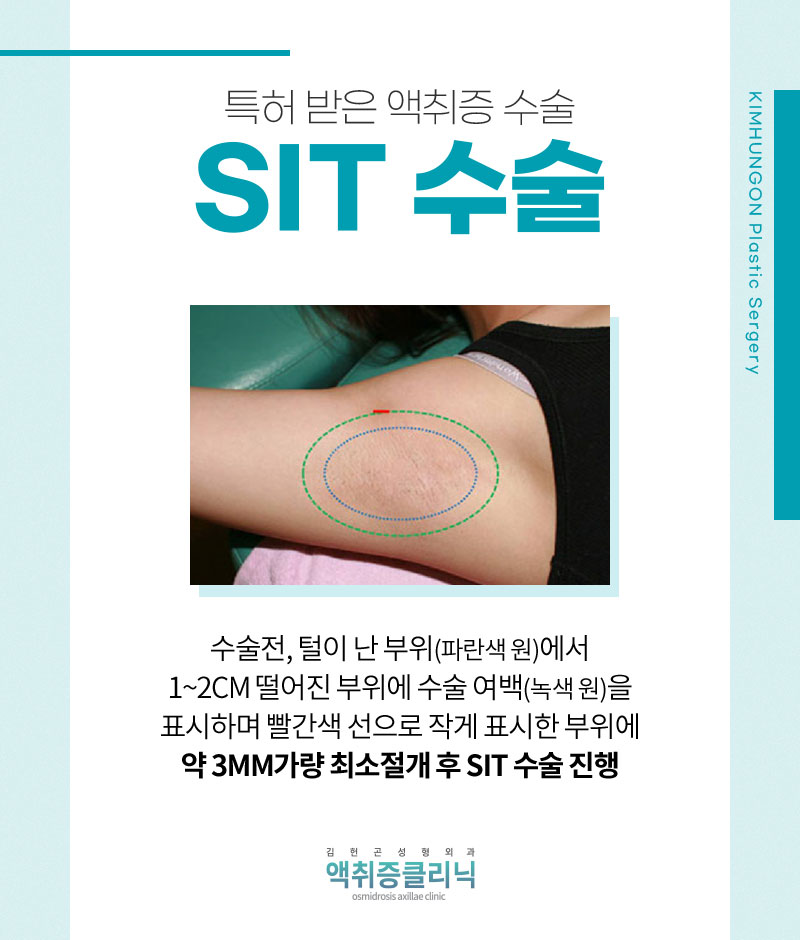
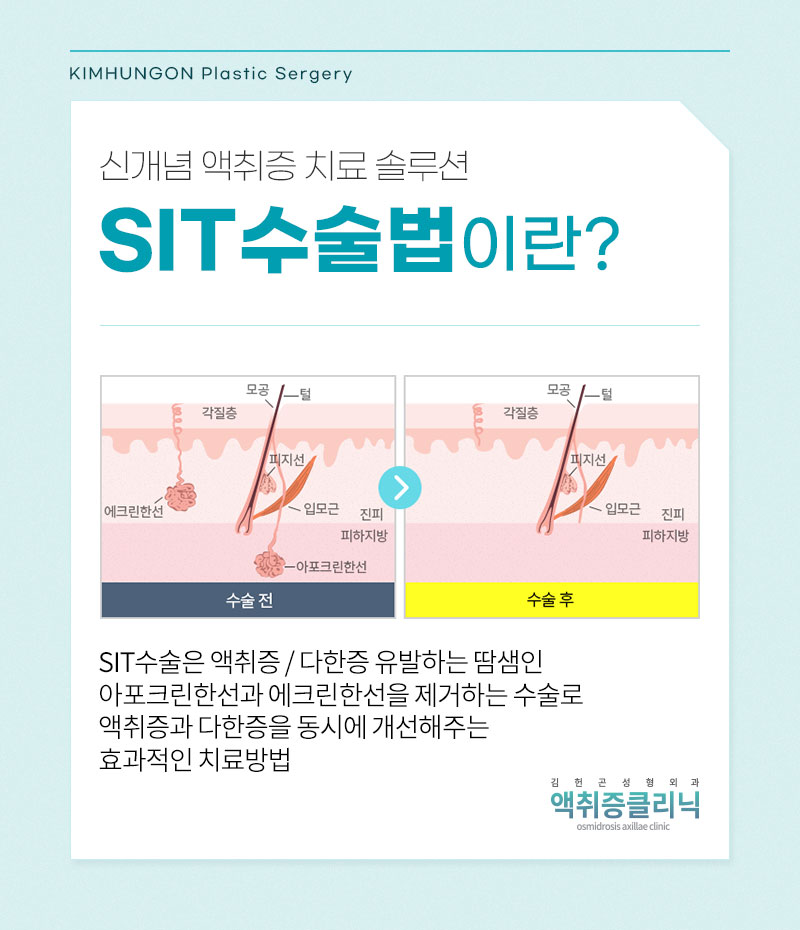
SIT surgery was developed as a treatment for bromhidrosis and is a good surgical method that can broadly remove even hyperhidrosis.
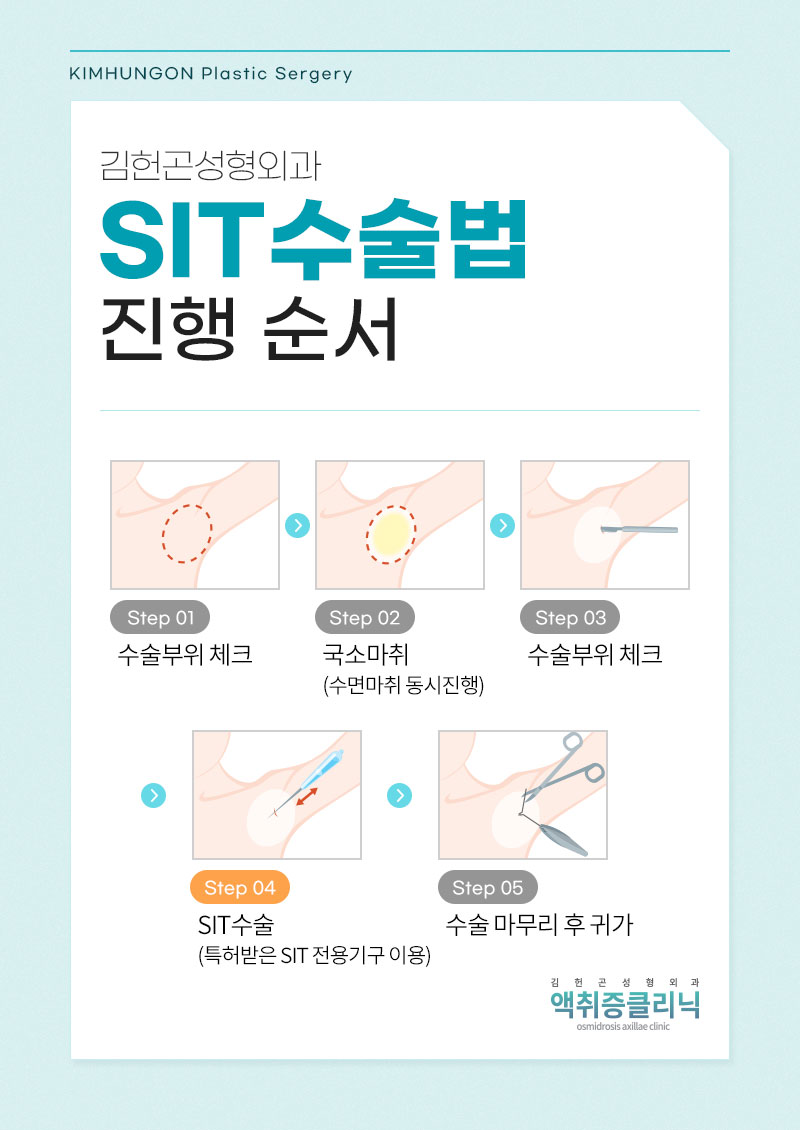
Removing sweat glands ultimately means cutting out the sweat glands themselves, and SIT surgery uses a small but very sharp knife to pass under the skin and thoroughly remove the subcutaneous sweat glands over a very wide area.

SIT surgery, developed as a treatment for bromhidrosis, is a procedure that can also improve hyperhidrosis, and the key point is the removal of sweat glands.
Because the surgical blade used in SIT surgery is small, there is no need for large skin incisions, which means scars can be kept very minimal. In addition, it can treat a wider area than traditional incision methods, resulting in a lower recurrence rate than incision-based surgery.

Recovery is also one of its advantages. In the case of excision methods, which remove the sweat gland tissue itself, a 4 to 5 cm skin incision is made, leaving a large scar, and the recovery period involves wearing a compression bandage for about 10 to 15 days. In comparison, SIT surgery requires a compression bandage for only 3 days after surgery, shortening the recovery period.

If you are considering a hyperhidrosis surgery hospital, we hope you will consider improvement through the SIT surgical method, which has a low rate of side effects and recurrence. However, please do not forget that you must make the right treatment decision through sufficient consultation with a specialist.
If you are worried about hyperhidrosis or bromhidrosis, please feel free to contact Kim Heon-gon Plastic Surgery Bromhidrosis Clinic, a hyperhidrosis surgery hospital, at any time.
Thank you.

- The above post is a medical advertisement for Kim Heon-gon Plastic Surgery Bromhidrosis Clinic,
and it was written directly by our clinic in compliance with Article 56, Paragraph 1 of the Medical Advertising Act.
Depending on the individual, side effects may occur after surgery/procedure,
so please be sure to review the precautions before and after treatment
after sufficient consultation with the attending medical staff. -






Previous image
Next image







Previous image
Next image