Hello, this is Woori Plastic Surgery.
If you look into contouring surgery methods, terms like fixation pins, absorbable pins, and non-fixation methods can make things even more confusing, right? Today, let’s take a look at contouring surgery methods.
Do you need fixation pins?

The representative contouring surgeries are square jaw surgery, chin surgery, and cheekbone reduction. Among these, square jaw surgery does not require fixation pins, but chin surgery and cheekbone reduction involve repositioning the bone, so fixation is essential in contouring surgery methods. You can think of pin fixation as necessary so the bone can settle stably without shifting from the intended position.
Fixation methods

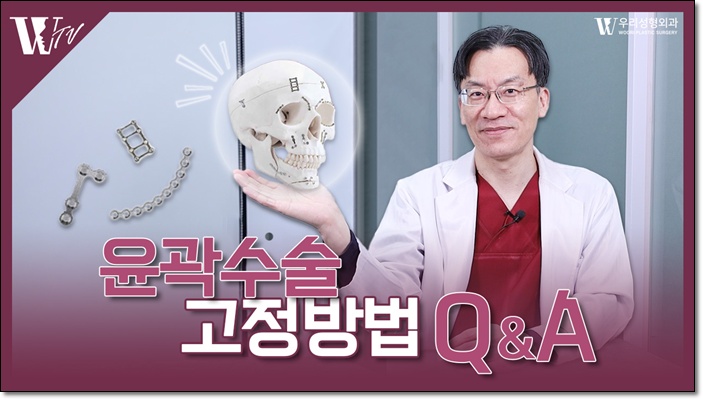
Fixation methods are divided into metal pins and absorbable pins. Metal pins provide the strongest fixation, so they are mainly used in areas that bear a lot of force or in surgeries with a large amount of movement, and their advantage is that the result remains stable without shifting. On the other hand, absorbable pins are made of a material that gradually breaks down in the body and are used in areas that do not require strong fixation. They do not need to be removed, but for areas that require strong fixation during contouring surgery, metal pins are preferred.
The method of tying with thread

Tying bones with thread is virtually impossible in surgeries with a large amount of movement, such as contouring surgery. There is a wiring method that uses wire stronger than thread, but at present, pin fixation with stable fixation strength is the mainstream.
Why fixation is needed

Even if the bone is reduced and moved as much as desired after contouring surgery, it can easily become deformed from even a small impact or movement during the recovery process. That is why fixation pins help keep the bone stably in place from immediately after surgery until recovery is complete. Put simply, it is easy to understand as “a device that protects the beautifully created line from shifting.”
In contouring surgery methods, fixation pins are an essential step for result stability and maintenance. The surgical method and type of pin vary from person to person, so it is most important to have a consultation at a hospital that can accurately guide you on the fixation method appropriate for your condition.