Hello, this is Woori Plastic Surgery.
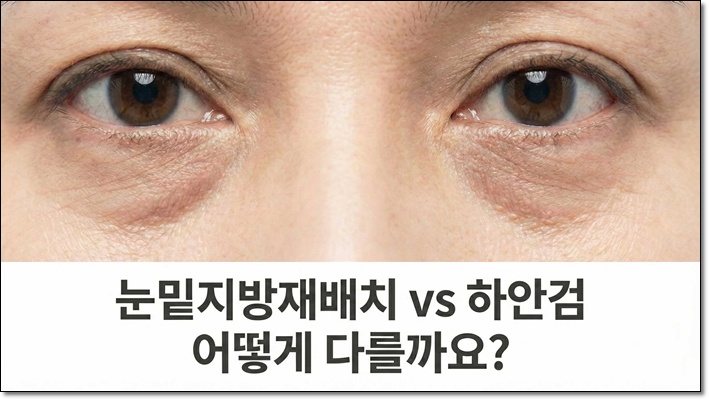
When consulting about the under-eye area, we often meet people who think under-eye fat repositioning and lower blepharoplasty are the same procedure. Both surgeries aim to improve the tired appearance caused by the under-eye area, but the underlying causes and the extent of surgery needed differ depending on the case. Today, let’s look at how to distinguish between these two procedures and choose the right one.
When under-eye fat repositioning may help

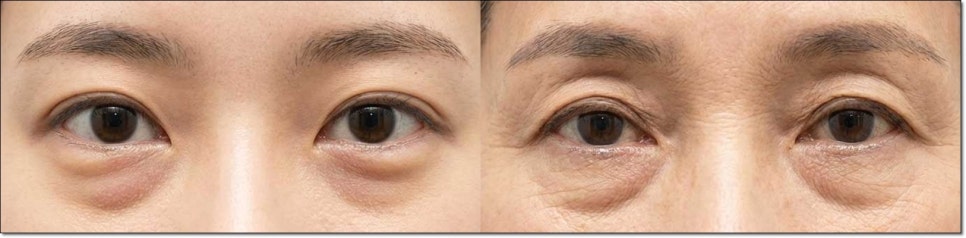
Under-eye fat repositioning can be considered when the fat beneath the eyes protrudes forward and the tear trough below it appears sunken. The important criterion here is that the skin sagging is not severe.
Rather than simply removing the protruding fat, part of it is repositioned and evenly distributed into the hollowed areas. As a result, the boundary between the bulging and sunken parts of the under-eye area can be softened, making the uneven-looking under-eye line appear smoother.
If the elasticity of the skin and muscle is relatively well preserved, meaningful improvement can often be expected with an internal approach alone, without a separate external incision. Recovery is relatively fast, and because the change is not overly dramatic, it is often suitable for those who want a natural-looking result.
When lower blepharoplasty is needed

There are certainly cases where improvement is difficult with under-eye fat repositioning alone. If fat protrusion is accompanied by sagging skin, fine lines, and muscle laxity, lower blepharoplasty may be necessary.
Lower blepharoplasty is performed by making a fine incision along the line just below the eyelashes, then trimming excess skin and re-supporting the loosened muscle. If needed, fat repositioning may also be performed at the same time, so the goal is not only to improve simple bulging but also to refine the overall under-eye structure.
If the under-eye sagging makes the face look especially tired, or if the aegyo-sal appears to have dropped lower, lower blepharoplasty may be more appropriate. The recovery period can be somewhat longer than that of under-eye fat repositioning, but it has a clear advantage when it comes to creating a firmer under-eye line.
How do you choose between under-eye fat repositioning and lower blepharoplasty?

The deciding factor between the two procedures is not age or trend, but the cause of the under-eye condition. Under-eye fat repositioning is suitable when the main problems are fat protrusion and tear trough hollowing, and because it is often performed without a skin incision, the recovery burden is relatively lighter. On the other hand, lower blepharoplasty is considered when sagging of the skin and muscle also needs to be addressed in addition to the fat. Even if the concern looks the same on the surface, the actual cause is often completely different, so rather than judging from photos alone, it is important to check the condition in person.
Both under-eye fat repositioning and lower blepharoplasty are ways to improve the appearance of the under-eye area, but they are not interchangeable procedures. The approach should differ depending on whether the main issue is fat, or whether it also includes skin laxity and reduced elasticity. Choosing a procedure that does not suit your condition may lower satisfaction, so we recommend receiving an accurate diagnosis of the under-eye area through sufficient consultation with a specialist before making a decision.