
Hello, this is Woori Plastic Surgery.
When consulting about breast reduction surgery, many people ask whether it is possible to expect sufficient changes while minimizing the incision area as much as possible. Breast reduction surgery is not simply a procedure to reduce size; it is a surgery that must also take into account the heaviness and shape changes caused by sagging breasts, areola size, and long-term stability. Today, we will organize the incision methods often discussed in breast reduction surgery and the characteristics of each.
What Is Breast Reduction Surgery?

Breast reduction surgery removes an appropriate amount of breast tissue and skin to reduce discomfort caused by large, heavy breasts, and adjusts the position of the nipples and areolas upward to reshape the overall breast contour. It is often considered not only for issues such as shoulder or neck pain, bra marks, and clothing fit, but also when sagging breasts cause discomfort in daily life. It can be seen as a surgery that aims to ease functional burden along with aesthetic changes.
Main Incision Methods
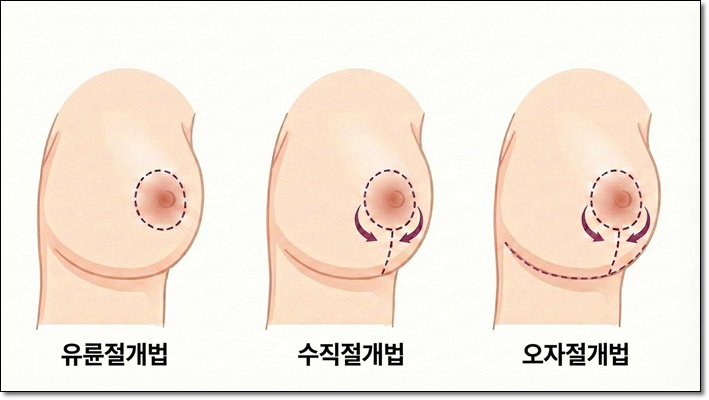
In breast reduction surgery, the incision method varies depending not only on breast size, but also on the degree of sagging and the condition of skin elasticity.
- Periareolar incision method
This is a method that makes an incision along the edge of the areola, with the advantage that the scar is relatively inconspicuous. However, it is suitable when the breasts are not very large and the sagging is not severe. Recently, a method has also been used in which a wide area of skin around the areola is removed and then sutured to fit the smaller areola, but as time passes, the surrounding skin may stretch again and the areola may become larger, so there may be limitations in long-term stability.
- Vertical incision method
This method involves a vertical incision from below the areola toward the inframammary fold. Because it allows relatively stable removal of breast tissue and stretched skin, it is considered when breast size reduction and correction of sagging are both needed at the same time. Since it addresses not only the area around the areola but also the stretched skin itself, the possibility of the areola becoming larger again over time is relatively low.
- Anchor incision method
This method adds an incision along the inframammary fold to the vertical incision and is used in cases where both breast size and sagging are severe. Although the incision area is relatively large, it is a method that can provide stable results in sufficiently reducing and lifting the breasts.
Should the Incision Be Minimized?

During consultations, some people say they want to address the issue with only a periareolar incision or liposuction. However, when the breasts are large and sagging is present, methods that minimize the incision alone often make it difficult to achieve the desired results. This is because if the stretched skin is not sufficiently removed, there is a risk that the breasts may sag again or lose their shape over time. In such cases, choosing the incision method that matches the condition of the breasts from the beginning can help reduce the possibility of revision surgery.
Important Criteria in Breast Reduction Surgery

Breast reduction surgery should be planned by considering breast size, skin elasticity and degree of sagging, the possibility of changes in areola size, and long-term shape maintenance together. Rather than choosing a surgical method simply because the incision area is smaller, it is important to judge based on which method can provide the most stable result for the current condition of sagging breasts.
Breast reduction surgery is not performed in the same way for everyone. To achieve a high level of satisfaction, it is necessary to consider not only the visible change in size, but also the structural stability that allows the shape to remain over time. We recommend making a careful decision after receiving a thorough consultation and an accurate diagnosis of the appropriate incision method and surgical scope based on your breast condition and the degree of sagging.