
Hello, this is Woori Plastic Surgery.
As the age group interested in anti-aging surgery continues to expand, inquiries about mini facelifts, which place less of a burden on the body than traditional facelifts, are also steadily increasing. In particular, one of the most common questions during consultations is how the mini facelift price is determined and why incision lines are divided into several types.
Today, based on what we actually explain in the consultation room, we will organize the criteria used to choose incision lines in a mini facelift, along with the reasons why the mini facelift price may vary.
Reasons Why There Are Several Incision Methods

The incision line for a mini facelift is not fixed as a single standard formula. In the past, a relatively uniform incision pattern was mainly used, but recently, as patients’ age groups, skin elasticity, degree of sagging, and the areas they want to improve have become more diverse, incision lines have also developed in various ways.
However, this does not mean that a completely new line is created arbitrarily. The basic approach is to build on incision lines whose safety and efficiency have been verified in traditional facelifts, while adjusting only the necessary parts by considering scar location, the extent of dissection, and the surgical field. These factors ultimately become one of the elements that affect the mini facelift price.
Criteria for the Incision Line

In a mini facelift, the incision location is determined by comprehensively considering the following items.
✔️ The area the patient wants to improve
✔️ The main areas of concern among nasolabial folds, the corners of the mouth, marionette lines, and the jawline
✔️ Skin thickness and elasticity
✔️ The direction and degree of sagging
✔️ Previous surgical history
For example, if the main goal is to improve nasolabial folds, an incision planned in the upper direction is often considered, while if sagging around the corners of the mouth or the jawline is the focus, it may be designed relatively lower. Because this kind of customized approach is used, the mini facelift price inevitably differs from person to person.
Using the Hairline Area
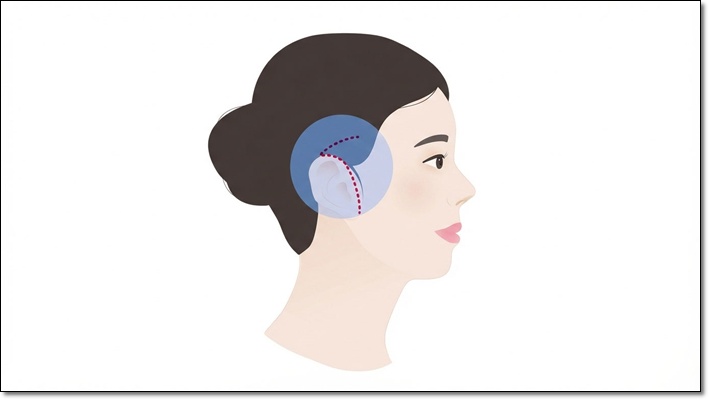
The mini facelift incisions currently used most often are largely divided into two types.
The first starts near the earlobe, follows along the ear opening, and continues behind the sideburn and into the scalp. Depending on the situation, it may be adjusted toward the front of the sideburn instead of inside the scalp.
This method can secure a dissection range similar to that of a traditional facelift when based on nasolabial folds and marionette lines, which helps improve sagging in the front of the face. Another advantage is that no scar remains behind the ear, and the mini facelift price may vary depending on the range of application.
Centered on the Front of the Sideburn
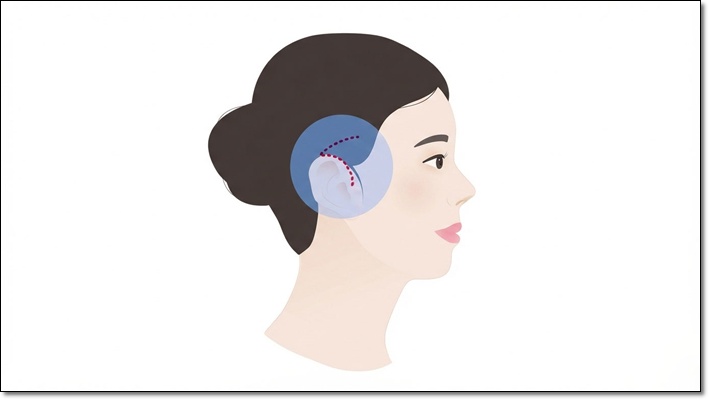
The second method is a relatively short line that starts inside the ear opening and continues behind the sideburn and into the scalp. Because it does not include an incision near the earlobe, the visible scar is often limited to about 2 cm behind the sideburn.
It is mainly chosen when the goal is to improve nasolabial folds or the upper area around the corners of the mouth, and sufficient lifting effects can be expected within that range. When the incision range is relatively limited, the mini facelift price may also differ from other methods.
It Is Not Applied in the Same Way for Everyone

Even with a mini facelift, the same incision pattern is not applied to everyone. If sagging is significant, a mini facelift alone may not be sufficient, and conversely, if the goal is to improve only a localized area, a minimally invasive approach may be more appropriate.
Therefore, before surgery, it is important to first evaluate the overall structure of the face and determine which areas need to be corrected and by how much in order to expect realistic results. A short incision is not automatically better; priority is given to how much range is needed to achieve the intended effect. These factors together determine the mini facelift price.
A mini facelift is not simply a surgery that reduces the incision. It is a process of designing the lifting range according to facial structure and aging patterns. Because the level of difficulty and the time required can vary depending on the incision location, extent of dissection, and direction of correction, the mini facelift price inevitably differs from person to person.
If you are considering a mini facelift, rather than deciding based only on cost, we recommend checking through sufficient consultation which incision method is suitable for you and what degree of improvement you are aiming for.