
Hello. This is Woori Plastic Surgery.
Today, we’d like to explain endoscopic forehead lifting, which we are often asked about in consultations, focusing on recent surgical trends and the key factors that affect results. When people think of forehead lifting, many first think of improving forehead wrinkles or glabellar wrinkles. But in actual consultations, many patients want their eyebrows to be lifted so they do not look heavy, or hope for a clearer impression around the eyes. These changes are difficult to achieve by simply pulling the skin upward, so it is very important how the structures are handled during an endoscopic forehead lift. Today, we’ll look at the characteristics of endoscopic forehead lifting, one of the forehead lift procedures.
Why Eyebrows Do Not Lift
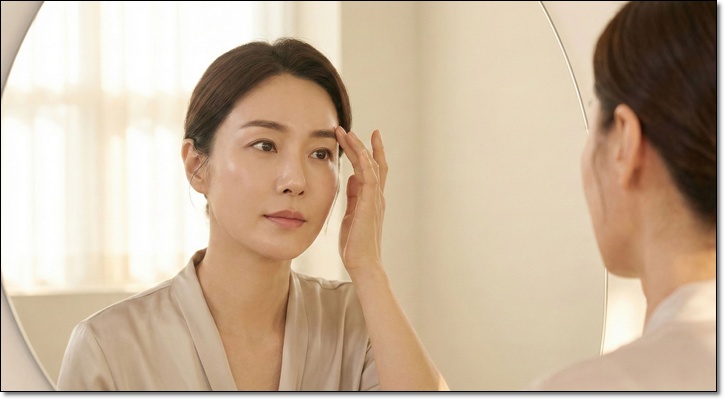
There are cases where the eyebrows do not change much even after a forehead lift, or where they gradually drop again over time. There is an anatomical background to this phenomenon. Around the eyebrows, there are muscles that pull the brows downward or draw them inward, and there are also adhesion areas firmly attached to the bone. If these structures are not sufficiently released, the eyebrows may not lift clearly even if the skin is raised upward.
Especially near the eyebrows, there are nerves that control facial movement, so anatomical understanding is very important when performing an endoscopic forehead lift. If the structure is not accurately identified, the correction range may be limited for safety reasons.
Recent Trends in Forehead Lift Surgery

The key point of recent endoscopic forehead lifting is not simply smoothing wrinkles, but precisely adjusting adhesion areas and muscle structures so that the eyebrows can rise naturally and stably.
Only when the area where the eyebrows are strongly attached to the bone is appropriately released, and the pulling force downward is reduced, can the eye area look brighter and the glabellar area feel softer as well. If this process is not sufficiently carried out, the effect may be limited, or sagging may be felt again relatively quickly.
That is why these days, it is becoming more important to carefully analyze and plan the structure from the very beginning of the endoscopic forehead lift stage, so that situations such as “I had a forehead lift, but I was told I need eyebrow surgery again” or “I was told I may need revision surgery” do not occur.
Key Points in a Forehead Lift

A forehead lift is not simply a procedure that pulls the skin upward. A more stable result can be expected only when eyebrow position, muscle action, the degree of adhesion, and the path of the nerves are all considered together.
During consultations, we look not only at forehead wrinkles but also at eyebrow height, left-right balance, and the overall impression around the eyes, and then explain how much correction would be appropriate. Raising them as much as possible is not always the best approach; the most important thing is a change that suits the overall facial balance.
What You Should Check Before Surgery

If you are considering an endoscopic forehead lift, rather than simply aiming to improve wrinkles, it is necessary to receive an accurate diagnosis of the following factors first.
✔️ How much the eyebrows have actually dropped
✔️ How they affect the impression around the eyes
✔️ Which structures need to be corrected to achieve the desired change
Because the approach and the extent of correction can differ depending on facial structure, it is most important to establish a plan that suits you through 충분한 consultation.
A forehead lift is a procedure that can adjust forehead wrinkles as well as eyebrow position and the impression around the eyes at the same time, but the result can vary greatly depending on how the structures are handled during surgery.
If you are concerned about forehead and eyebrow sagging, we recommend first examining your current condition accurately and then deciding after calmly hearing what changes are possible.