Hello. This is Woori Plastic Surgery.
During consultations, we are often asked, “Unlike contouring surgery, why is orthodontic treatment always discussed together with jaw surgery?”
Many people think of jaw surgery as a procedure that simply improves appearance, and then become curious when they are told that orthodontic treatment is also needed. Today, we will explain in detail why orthodontic treatment is important in the jaw surgery process.
Purpose of Jaw Surgery

Jaw surgery is not simply a cosmetic procedure to refine facial contours. Basically, it is closer to a functional treatment to correct malocclusion.
If the positions of the upper jaw (maxilla) and lower jaw (mandible) are abnormal, the teeth do not fit together properly. As a result, various functional problems may occur, such as difficulty eating, speech issues, temporomandibular joint pain, and facial asymmetry.
Therefore, it is more accurate to understand jaw surgery as a treatment-oriented operation that repositions the jawbones within the normal range and helps form a proper bite accordingly.
Why Orthodontic Treatment Is Important

Jaw surgery is not simply a process of cutting and moving the jawbones. It is planned by precisely calculating the direction, angle, and amount of movement of the upper and lower jaws based on how the teeth fit together.
If the alignment of the teeth is irregular or there is significant protrusion or rotation, it becomes difficult to establish an accurate reference point. In such cases, the precision of the surgical plan may be reduced, and there may also be limitations in achieving a stable bite after surgery.
In particular, when there is a large difference in the positions of the upper and lower jaws, such as with underbite, receding chin, or facial asymmetry, the bite becomes an even more important reference. Orthodontic treatment clarifies these reference points and is a key process that improves the accuracy of the surgical plan.
The Role of Occlusion in Surgery
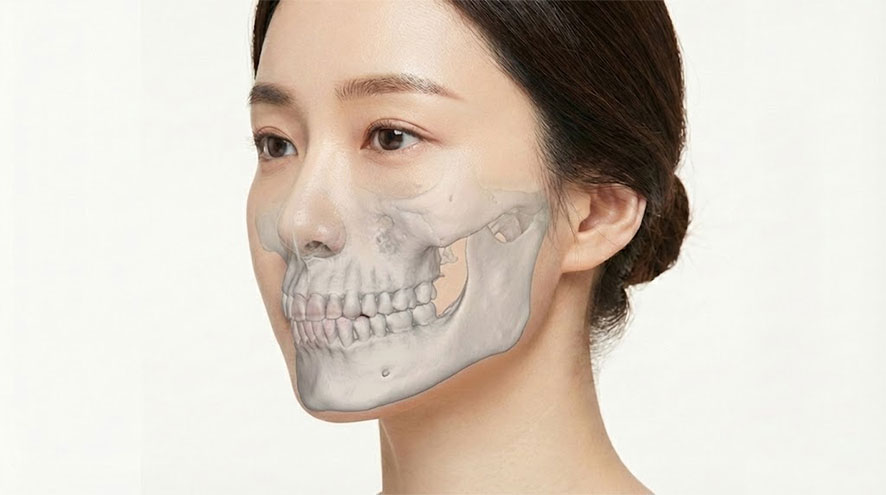
For example, in cases of underbite, it is often not just the lower jaw that is positioned too far forward; abnormalities in the position of the upper jaw may also be involved. Jaw surgery is the process of moving these skeletal problems into a normal position.
At this point, the standard used to decide “in which direction, by how much, and at what angle” to move is the occlusal condition of the teeth. A bite that has been aligned through orthodontic treatment plays an important role in accurately reproducing the intended position during surgery.
In jaw surgery, a device called a ‘wafer’ is used to fix the jaw position during the procedure. This device is made by taking an impression of the patient’s bite and is divided into two types depending on the surgical stage.
Intermediate Wafer
A device used after the upper jaw has been moved first and before aligning the lower jaw based on that new position.
Final Wafer
A device that helps maintain the completed bite after the lower jaw has also been moved to its final position.
Because jaw surgery is planned and performed around the bite, orthodontic treatment is often not an option but an essential preparatory process.
Today, we explained why orthodontic treatment is needed during the jaw surgery process.
Jaw surgery can also improve appearance, but its essence is treatment aimed at restoring function. Correcting the position of the jawbones is not simply for cosmetic purposes, but is a process for establishing a stable bite and improving temporomandibular joint function.
For accurate surgical results and long-term stability, surgery and orthodontic treatment must be planned in an integrated way. Since the treatment plan may differ depending on each person’s skeletal structure and bite condition, it is most important to make the right decision for yourself through sufficient consultation and precise diagnosis.