Hello, this is Woori Plastic Surgery.
Because the nose is located at the center of the face, even small changes can have a major impact on the overall mood and impression of the face. That is why rhinoplasty is not simply about raising the height of the nose; it is important to consider harmony with the face and the internal structure of the nose as well.
In particular, the direction and support of the nasal tip, the nasolabial angle, and the overall nose line are considered important factors. Today, we will look at septal extension fixation, the nasolabial angle, and nose line design, which are important considerations in rhinoplasty.
The structure that determines the direction and support of the nasal tip
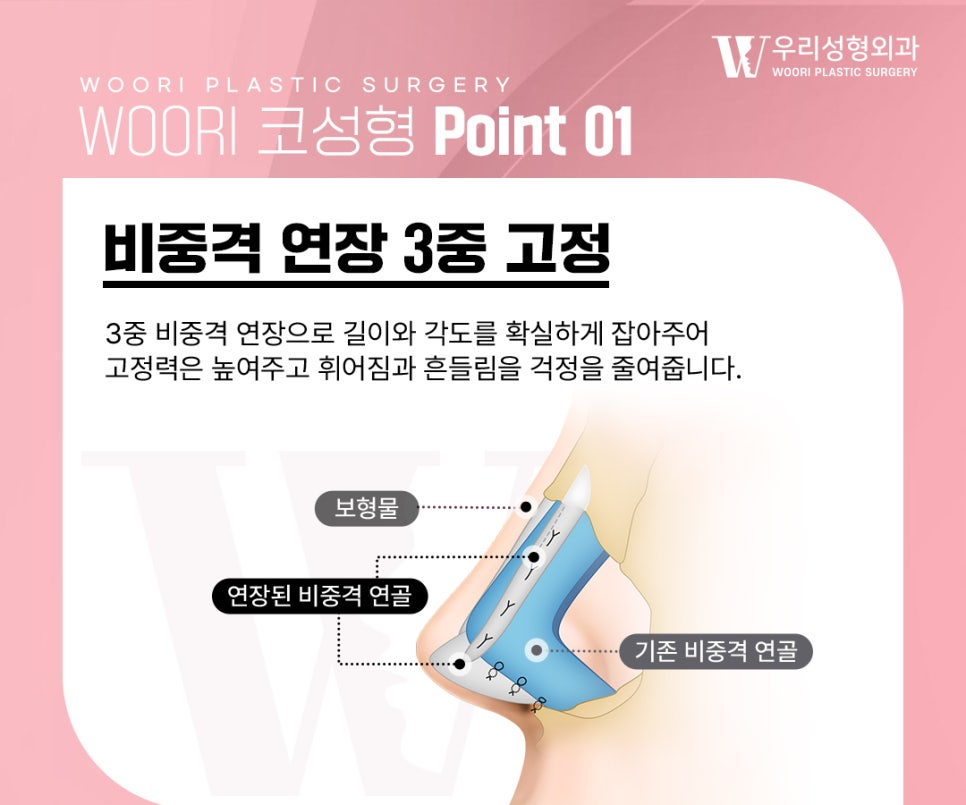
One important part of rhinoplasty is how stably the shape of the nasal tip can be maintained.
What plays an important role here is septal extension fixation. When a structure that supports the nasal tip is created using the septum, it can help reduce the possibility of the nasal tip drooping or its direction changing over time.
Simply raising the nasal tip may make it difficult to expect a natural and stable result, so how the internal support structure of the nose is designed becomes an important factor. In particular, if the nasal tip skin is thick or the support is weak, a more stable fixation method may be needed.
In this way, rhinoplasty should consider not only the appearance on the outside but also the internal structure in order to lead to a more natural and balanced result.
How the nasolabial angle affects the overall mood of the face

The nasolabial angle, which refers to the angle between the nose and the lips, is one of the important criteria that affects the facial impression.
If the nasolabial angle is too narrow, it can create a cramped or dull feeling, while if the angle becomes too wide, it can lead to an unnatural or awkward impression.
In general, it is important to set an angle that connects naturally while considering facial proportions and harmony among the features. The appropriate direction may vary depending on the individual’s face shape and the image they want.
Therefore, in rhinoplasty, it is necessary not only to adjust the height of the nose, but also to consider the angle of the nasal tip and the connection with the lips and jawline.
The 기준 for a natural and refined nose line

The nose line is not simply a matter of being high or low; the overall mood can change depending on how the flow from the forehead to the nasal tip is connected.
A gently connected curved line can create a natural and soft image, while a line that is closer to straight can give a clear and refined feeling.
What matters is not applying a trendy shape as it is, but designing a direction that suits the individual’s face shape and features. Rather than an excessively high nose, a line that harmonizes with the face is more likely to lead to a natural result.
Also, it is necessary to consider not only the front view but also the three-dimensional balance seen from the side and at a 45-degree angle so that the overall harmony can feel natural.
Rhinoplasty is not simply a surgery that changes the height or shape of the nose; it is a process that considers the overall facial proportions and nasal structure together.
Because several factors, such as septal extension fixation, the nasolabial angle, and nose line design, work together, it is important to confirm the current condition of the nose and the desired image through sufficient consultation.
If you are considering rhinoplasty, rather than simply changing the height, we recommend taking the time to discuss what direction will harmonize with your face.