Hello, this is Woori Plastic Surgery Clinic.
When the cheekbones develop outward, the face may appear wider from the front, or the outer facial contour may look more prominent. For this reason, many people look into lateral cheekbone reduction.
However, the cheekbones are an important structure that forms not only the width of the face but also its overall three-dimensional appearance and contours. Therefore, rather than reducing the protruding areas as much as possible, it is important to plan the surgery by considering the current position and direction of the cheekbone projection, as well as its balance with the jawline.
Today, we will look at what should be assessed to achieve natural-looking cheekbone reduction.
Will reducing only the lateral cheekbones make the face look natural?
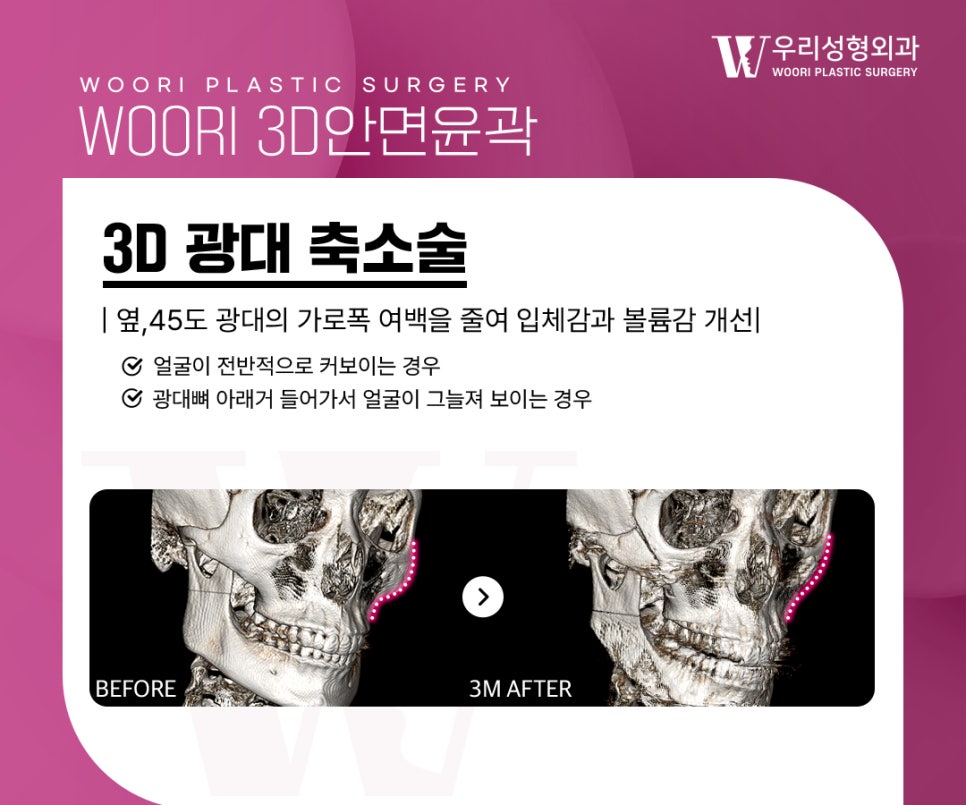
The cheekbones should be assessed from multiple angles, including the 45-degree cheekbones visible from the front and oblique views, as well as the lateral cheekbones that project outward from the side.
When the lateral cheekbones are prominent, the face may appear wider from the front. When the 45-degree cheekbones are pronounced, the projection of the cheekbones may be emphasized from an oblique angle.
Therefore, when planning lateral cheekbone reduction, it is important to analyze the shape of the cheekbones as seen from both the front and 45-degree views, rather than focusing on reducing only one area.
The direction and degree of cheekbone movement should be determined according to each person's facial shape to achieve more balanced facial contours.
Reducing the cheekbones as much as possible is not the most important factor
The purpose of cheekbone reduction surgery is not simply to move the bones as far inward as possible.
Because the cheekbones are a structure that creates the three-dimensional appearance of the face, it is important for the front cheek volume and the width of the lateral cheekbones to be in harmony.
In particular, when the area below the cheekbones appears relatively sunken, it is necessary to assess not only the degree of bony projection but also the surrounding soft tissue and the overall facial contours.
Therefore, before lateral cheekbone reduction, it is necessary to examine the structure of the cheekbones through imaging such as CT scans and plan individually which areas should be moved and to what extent.
Why the square jaw and chin should also be assessed
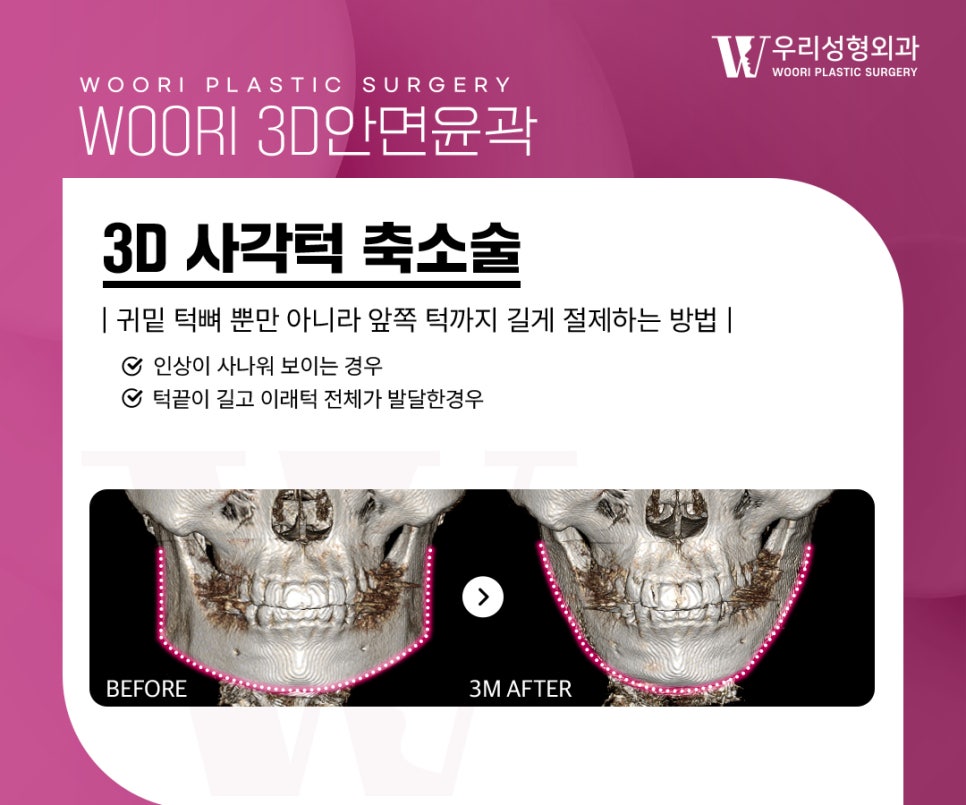
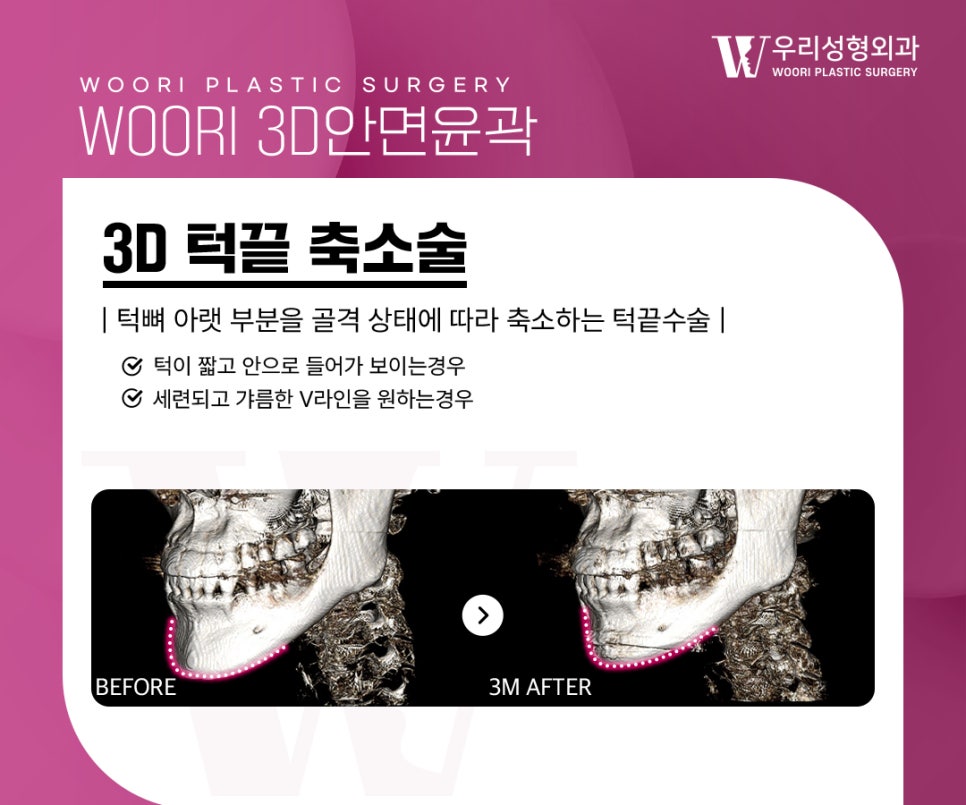
Facial shape is not determined by the cheekbones alone.
If the lower jaw is broadly developed or the mandibular angle near the ears is prominent, the face may still appear wide overall even after the cheekbones are reduced.
Also, if the chin is short or set back, the proportions of the lower face and the appearance of the V-line may look different.
For this reason, if the goal is to improve the balance of the entire face, the skeletal conditions of the square jaw and chin should be analyzed along with the cheekbones.
However, this does not mean that cheekbone, square jaw, and chin surgery all need to be performed. The necessary surgical scope varies according to each person's skeletal structure and desired changes.
The fixation of the cheekbones should also be assessed
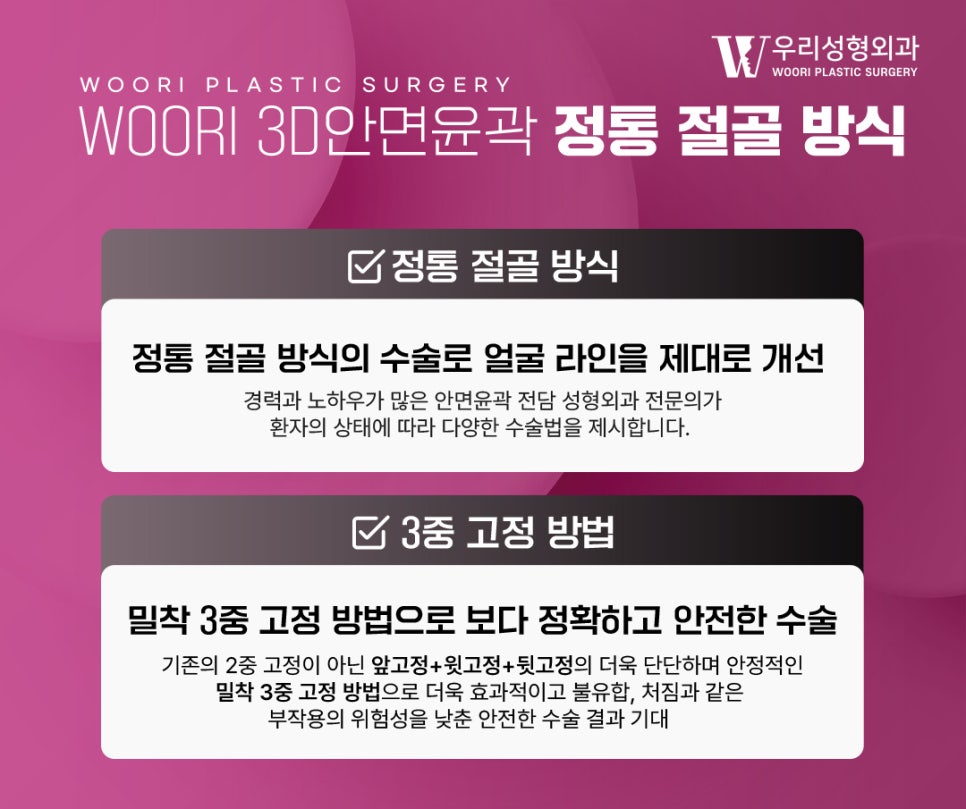
Cheekbone reduction surgery may include cutting the cheekbone, moving it to the planned position, and then fixing it in place.
At Woori Plastic Surgery Clinic, we apply a three-point fixation method that fixes the bone at the front, upper, and rear areas according to the surgical plan.
However, the safety or outcome of surgery is not guaranteed simply because a greater number of fixation points is used. It is important to consider the osteotomy location, direction of movement, bone contact, and fixation method comprehensively.
Therefore, when researching clinics, it is advisable to look beyond a specific fixation method and check what osteotomy and fixation plan will be applied to your individual cheekbone structure.
Lateral cheekbone reduction is not a procedure that ends with reducing prominent cheekbones. It should also take into account the width and three-dimensional appearance of the face as seen from the front and at a 45-degree angle.
In addition to the degree and direction of cheekbone development, the proportions of the overall facial skeleton, including the square jaw and chin, should also be assessed.
In particular, rather than pursuing excessive reduction solely to make the face appear smaller, it is important to plan the procedure in a way that creates natural contours while preserving the three-dimensional appearance of the existing face.
If you are concerned that prominent lateral cheekbones make your face look wide, consider determining the surgical scope you need based on skeletal analysis using 3D CT and a consultation.