People who are considering Ulthera
most often ask one thing:
“When does cheek hollowing appear if it happens?”
It’s very natural to worry that, while you want a lifting treatment, your face might look more sunken.
Today, I’ll organize the timing and reasons for Ulthera cheek hollowing, which are often discussed in consultations at Cheongdam Dermatology Clinic, along with ways to reduce it in advance.
-
The lifting principle of Ulthera and why “cheek hollowing” can be confusing
-
When does cheek hollowing show up? A timeline
-
Four major causes of cheek hollowing
-
Prevention and response: things you can do before and after the procedure
-
The change process shown through a hypothetical case
- The lifting principle of Ulthera and why 'cheek hollowing' can be confusing
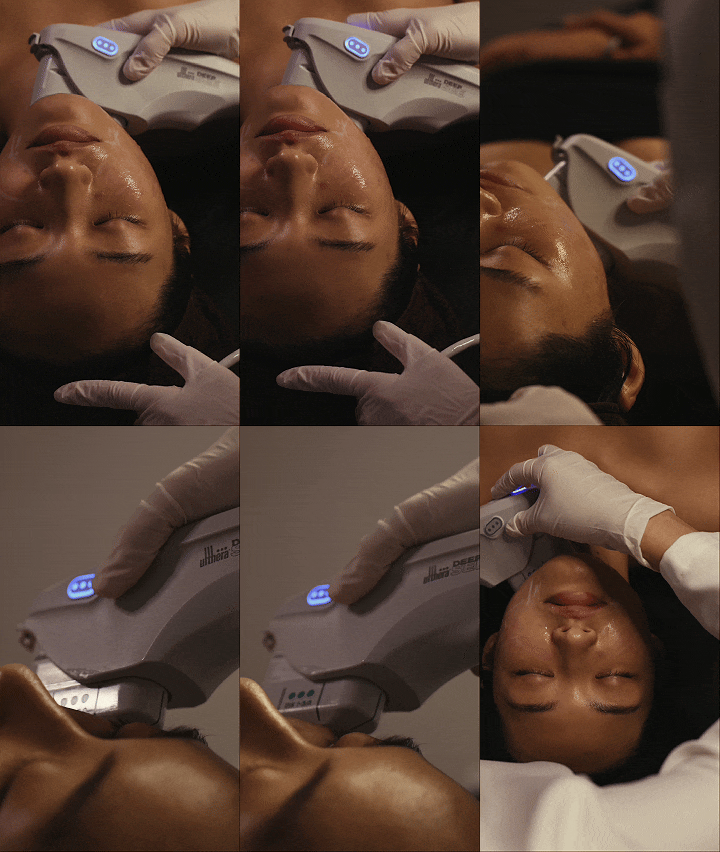
Ulthera is a lifting treatment that delivers ultrasound energy deep into the skin to improve elasticity.
Right after the procedure, swelling or warmth may make the cheeks look fuller, so people may think, “This seems fine,” only to notice later that as facial contours settle, the hollowing becomes more noticeable.
That’s why it’s important to distinguish between “true cheek hollowing” and the optical illusion that appears as swelling goes down.
- When does cheek hollowing show up? A timeline
| Right after the procedure to 1 week |
|---|
| Swelling, tightness, and soreness when touched come first. It is not accurate to judge cheek hollowing at this stage. |
| 2–4 weeks |
| As swelling subsides, the face may look slimmer, and people who originally had less cheek fat may feel as if it looks sunken. |
| 1–3 months |
| As collagen regeneration progresses, the lines become more defined. This is the period when people most often say, “I think my cheeks have hollowed.” |
| 3–6 months |
| This is the period when changes stabilize. It is best to assess the final result around this time. |
In other words, if you ask “when does it start,” it is usually felt from about 2–4 weeks, and may become clearest at 1–3 months.
- Four major causes of cheek hollowing
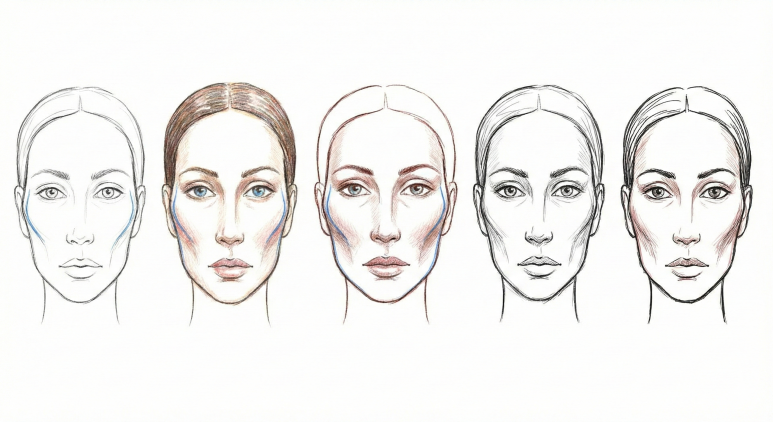
First,
it can be due to a face shape with naturally little cheek fat and more prominent cheekbone lines.
Second,
it can happen when the energy affects a wide area and has a greater impact on the fat layer. In particular, skin thickness and fat distribution vary from person to person.
Third,
if body weight decreases after the procedure or if changes in physical condition overlap, the hollowing may become more noticeable.
Fourth,
existing aging changes in progress (reduced cheek fat, decreased skin elasticity) can become more pronounced together with the contour refinement after Ulthera.
- Prevention and response: things you can do before and after the procedure
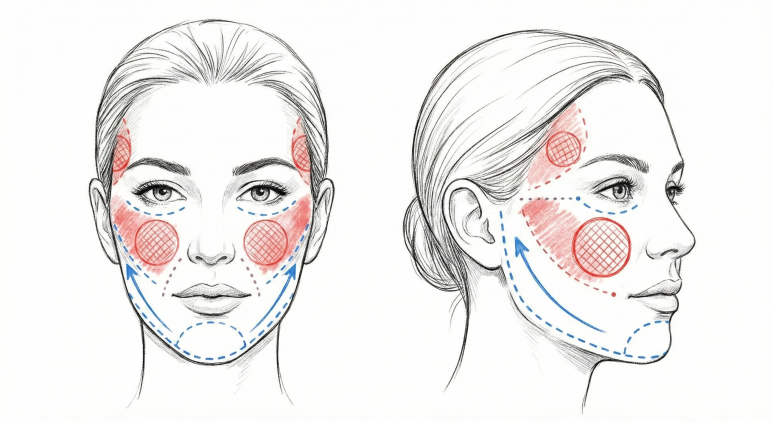
Before the procedure,
it is key to check the face shape and the thickness of the cheek pad (cheek fat), and design the treatment by dividing areas into “where to lift” and “where to preserve.”
For people worried about cheek hollowing, a safer approach is not to use strong settings everywhere, but to apply precise treatment only where it is needed.
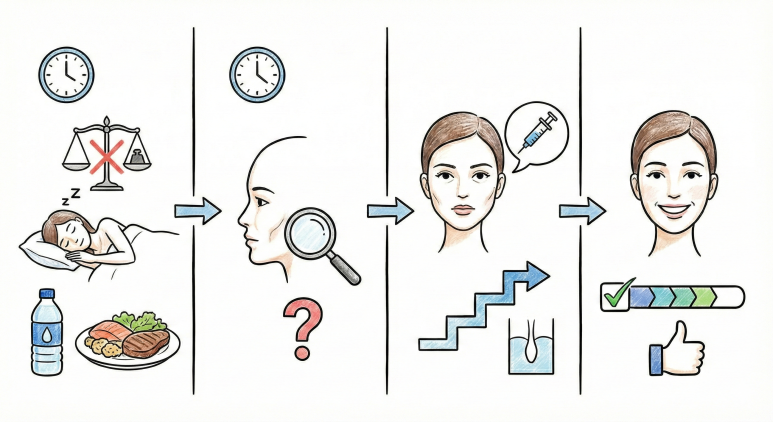
After the procedure,
for 2–4 weeks, avoid sudden weight changes and maintain stable sleep, hydration, and protein intake.
If hollowing is bothersome between 1 and 3 months, first identify the cause, then gradually consider additional corrective treatment (for example, volume correction).
However, the right method varies depending on each person’s condition, so it is best to make a plan after a medical consultation.
- The change process shown through a hypothetical case
For example,
Patient A in her late 30s looked puffy from swelling for up to 1 week after Ulthera.
However, at the 3-week mark, as the swelling went down, the area below the cheekbone felt slightly sunken, and by the 2-month mark, the jawline looked better but the center of the cheeks felt empty.
Upon checking, she had naturally thin cheek fat and was a type in which contour refinement appeared quickly.
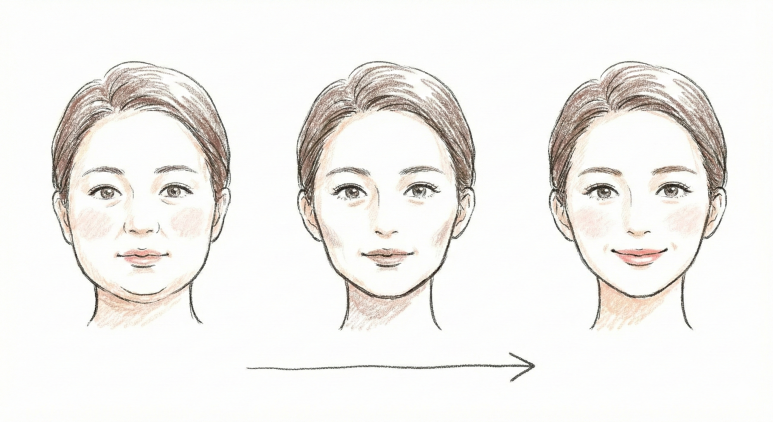
In this case, it is better to plan in a direction that balances volume rather than adding more lifting aggressively.
Ulthera cheek hollowing is not a matter of “it always happens” or “it never happens.” It is the result of face shape, skin thickness, energy design, and post-procedure changes coming together.
If you are worried, the most realistic approach is to start with a design that preserves volume from the beginning.
If you need a consultation, please feel free to contact Cheongdam Dermatology Clinic, where we will help organize the direction based on your current facial condition.
This post was written directly by Larian Cheongdam Clinic for information purposes in compliance with Article 56 of the Medical Service Act and the Enforcement Decree of the same Act.
All procedures and surgeries may cause adverse reactions, so please receive treatment after sufficient consultation with the medical staff.
Director Kang Ji-yeon, Larian Cheongdam Clinic