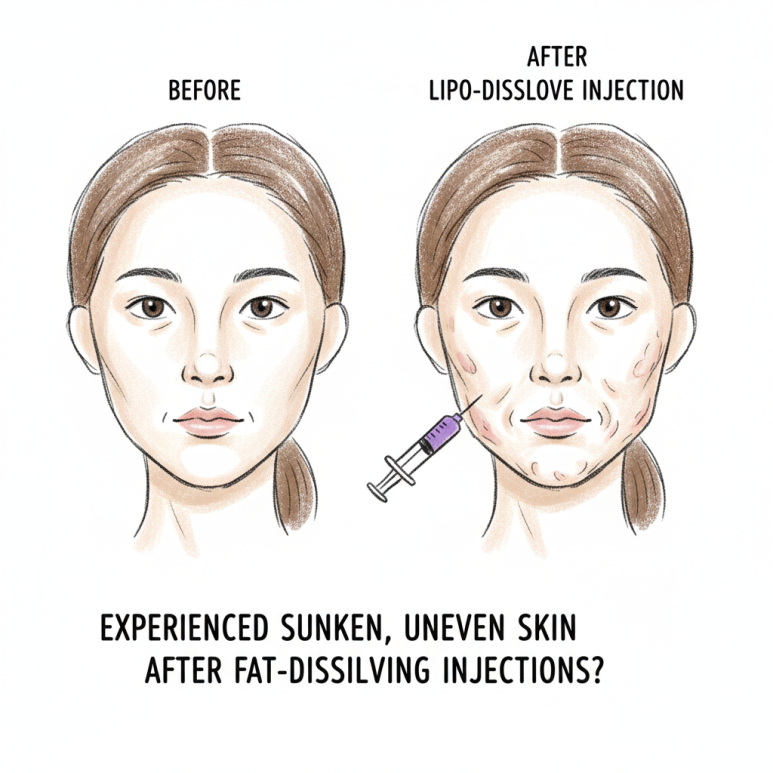
After receiving a fat-dissolving injection,
have you ever experienced
your face becoming hollow
or your skin becoming uneven?
Many people undergo the procedure expecting results, but we often see cases where they become concerned about adverse reactions after proceeding without checking the ingredients.
-
Why steroid ingredients are included
-
Ingredients and mechanism of injections without PPC
-
Things you must check before the procedure
Why steroid ingredients are included
Some fat-dissolving injections contain steroid ingredients to reduce inflammatory reactions.
During the process in which fat cells are broken down, swelling or pain may occur, and steroids are used with the goal of quickly calming these symptoms.
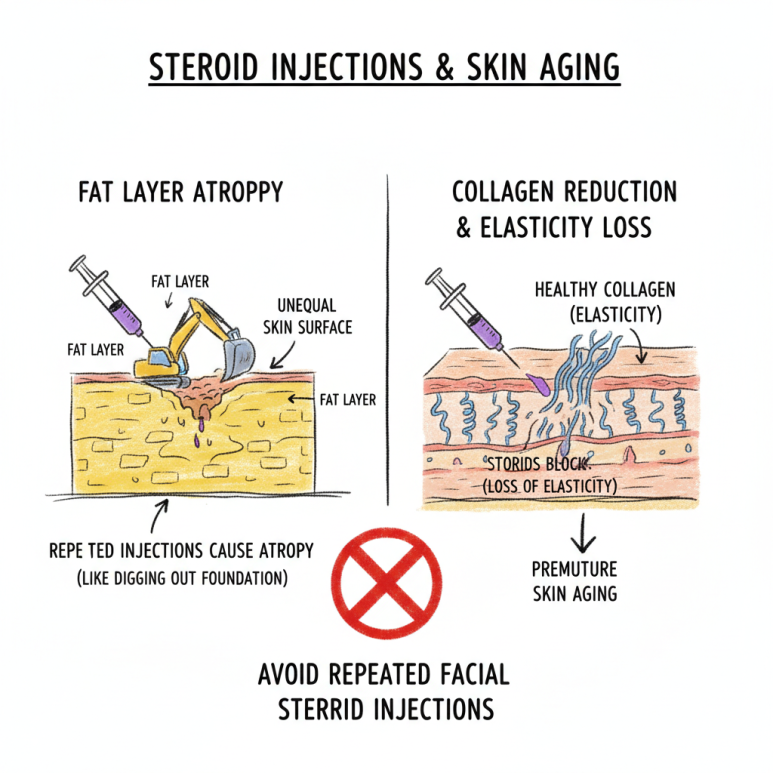
However, if steroids are repeatedly injected into the face, the subcutaneous fat layer can become excessively atrophied. This is like digging away too much of a building’s foundation, resulting in a sunken appearance or an uneven skin surface.
In addition, steroids can interfere with collagen production, which may reduce skin elasticity. Even if the swelling appears to go down temporarily, they can become a factor that accelerates skin aging in the long term.
Many people think of fat-dissolving injections as procedures that simply remove fat, but in reality, depending on the injected ingredients, they affect the entire skin tissue.
Ingredients and mechanism of injections without PPC
PPC is an ingredient called phosphatidylcholine, which helps break down fat by dissolving fat cell membranes.
Injections that do not contain this ingredient are mainly composed of deoxycholic acid-based ingredients, and they work by destroying the fat cells themselves.
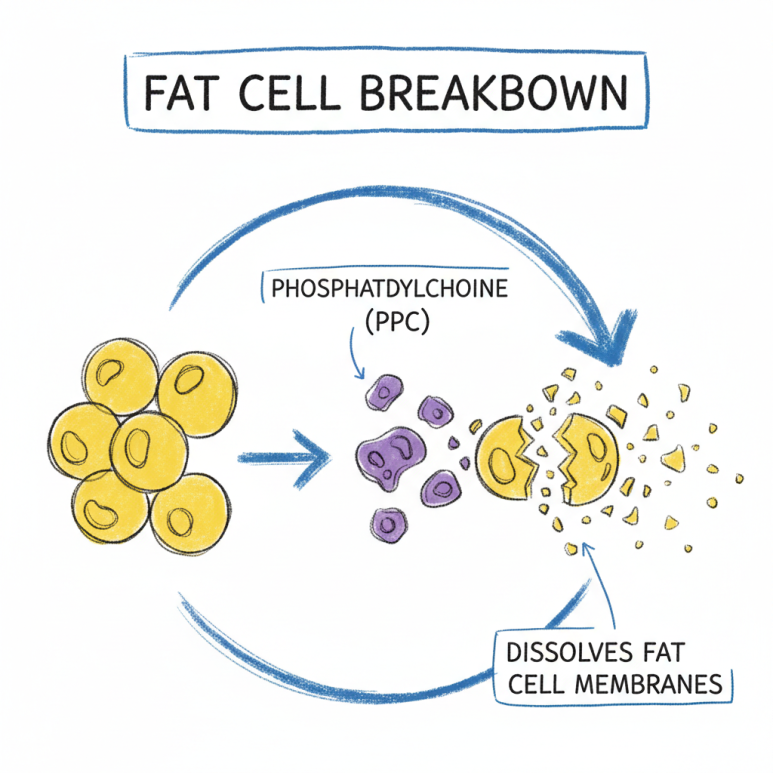
In the first step, when the ingredient is injected into the fat layer, the fat cell membrane begins to be damaged. This process slowly continues over about 48 hours, and the fat inside the cells is released into the blood vessels and lymphatic system.
In the second step, the body’s macrophages remove the destroyed fat cells. At this time, an inflammatory reaction naturally occurs, but even without steroids, it usually subsides in about 3 to 5 days.
The third step is when new collagen fills the area where the fat has been removed. Usually, you can feel skin elasticity return between 2 and 4 weeks.
The final result appears in the fourth step, around 6 to 8 weeks after the procedure, and at that point you can see both fat reduction and skin improvement at the same time.
Things you must check before the procedure
| First |
|---|
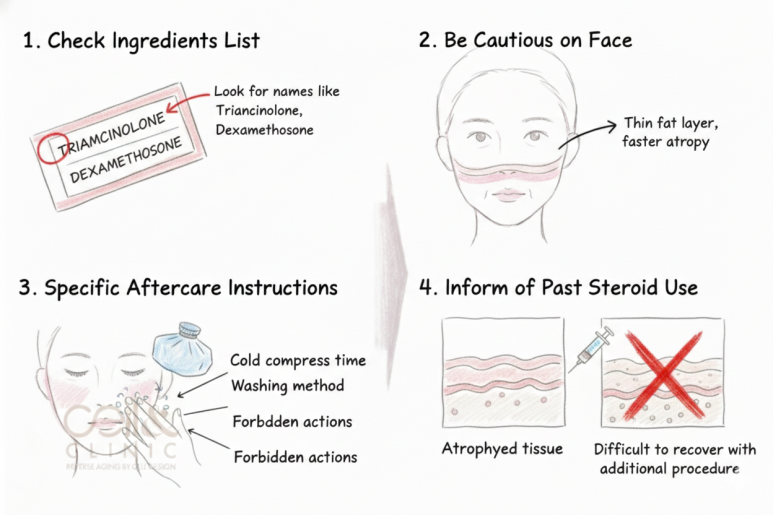
| Please request the product information leaflet and check the ingredient list yourself. |
| Steroid ingredients are listed under names such as triamcinolone and dexamethasone, so you can look for those terms. |
| Second |
|---|
| You should be especially careful if the treatment area is the face. |
| This is because the subcutaneous fat layer in the face is thin, so steroid-induced atrophy can appear more quickly. |
| Third |
|---|
| You should receive detailed guidance on how to care for the area after the procedure. |
| It is important to be clearly informed about the cold compress time, washing methods, and prohibited actions to manage swelling. |
| Fourth |
|---|
| If you have previously received steroid injections, you must inform the medical staff. |
| Additional treatment on tissue that has already atrophied may make recovery difficult. |
Behaviors to avoid include drinking alcohol, using a sauna, and doing strenuous exercise on the day of the procedure. These activities widen blood vessels, worsen swelling, and may cause more severe bruising.
Also, frequently touching or massaging the treated area with your hands is not allowed. If you stimulate the area before the injected ingredient has spread evenly, it may affect unintended areas.
If severe pain continues for more than 3 days after the procedure, or if the skin feels hard and stiff, it is advisable to visit Cheongdam Dermatology for an examination. Confirming the exact ingredients is the starting point of a safe procedure.
This post was written directly by Larian Cheongdam Clinic for informational purposes in compliance with Article 56 of the Medical Service Act and its Enforcement Decree.
All procedures and surgeries may cause adverse reactions, so please receive treatment after充分 consultation with the medical staff.
Director Kang Ji-yeon, Larian Cheongdam Clinic