Have you ever had a lifting procedure
only for the effect to fade quickly?
Many people expect long-lasting results from a single treatment, but changes in skin tissue require a certain amount of time and repetition.
-
The principle of collagen recovery progressing in stages
-
Why one-month intervals are appropriate
-
The background for recommending three sessions
The principle of collagen recovery progressing in stages
Titanium lifting works by delivering radiofrequency thermal energy to the dermis to induce collagen production.
Immediately after the procedure, the existing collagen fibers contract from the heat, creating an immediate change in firmness.
But the real effect begins afterward. Skin tissue that has received thermal stimulation creates new collagen during the recovery process.
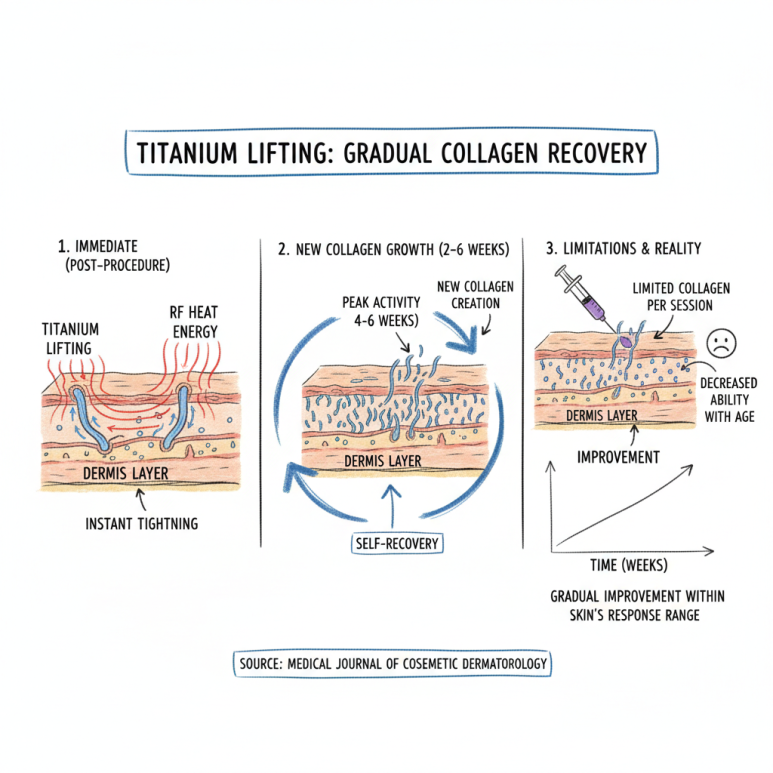
This process begins in earnest two weeks after the procedure and progresses most actively between four and six weeks.
The problem is that there is a limit to the amount of collagen produced from a single stimulation. As we age, our ability to produce collagen declines, so it is difficult to create noticeable changes with just one treatment.
Many people expect that getting a lifting treatment will make them look ten years younger right away, but in reality, improvement happens gradually within the range that the skin can respond to.
Why one-month intervals are appropriate
After the first treatment, the skin goes through about four weeks of rest and recovery.
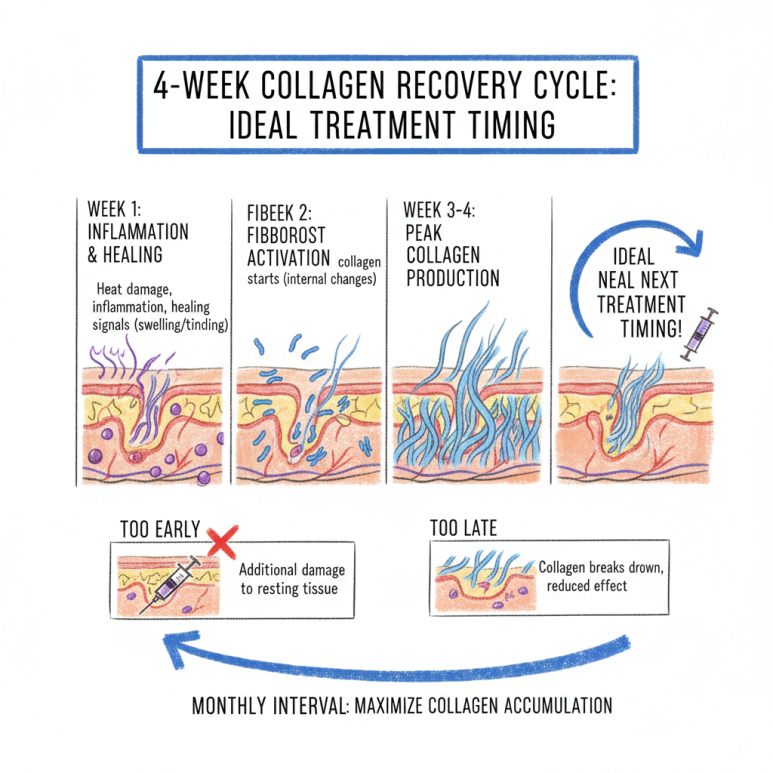
In the first week, the tissue that has been thermally damaged triggers an inflammatory response and sends healing signals. During this period, there may be slight swelling or a tingling sensation.
From the second week on, fibroblasts become activated and begin producing new collagen. Changes are taking place inside the skin, but they are not yet very visible on the outside.
Between the third and fourth weeks, collagen production reaches its peak. This is the ideal time for the next session.
If a follow-up treatment is done too soon, additional stimulation may be applied to tissue that is still resting, which could actually cause damage. On the other hand, if it is done too late, the collagen that was created may begin to break down naturally again, weakening the effect.
A one-month interval is a cycle that adds new stimulation when the effects of the previous treatment have reached their maximum, maximizing collagen accumulation.
During the procedure, the temperature is adjusted according to the depth of the dermis, and it takes about 30 to 40 minutes. After the procedure, soothing care is provided to quickly reduce any warmth.
The background for recommending three sessions
| 1 session | The collagen layer forms thinly and is easily broken down by the normal aging process. |
|---|
| 2 sessions | As a second layer builds on top of the first, structural stability begins to develop, but the duration is still somewhat lacking. |
| 3 sessions | Collagen accumulates to a sufficient thickness, increasing resistance to external irritation and aging. In addition, repeated stimulation three times increases fibroblast activity, improving the ability to produce collagen on its own even after the procedure. |
How to care after the procedure
First,
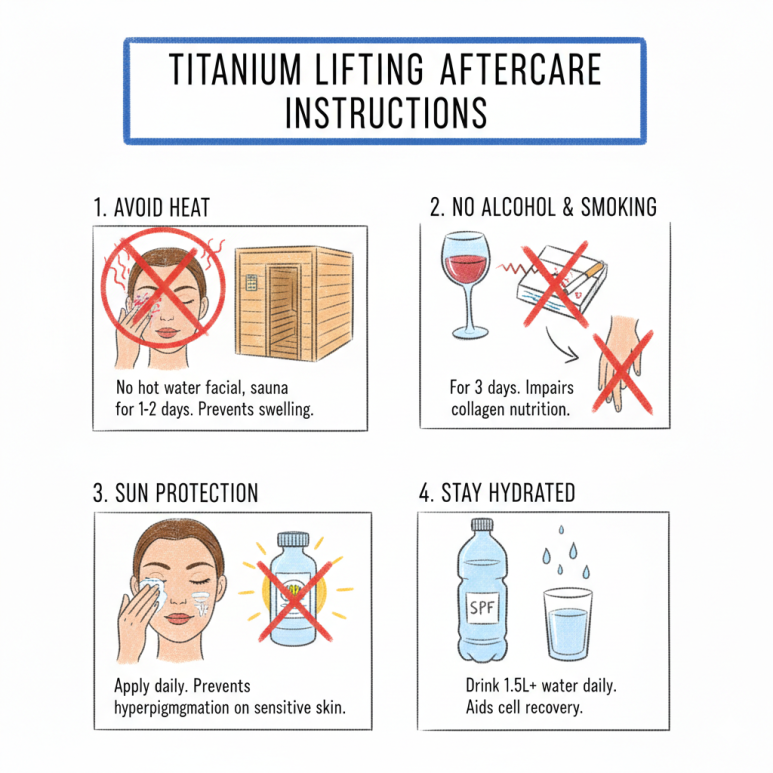
On the day of the procedure and the following day, you should avoid washing your face with hot water or going to a sauna. If heat is applied, it can further irritate the treated area and worsen swelling.
Second,
It is best to avoid alcohol and smoking for three days after the procedure. Alcohol and nicotine constrict blood vessels and interfere with the supply of nutrients needed for collagen production.
Third,
You should apply sunscreen carefully every day. Since the skin is temporarily more sensitive after the procedure, exposure to ultraviolet rays may cause pigmentation.
Fourth,
It is important to drink enough water, at least 1.5 liters per day, to help cells recover.
If redness lasts for more than a week after the procedure, or if you feel that the skin surface has become uneven, please visit the Cheongdam dermatology clinic for an evaluation. A systematic treatment plan creates satisfying results.
This post was
written directly by Larian Cheongdam Clinic
for informational purposes,
in compliance with Article 56 of the Medical Service Act and the Enforcement Decree of the same Act.
Because all procedures and surgeries may cause
adverse reactions,
please receive treatment only after
sufficient consultation with medical staff.
Director Kang Ji-yeon, Larian Cheongdam Clinic