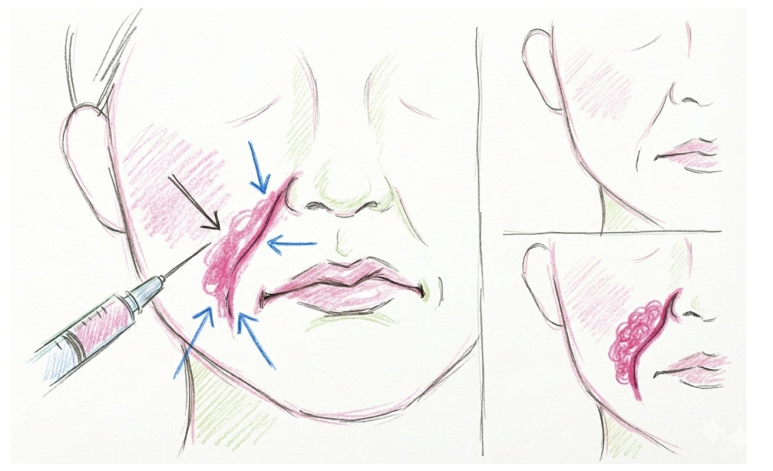
I got an expensive filler that everyone said was good,
so why do my nasolabial folds look even deeper
and awkward?
When I see people feeling upset because a procedure they made up their mind to get seems to have backfired, I feel sorry for them.
-
Three real reasons nasolabial folds deepen
-
Types of nasolabial fold procedures by condition and selection criteria
-
Daily care methods to improve durability after treatment
Three real reasons nasolabial folds deepen
Many people simply think of nasolabial folds as
shallow marks where the skin folds on the surface.
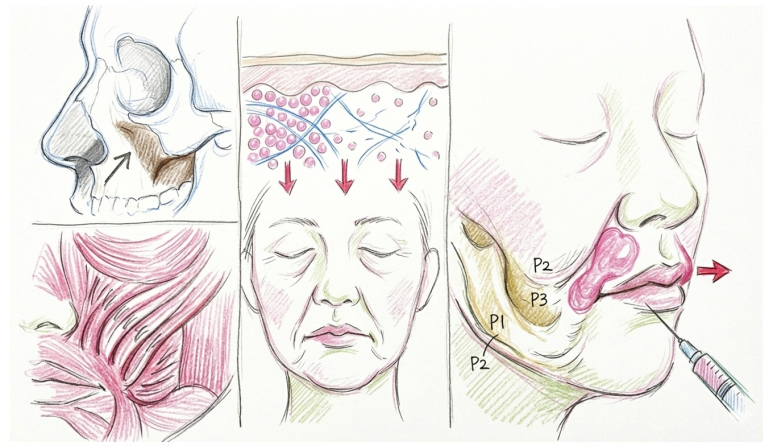
However, the cause of a deep crease is not a surface issue; it begins with three-dimensional changes deep within the skin, and can be broadly divided into three categories.
| First |
|---|
| A congenital structural issue in the bone framework, where the maxillary bone next to the nose itself is deeply sunken, causing a dark shadow from childhood |
| Second |
| A reduction in collagen and an overall decrease in skin elasticity due to natural aging over time |
| The loss of valuable collagen in the dermis is like the rebar in a sturdy building slowly corroding until the heavy outer wall collapses. As the support structure inside the skin loosens and weakens, the heavy fat tissue in the cheeks can no longer resist gravity and sags downward along with it. |
| Third |
| Repeated strong folding of specific areas due to excessive movement of the facial muscles used when talking or laughing loudly |
There have also been unfortunate cases where the actual root cause was sagging cheek fat, yet filler volume was forced into the area beside the nose, making the mouth look even more protruded.
If you blindly fill in areas without carefully identifying the underlying cause of the wrinkle, the result can look very unnatural and awkward.
Therefore, it is most important to deeply understand each person’s different facial anatomy and establish a treatment plan that precisely matches the cause.
Types of nasolabial fold procedures by condition and selection criteria
We carefully diagnose the patient’s skin thickness, fat volume, and the degree of sagging in the fascia.
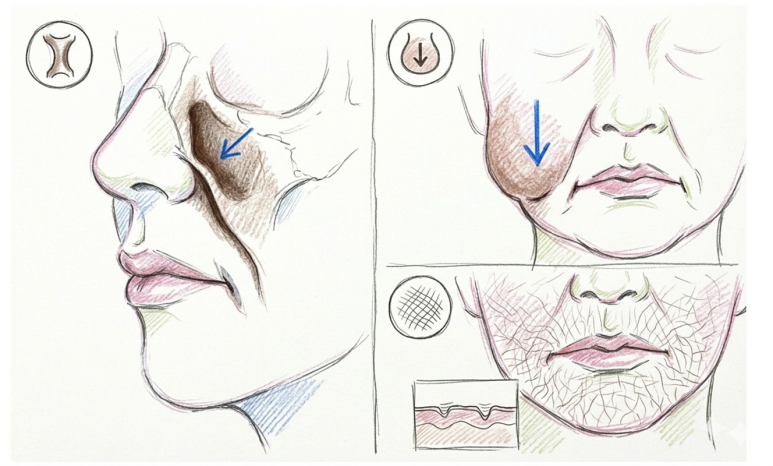
Nasolabial fold procedure types can be broadly divided, according to treatment purpose, into procedures that add volume, procedures that lift sagging tissue upward, and procedures that strengthen the skin itself.
If the bone structure next to the nose is sunken
or the wrinkle is a deep,
hollow crease, are you concerned?
Hyaluronic acid filler, which immediately restores volume to a hollow area, can be very helpful.
However, because important blood vessels are intricately intertwined in this area, we prioritize safety with the sincere mindset of treating my own family’s face, and inject only the minimum necessary amount with careful design.
If the heavy fat tissue in the cheek or deep cheek area
has sagged significantly downward,
making the wrinkle stand out clearly?
Rather than adding material to fill it in, a lifting approach that pulls it upward is much more suitable.
At this time, we actively use skin-firming lifting devices such as Shurink or Ulthera, which precisely deliver focused ultrasound energy to the deep fascial layer of the skin.
Through safe thermal energy, the loosened and sagging tissue is strongly contracted, and the spontaneous production of new collagen and elastin within the skin is encouraged, helping improve the contour in a very natural way.
If the skin itself is very thin like paper
and fine wrinkles
are broadly accompanied around the mouth?
We first recommend combining collagen skin booster procedures such as Juvelook.
This is a scientific principle that directly delivers essential nutrients to the skin’s dermal environment deep inside, firmly rebuilding the damaged skin barrier and strengthening the skin’s innate regenerative ability.
Rather than there being only one treatment that is always the answer, the most ideal prognosis can be expected when two or more methods are appropriately combined and applied according to each individual’s complex skin condition.
Daily care methods to improve durability after treatment
Even if you receive an excellent and precise procedure, if the patient’s own consistent aftercare is not maintained, the beautiful duration of the results will inevitably become shorter.
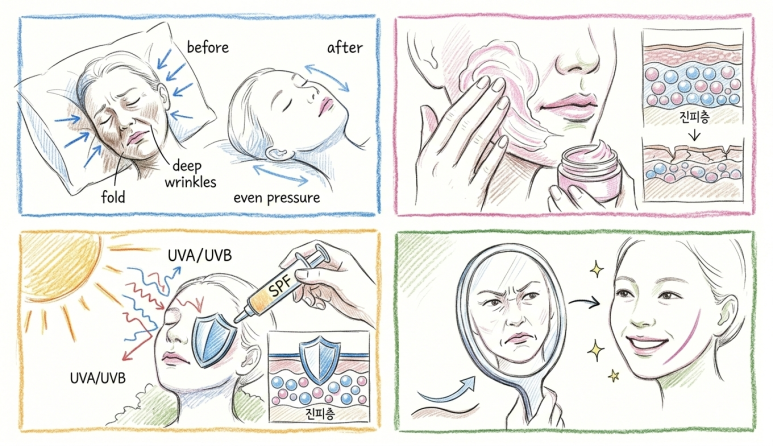
Sleep posture
First of all, when you lie down in bed and sleep every night, you must make a careful effort to continuously maintain the correct sleeping posture.
The habit of burying your face in a pillow and sleeping face down, or sleeping on your side, causes your cheeks and jaw to be strongly pressed throughout the night, which further deepens and fixes the folded wrinkles.
Moisturizing after cleansing
Also, when doing skincare after cleansing, it is good to apply plenty of moisturizing cream so that the skin around the mouth, which has relatively few sebaceous glands, does not become dry and dehydrated.
This is because skin that lacks sufficient moisture and becomes dry creates a vulnerable environment where fine wrinkles form very easily, just like dry land cracked wide open after a long drought.
Applying sunscreen
When going বাইরে, regardless of the season or cloudy weather, it is also an essential guideline to carefully reapply sunscreen and actively prevent the destruction of precious dermal collagen caused by photoaging.
Practicing smiling expressions
Lastly, rather than forcing facial expressions such as frowning and overusing the facial muscles, the habit of looking in the mirror and gently smiling with the corners of the mouth raised is very helpful in creating a softer and prettier facial line.
As such, treatment for nasolabial folds, which is extremely delicate, is not a standardized single method; a detailed customized approach by Cheongdam Dermatology Clinic that comprehensively considers each individual’s unique facial bone structure and anatomical features is essential.
This post was written directly by Larian Cheongdam Clinic for informational purposes
in compliance with Article 56 of the Medical Service Act and the Enforcement Decree of the same Act.
All procedures and surgeries may cause adverse reactions,
so please receive treatment after sufficient consultation
with medical staff.
Director Kang Jiyeon, Larian Cheongdam Clinic