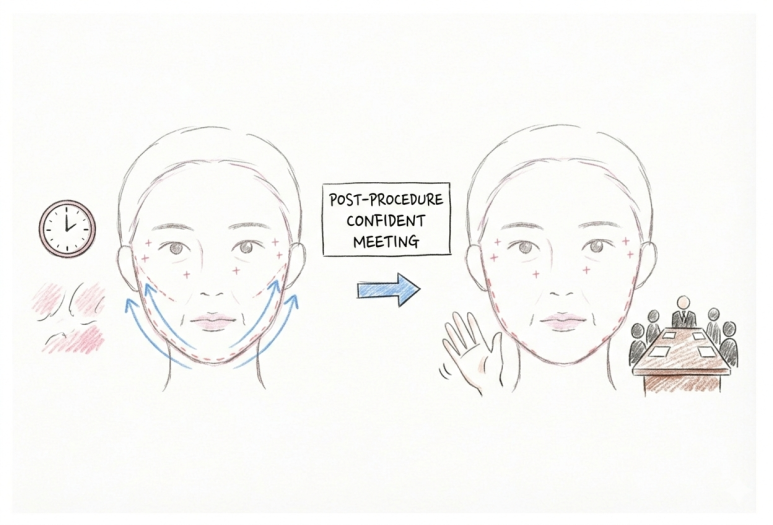
I have an important meeting right after the procedure.
Will my face become very red
or swell?
For those who do not want to neglect self-care amid a busy daily life, the recovery period after a procedure—downtime—is likely one of the most sensitive concerns. Here, we would like to talk about the Onthium procedure and the downtime that may follow.
-
The fundamental reasons for redness and swelling after the Onthium procedure
-
The process for reducing recovery time
-
Key care guidelines to help you return to daily life quickly
The fundamental reasons for redness and swelling after the Onthium procedure
Onthium is an excellent procedure that delivers energy deep into the skin to improve firmness, but from the skin’s perspective, it is perceived as an external stimulus from strong energy.
When thermal energy is delivered into the skin, a microscopic inflammatory response occurs. This is similar to how muscles may feel temporarily sore after exercise as part of the process of becoming firmer, which may make it easier to understand.
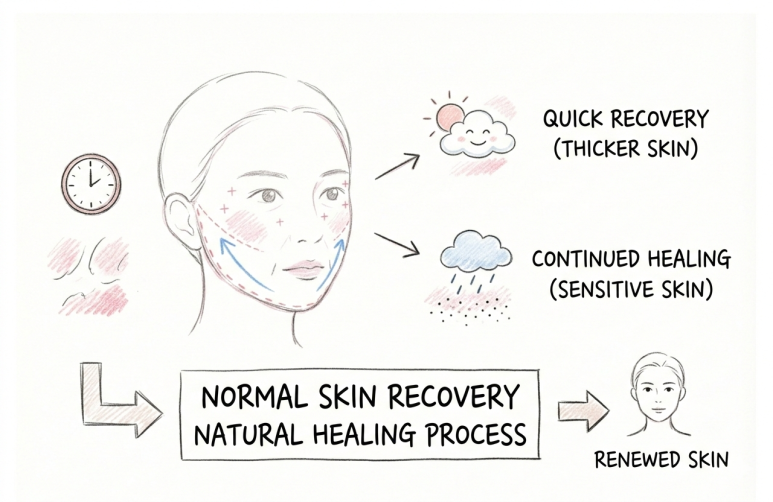
Usually, immediately after the procedure, the skin may become slightly flushed or develop mild swelling, which is also a positive sign that the energy has reached the target layer accurately.
However, because everyone’s skin thickness and sensitivity are different, even with the same energy setting, some people recover quickly while others may continue to experience it for a few more days.
The part that is often misunderstood is thinking of this “recovery response” as a side effect and becoming overly anxious. In fact, it is a natural stage in which the skin regenerates on its own.
The process for reducing recovery time
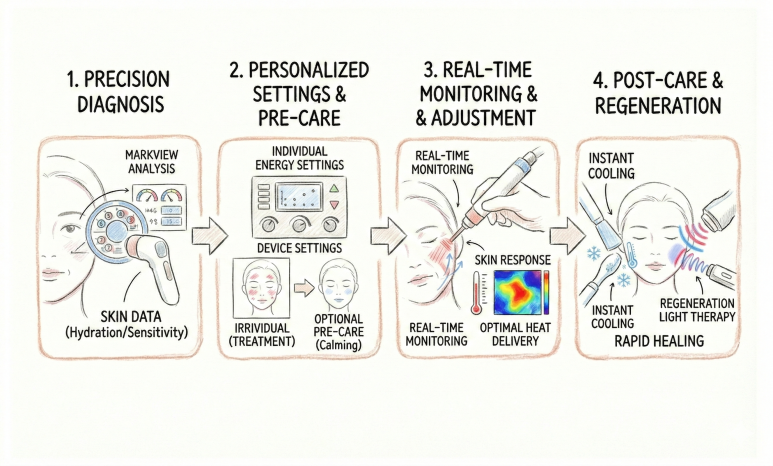
Before the procedure, a precise diagnosis using “MarkView” quantifies the skin’s current moisture level and sensitivity, and the energy settings are adjusted individually.
If energy is delivered too aggressively when the skin is excessively dry or the skin barrier is compromised, downtime will inevitably increase, so in some cases, pre-procedure soothing care is performed first.
During the procedure itself, carefully adjusting the handpiece while monitoring the skin’s response in real time to prevent heat from concentrating too much in one area is the treatment philosophy our medical staff insists on.
Immediately after the procedure, we place great emphasis on aftercare that quickly calms the inflammatory response by combining a special cooling system that immediately lowers the skin temperature with regenerative light therapy.
Thanks to this step-by-step customized approach, many patients say they are able to apply makeup the next day and continue their daily social activities without much difficulty.
Key care guidelines to help you return to daily life quickly
For the first three days after the procedure, the skin barrier is in a very delicate state, so careful attention is needed.
The first thing we would like to emphasize is to cleanse gently, as if you were handling baby skin. Cleansers containing scrubbing agents or strong vibrating cleansing devices should be avoided.
Also, until the heat inside the skin has completely subsided, it is best to avoid for about a week any activities that raise body temperature, such as saunas or vigorous exercise, as this helps speed recovery.
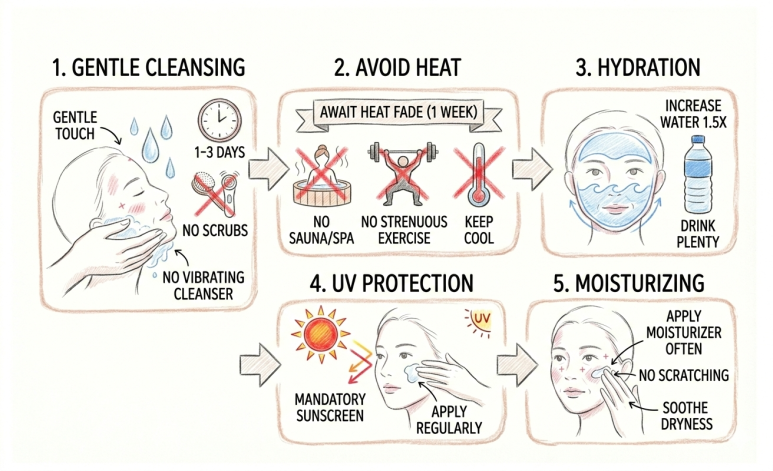
Please increase your water intake to about 1.5 times your usual amount, and when going বাইরে, apply sunscreen more carefully than usual to protect the regenerating skin from external irritation.
Occasionally, the treated area may feel itchy or dry. In such cases, rather than touching it with your hands, it is better to apply moisturizer frequently so the skin does not become dehydrated.
If accurate diagnosis and attentive aftercare from Cheongdam Dermatology are combined, downtime will no longer be an obstacle that makes you hesitate about the procedure.
This post was
written directly by Larian Cheongdam Clinic
to provide information in compliance with
Article 56 of the Medical Service Act and the Enforcement Decree of the same Act.
All procedures and surgeries may cause adverse reactions,
so please receive treatment after
sufficient consultation with the medical staff.
Director Kang Ji-yeon, Larian Cheongdam Clinic