Have you ever heard the expression “Wegovy face,” which is now being discussed alongside weight management and even changes in facial appearance?
This term refers to the phenomenon in which a person’s facial appearance changes as they lose weight, and it has recently been attracting a lot of attention. Unlike simply losing body fat, changes in facial volume and elasticity may occur at the same time, so it is important to understand it accurately.
-
What Wegovy face is
-
Why facial changes appear
-
When these changes may occur
-
How to manage it from a skin perspective
-
How to maintain a natural look
What is Wegovy face?
This expression refers to a change that gives a slimmer or more tired-looking impression than before as facial fat also decreases during the weight-loss process.
In particular, as volume in the cheeks, temples, and jawline decreases, the facial contours can change. To explain it in a way even a child could understand, you can think of it as the body getting smaller and the face getting smaller too, but in the process, as fat is lost, the face may look a little flatter.
Why facial changes appear
There is more facial fat than people might think.
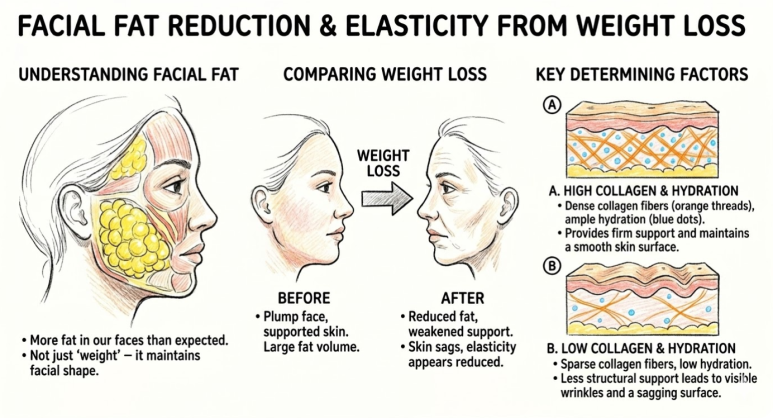
This fat is not just body fat; it plays an important role in maintaining the shape of the face. When weight is lost, body fat decreases overall, and facial fat also decreases along with it. If the structure supporting the skin weakens during this process, the skin may appear less elastic. Also, depending on the condition of collagen and moisture in the skin, the degree of facial change can vary even with the same amount of weight loss.
When these changes may occur
When weight decreases rapidly, facial changes tend to stand out more. In particular, if the change happens drastically over a short period of time, the skin may not have enough time to adapt, creating a sagging feeling.
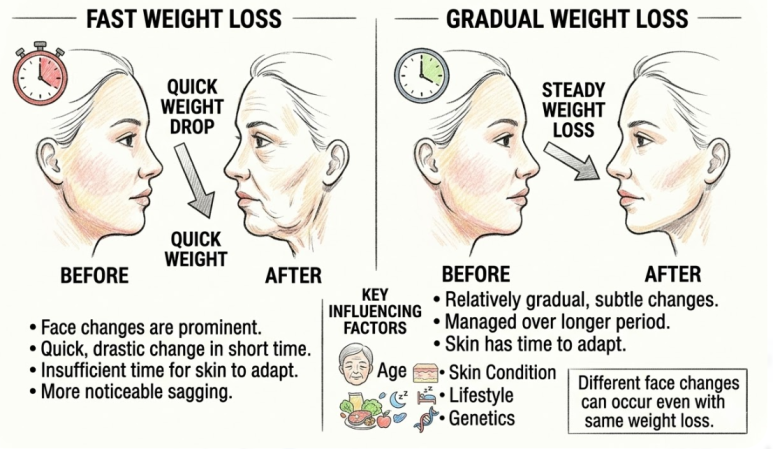
On the other hand, when weight is managed more gradually, the changes may appear more slowly. Differences also occur depending on a person’s skin condition, age, and lifestyle habits. In fact, even with the same amount of weight loss, some people barely notice any change in their face, while others feel that their expression has changed.
How to manage it from a skin perspective
To ease these changes, it is important to maintain the skin’s own elasticity. Adequate water intake and balanced nutrition are the basics. In addition, if care focused on skin elasticity is combined, it can help reduce the burden of the change.
Skin should not be managed only on the surface; the internal environment must also be considered. Keeping lifestyle habits stable is also an important factor.
How to maintain a natural look
Rather than losing weight too aggressively, proceeding step by step can also help in terms of facial changes. In addition, making a habit of checking your skin condition while managing your weight can make it easier to respond to changes.
Most importantly, it is important to choose a method that suits your individual condition. Since the same changes do not appear in everyone, finding the direction that works for you is key.
Recently, as interest in these facial changes has increased, various kinds of information have been shared. However, content that uses exaggerated expressions or presents overly definite conclusions should be viewed with caution. Because medical information requires accuracy and balance, it is advisable to approach it carefully.
Changes in facial appearance that occur alongside weight change are a natural phenomenon that can appear differently for each person. Understanding this and setting a direction for management is important. At Cheongdam Dermatology Clinic, you can consider more stable changes through skin care that takes each individual’s condition into account.
This post was written directly by Larian Cheongdam Clinic for the purpose of providing information, in compliance with Article 56 of the Medical Service Act and the Enforcement Decree of the same Act.
All procedures and surgeries may cause adverse reactions, so please receive treatment after sufficient consultation with the medical staff.
Director Kang Ji-yeon, Larian Cheongdam Clinic