Deep nasolabial folds can naturally develop as you get older, but they may be felt as a factor that makes the face look tired or older than it really is. In particular, if the line looks deep not only when smiling but also at rest, it may be necessary to consider not just simple wrinkles, but also a decrease in skin elasticity and structural changes.
- Why Deep Nasolabial Folds Form
Deep nasolabial folds are often not just lines on the skin’s surface, but a result of changes in the structures beneath the skin. Simply put, you can think of it as a situation where the cushion supporting the face sinks in, making the wrinkle stand out more.
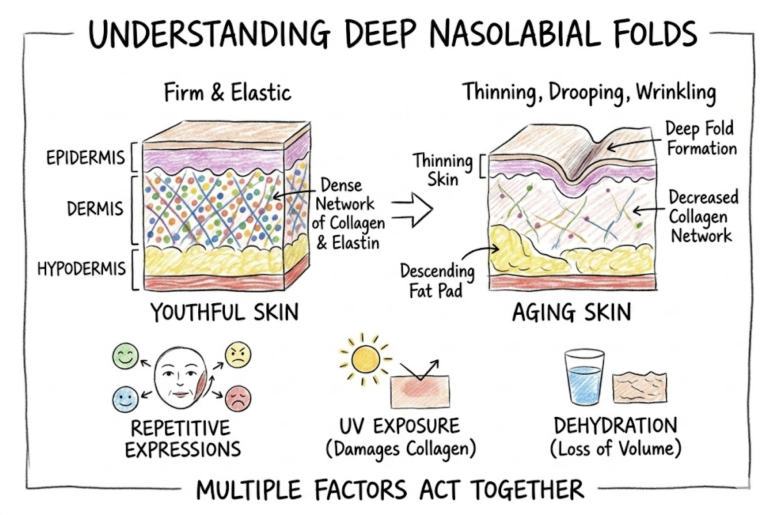
The skin is made up of the epidermis, dermis, and subcutaneous fat layer. As collagen and elastic fibers decrease with age or due to lifestyle habits, the skin gradually becomes thinner and sags. In addition, as cheek fat moves downward, the area from the side of the nose to the mouth becomes more deeply folded.
Also, repeated facial expressions, sun exposure, and lack of moisture can all have an effect. Therefore, deep nasolabial folds are often the result of multiple factors working together rather than a single cause.
- When Is a Lifting Effect Needed?
The time when a lifting effect is needed should be judged not simply by whether wrinkles are present, but by whether the overall balance of the face has changed.
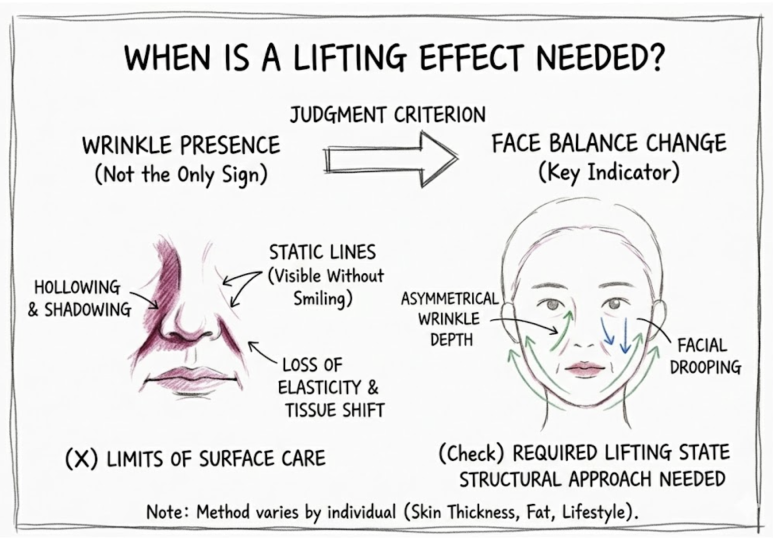
For example, if the nasolabial area becomes sunken and shadows appear more deeply, or if the line remains visible even without smiling, there may be a possibility that loss of skin elasticity and tissue movement are progressing together. In such cases, improvement may be limited with simple moisturizing or surface-level care alone.
Also, if the depth of the folds differs on each side or there is a feeling that the face looks saggy, a more structural approach may be needed. However, the appropriate method may vary depending on an individual’s skin thickness, amount of fat, and lifestyle habits.
- Various Approaches to Improving Nasolabial Folds
Improving deep nasolabial folds is important not by solving them with one method, but by combining several approaches that suit the condition.
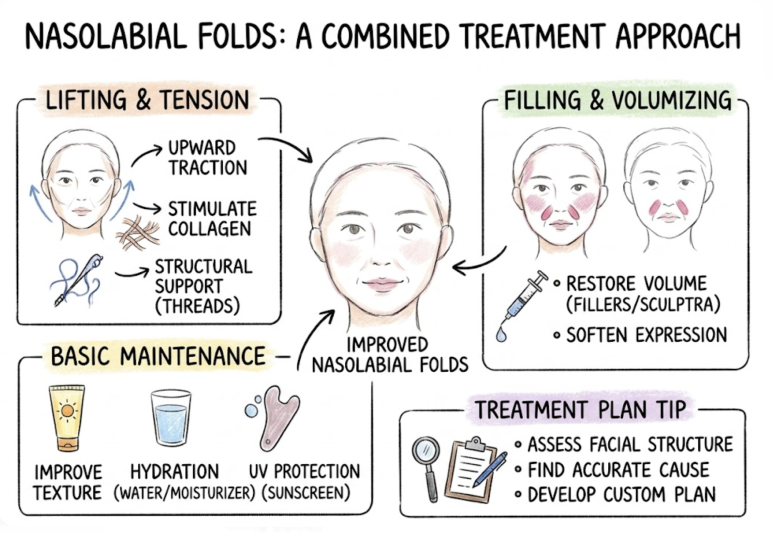
First, lifting procedures that help improve skin elasticity may help reduce the depth of wrinkles by pulling sagging tissue upward. This may be done by inducing collagen production within the skin or by physically supporting the tissue.
In addition, a method that fills in sunken areas may also be considered. When there is a lack of volume, the folds can look deeper, so if appropriate supplementation is done, the overall impression may become softer.
In addition, basic care such as improving skin texture, providing moisture, and protecting against UV exposure should also be done together for a more stable change. The important point is to establish a plan after accurately identifying the individual’s facial structure and the cause.
- Factors to Consider for Lifting
When considering lifting, it is necessary to look at several factors, not just the effect itself.
First,
Skin condition
The appropriate method may differ depending on whether the skin is thin or thick and how much elasticity it has.
Second,
Cause of the wrinkles
The approach differs depending on whether sagging is the main issue or whether volume loss is the main issue.
Third,
Degree of change expected
Options may differ depending on whether a natural improvement or a more noticeable change is desired.
Fourth,
Whether post-procedure care is manageable
This is because the maintenance period may vary depending on lifestyle habits and skin care condition.

As such, the lifting effect can appear differently depending on individual conditions, so the process of making a plan through sufficient consultation is important.
Deep nasolabial folds may be the result of facial structure and changes in elasticity working together rather than a simple skin issue. It is important to accurately understand the current condition and find the method that suits you, and these aspects can be carefully checked through consultation based on skin condition at Cheongdam Dermatology Clinic.
This post was written directly by Larian Cheongdam Clinic for informational purposes in compliance with Article 56 of the Medical Service Act and the Enforcement Decree of the same Act.
Please note that all procedures and surgeries may cause adverse reactions, so please receive treatment after sufficient consultation with medical professionals.
Director Kang Ji-yeon, Larian Cheongdam Clinic