
Many people choose cheekbone surgery when their cheekbones stand out prominently on the face.
So today, we’ll take a closer look at cheekbone surgery.

First of all, rather than simply pushing the bones inward as much as possible, personalized design and the direction of movement based on each person’s cheekbone condition are what matter most in cheekbone reduction surgery.
In particular, only by reflecting the osteotomy position and angle, the rotational movement of the cheekbone, posterior-superior movement,
and solid double fixation can you expect natural and smooth before-and-after results from cheekbone surgery.
 After-surgery photos may differ from reality due to the shooting environment, lighting, makeup, and other factors.
Results vary from person to person, and through an accurate consultation, confirm the procedure result that is appropriate for you.
After-surgery photos may differ from reality due to the shooting environment, lighting, makeup, and other factors.
Results vary from person to person, and through an accurate consultation, confirm the procedure result that is appropriate for you.
If we look at this process in more detail,
the first step is design and osteotomy that take into account the degree of prominence at 45 degrees and from the side cheekbones.
The cheekbone condition, which differs from person to person, is examined closely through 3D CT imaging.
By understanding the shape and size of the cheekbone,
we adjust the amount and angle of osteotomy in the 45-degree cheekbone area.
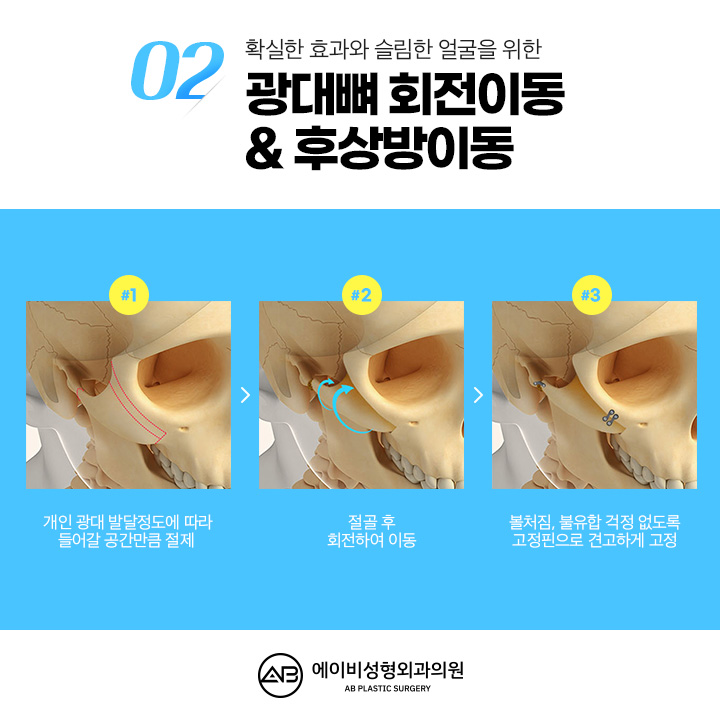
The second step is to perform rotational movement of the cheekbone and posterior-superior movement
in order to complete a slim facial line.
Depending on the degree of each person’s cheekbone development, only the space needed is removed,
and after osteotomy, the bone is rotated and moved,
then firmly fixed with pins so that concerns about side effects such as cheek sagging and nonunion can be reduced.
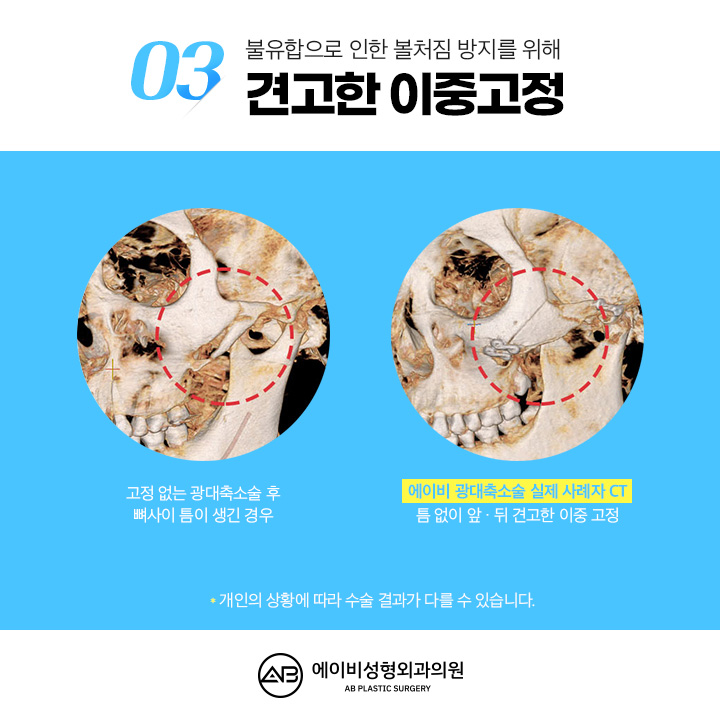
The third step can be described as solid double fixation, which helps prevent cheek sagging caused by nonunion.
If the bone segments created by osteotomy are not properly fixed,
cheek sagging due to nonunion and bone resorption may occur.
Therefore, the cut surfaces of the cheekbone are brought into maximum contact,
minimizing the gap before fixation.