Hello, this is AB Plastic Surgery :)
Today, we’ll take a look at under-eye fat repositioning!

If the skin tone is dark and it is actually pigmentation,
it is difficult to improve with surgery, and in such cases, dermatology procedures are needed.
When under-eye fat appears, there are two things to look at.
First, if the skin and muscle are close together and the muscle shows through, it can look dark.
If the skin is thin, the muscle may show through and make the area look darker.
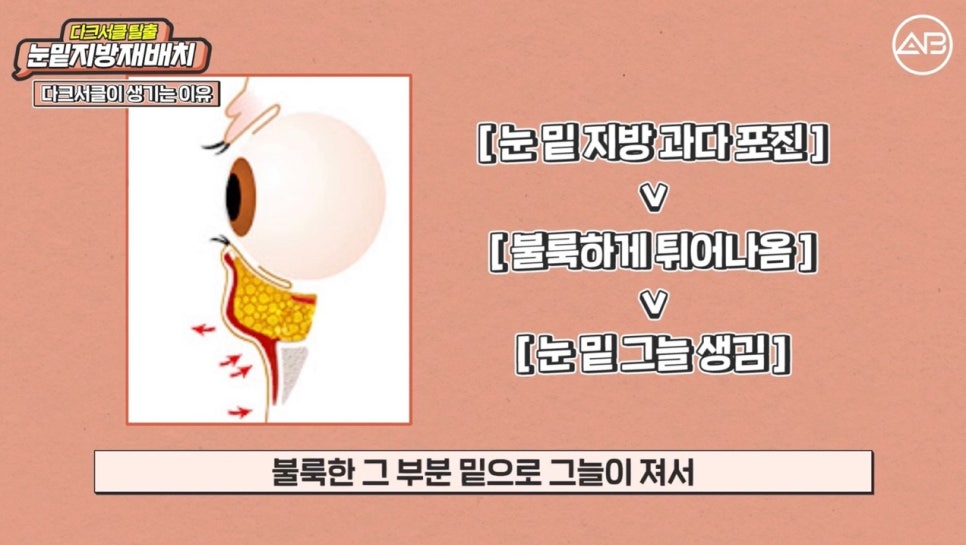
Second, if the area under the eyes is puffy, it can cast a shadow beneath it and make it look dark.

When there is too much fat concentrated in the back part, the membrane is opened
and the fat is spread downward to reposition it.
This helps reduce the dark appearance caused by the concentrated fat
and also reduces the shadowing caused by the bulging.
The procedure approaches through the conjunctiva inside the eye,
so there is no visible skin scar, and the fat is located and repositioned from the inside.

As for the recovery period, there may be some bruising and swelling during the first week,
but it varies from person to person and usually recovers in about a week.
There is no special aftercare, but strenuous exercise that greatly increases pressure in the face
may raise the likelihood of bruising and swelling, so it is better to avoid it.

If there is too much fat, it can be reduced a little more,
and if the under-eye area still looks puffy after under-eye fat repositioning,
it may not be fat but rather muscle developed around the eyes.
In that case, it is difficult to reduce it much, and lower blepharoplasty,
which makes an incision under the eye and reduces the muscle, is recommended.
On the other hand, if too much fat has been removed, autologous fat can be harvested from the inner thigh or abdomen
and fat grafting can be used to fill the hollow under-eye area.