
For those who hesitate to put an implant into the bridge of the nose,
and for those who want a natural nose line, this is something many people choose!
It is non-implant nose surgery.

As mentioned above, non-implant nose surgery is chosen not only by people who are uncomfortable with artificial implants,
but also by those who may experience inflammatory reactions or whose thin skin could make an implant show through.
In addition, it is also chosen by people who already have a bridge but want the tip of the nose to become more refined,
or by people whose nasal tip looks blunt and wide.
For a pretty nose line,
this is what non-implant rhinoplasty is often selected for.
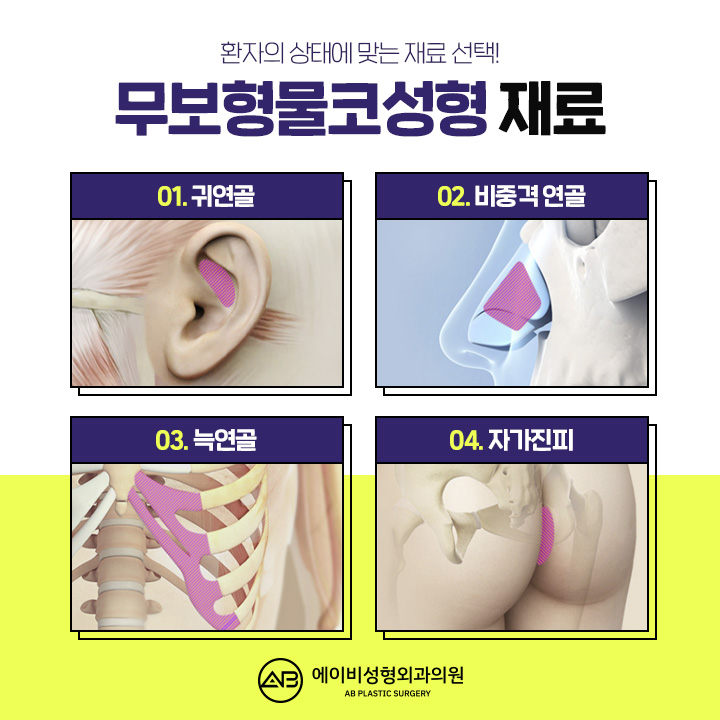
Without using an implant such as silicone,
self tissue such as septal cartilage, ear cartilage, costal cartilage, and autologous dermis
is used to create a three-dimensional yet attractive nose line.
This can be considered the advantage of non-implant nose surgery.
Then, if we look more closely at the materials used,
for ear cartilage, the shape of the cartilage is similar to the nose, round,
and has elasticity as well, making it suitable for building the structure of the nasal tip.
It is also appropriate for additional use by people who have insufficient septal cartilage.
Next, septal cartilage is mainly used after being carved
to raise the nasal tip or extend the length of the nose.
Because it is harvested from inside the nose, the advantage is that there is no separate incision.
Lastly, the costal cartilage that is often used
is cartilage from below the ribs; it has almost no side effects,
and because it has strong support and durability, it is an excellent choice
for people who want a more striking nose line.
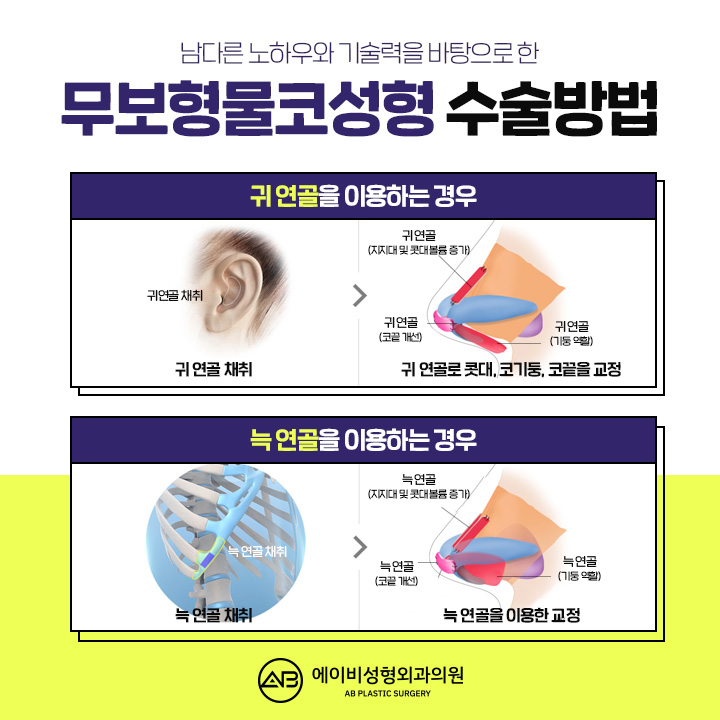
How is surgery performed using this kind of autologous tissue?
To explain the representative ear cartilage and costal cartilage surgical methods:
The ear cartilage surgical method is a way to raise the nose using only ear cartilage,
and by correcting the columella, nasal bridge, and nasal tip,
it corrects the overall nose height and nasal tip.
If ear cartilage and septal cartilage are used together,
ear cartilage is used for the nasal tip where curvature is needed,
and septal cartilage is used together for areas that need straight-line support.
Lastly, the costal cartilage surgical method is often used when the cartilage support structure is weak,
when tissue damage has occurred and revision nose surgery is needed.

So far, we have looked in detail at the materials and surgical methods for non-implant nose surgery.