
If you are looking into revision rhinoplasty,
I think this post will be worth your attention today.
As AB Plastic Surgery is proud of its expertise in revision rhinoplasty,
today we will take a detailed look at how revision rhinoplasty is performed at AB.

People usually consider revision rhinoplasty for the following reasons.
Due to reasons such as tip drooping, dissatisfaction with the nose line, a crooked nose, a still-wide nose, a hump nose, an upturned nose, or a contracted nose,
people end up looking into revision rhinoplasty.
Since there has already been one unsuccessful surgery,
concerns about side effects from revision rhinoplasty are likely to be high as well.
However, at AB Plastic Surgery,
we provide a detailed explanation of the revision rhinoplasty plan
through precise diagnosis.
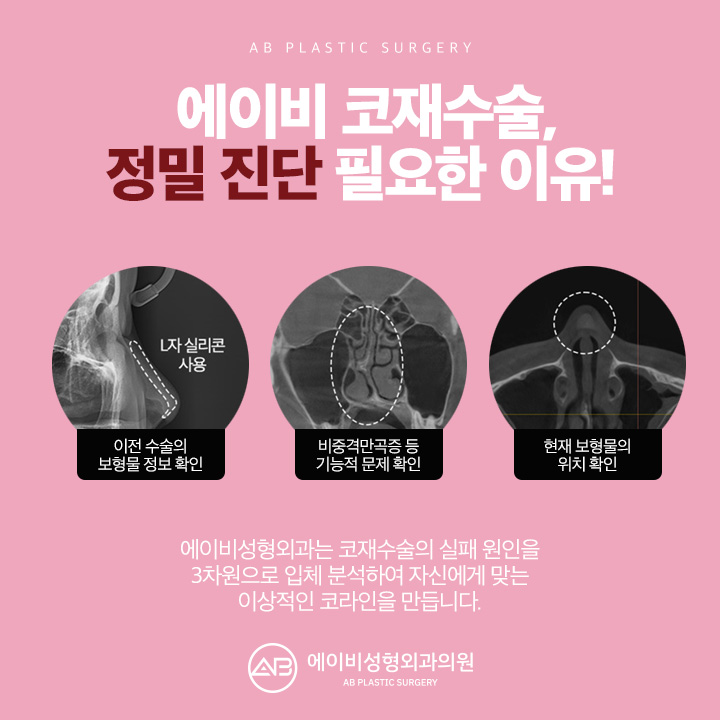
By three-dimensionally analyzing the causes of rhinoplasty failure,
we establish an ideal revision rhinoplasty plan suited to each person.
We closely examine information about the implant used in the previous surgery,
check functional issues such as a deviated septum,
and confirm the current implant position
to guide you through a successful revision rhinoplasty plan.
So how is revision rhinoplasty performed?
Various surgical methods are carried out depending on the causes mentioned above.
When the tip cartilage is weak and the columella is short, causing the tip to drop,
we either lengthen the septum itself
or strengthen the columella to help correct the nasal tip.
If the issue is dissatisfaction with the nose line, we help change it to a nose line that matches the overall proportions,
including the bridge height and tip height, as well as the desired image.
If the implant has shifted to one side and caused the nose to bend,
we improve it by carefully shaping the part that contacts the nasal bone so it fits the bone precisely.
If a hump nose or a wide nose remains even after surgery,
we additionally correct those symptoms to improve them.
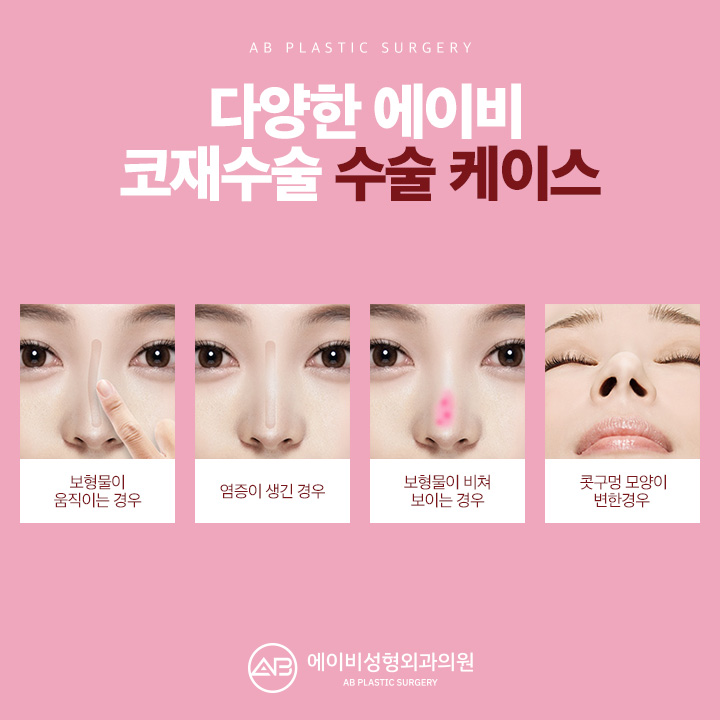
In addition, for cases such as an upturned nose, a moving implant, inflammation,
an implant that is visible through the skin, or a changed nostril shape,
we complete an ideal revision rhinoplasty result
with a surgical plan tailored to the specific cause.
Then when is the best time for revision rhinoplasty?
Revision rhinoplasty is generally recommended 6 months to 1 year after the original surgery.
To allow the damaged skin and tissue after surgery
enough time to recover,
revision surgery should be performed only after observing the area for a certain period,
which can help ease concerns about side effects from revision rhinoplasty.
Especially if inflammation has occurred,
it is better to have revision surgery again after the inflammation has subsided.
If the implant was removed for revision surgery,
it is wise to wait until the scar tissue at the removal site has softened as much as possible
before proceeding with revision surgery to insert the implant again.