Hello, this is AB Plastic Surgery.
Today, together with Director Shin Hee-ji,
we’ll take a look at exosomes and Rejuran.

Exosomes are a type of skin booster that has recently been gaining popularity.
You can think of them as substances that move between cells,
promote skin regeneration,
and help reduce skin inflammation.

Exosomes on the market vary in composition depending on the manufacturer,
but they are easy to understand if you think of them as highly concentrated skin nutrients
packed with growth factors, amino acids, peptides, vitamins, hyaluronic acid, minerals, and more.
Rejuran has ingredients similar to salmon injections, and its exact ingredient is called polydeoxyribonucleotide.
It is a DNA fragment similar to human DNA, and when injected directly into the skin,
it helps the body continuously produce many beneficial substances that can regenerate tissue.

In fact, the overall effects of Rejuran and exosomes are similar.
They promote skin regeneration by increasing beneficial substances in the skin,
help with moisturizing,
and reduce inflammation.
Unlike fillers or Botox, skin boosters do not have a clearly defined duration of effect,
and in general, 2 to 3 sessions at one-month intervals are recommended.

Rejuran is recommended for skin that is dry, has many fine wrinkles, is very thin, or has few breakouts.
There are also research findings showing that Rejuran makes the skin itself denser and thicker,
and when these patients undergo the procedure, they often feel the most noticeable improvement and that their skin has become firmer.

On the other hand, exosomes are recommended for combination skin that has many breakouts and often becomes sensitive or irritated.
The ingredients in exosomes help balance oil and moisture, and their anti-inflammatory effect can calm breakouts.
And for people in their early 20s whose skin already has plenty of moisture and is very resilient,
most of the ingredients may already be sufficient,
so the procedure may not be very helpful.
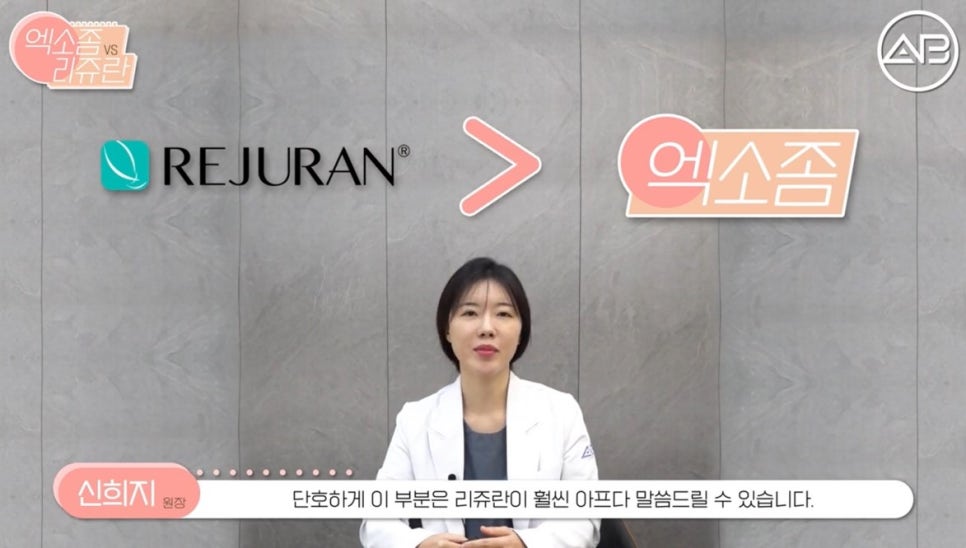
I can say without hesitation that Rejuran hurts much more.
In terms of the actual formulation, exosomes are a bit stickier and have smaller particle units,
but when you actually feel Rejuran, it is much more fluid than exosomes and has a larger molecular weight,
so the larger clumps remain in the skin for longer, but that also means it tends to be more painful.
For those who are sensitive to pain, options such as Rejuran HB Plus or Rejuran i, which have smaller particles and added hyaluronic acid, are sometimes used.
And for those who are extremely sensitive to pain, the procedure may be done under sedation.

We highly recommend skin boosters to the extent that we can say it is good to combine them with many procedures.
When undergoing procedures that create many openings in the skin or cause wounds, such as scar treatment or pore treatment,
adding ingredients that help regeneration is recommended because healing is faster and the results are better.
Also, for people with very dry skin, when undergoing lifting procedures that use thermal energy,
such as Ulthera or Shurink, combining them with a skin booster can help reduce dryness much more
and allow you to enjoy both lifting effects and added moisture at the same time.
Today, we compared Rejuran and exosomes among skin boosters.
Since each person’s skin type is different,
we recommend visiting the clinic in person for a consultation,
identifying the underlying cause of your skin concerns,
and then choosing the procedure that best suits your needs.