Hello, this is AB Plastic Surgery.
Today, with Director Ma Seong-hwan,
we will look at useful terms to know before a nose surgery consultation.

I will talk about the bridge of the nose, the tip of the nose, and the columella.
The part you can see at a glance is the nasal tip, the sides are the alae, and the bridge of the nose,
or the ridge of the nose, and the pillar between the nostrils is called the columella.
The alar cartilage runs from the columella up to the nasal tip,
spreading along the sides of the nasal bridge and forming a wing-like shape.
When raising the nasal tip, surgery is performed while adjusting the height and width of the alar cartilage.

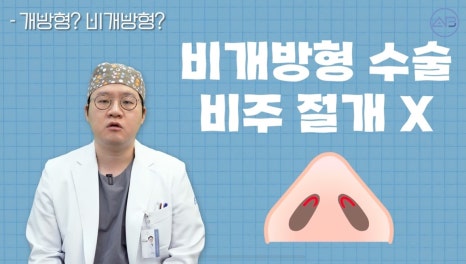
When performing a non-open approach, the columella is not incised, and incisions are made only on both sides of the area where the nostril transitions into the columella, on the upper inside edge of the nostrils.
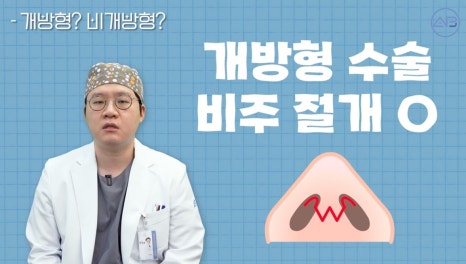
Open surgery involves making incisions on both the upper inside edges of the nostrils and the columella,
then lifting the nasal skin upward to perform the surgery while viewing the inside of the nose.

What many people think of as the nose bone is actually the maxilla, and when this area is too prominent,
osteotomy is performed to narrow it.
There are lateral osteotomy and medial osteotomy.
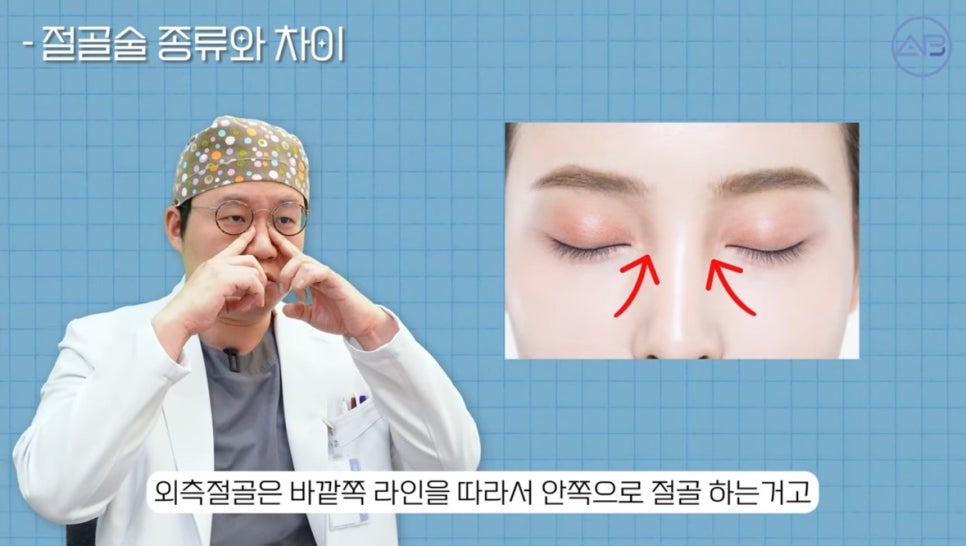
Lateral osteotomy is a method of cutting inward along the outer line,
and medial osteotomy is a method of cutting along the inner line.

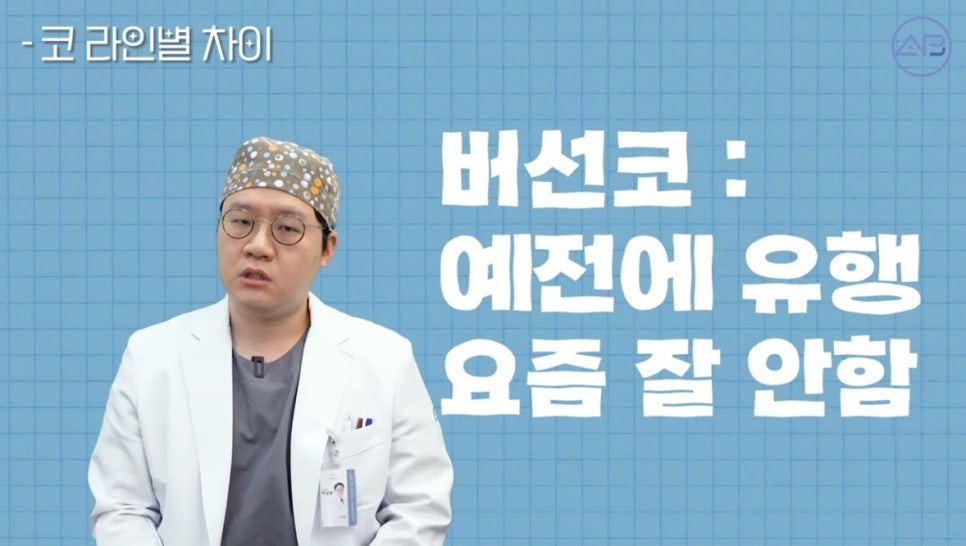
A curved, traditional-looking nose refers to a nose with a curved bridge and a more prominent tip,
with the tip turned upward in a traditional shoe shape.
Because the tip is raised quite a bit, the nose may look slightly upturned and the nostrils may be visible,
so this was a style that used to be very popular in the past.

A half-curved style has a gentle curved line all the way to the tip of the nose,
making it a bit more natural than the curved, traditional-looking nose.
It is a line chosen by people who want a look that is glamorous yet natural.
As an example of a celebrity, Min Hyo-rin's nose is a representative example.

In the straight-half-curved line, the tip of the nose is slightly higher than the bridge, similar to a half-curved style.
If a half-curved style has a slight curve in the bridge,
then the straight-half-curved style has a bridge that is almost straight,
with only the tip lifting slightly.
As a celebrity example, you can think of Shin Se-kyung's nose.

A straight line refers to a line with a natural slope from the bridge to the tip of the nose
and a neat, even shape.
It is also a style that many people are looking for these days, and in the past, some men insisted on a straight line,
while women preferred a straight-half-curved line.
Now, however, both men and women tend to prefer a straight line.
As celebrity examples, you can think of Go Youn-jung's or Winter's nose.



Silicone is mainly used to reinforce the nasal bridge.
In the past, Gore-Tex was also used, and sometimes a mixed material of Gore-Tex and silicone was used,
but these days, silicone is the main material used in most cases.
As for ear cartilage, it is one of the softest cartilages used in nose surgery.
When a natural level of height is desired, it can be used to reinforce the nasal structure, and in most cases it is used
for refining the shape of the nasal tip.
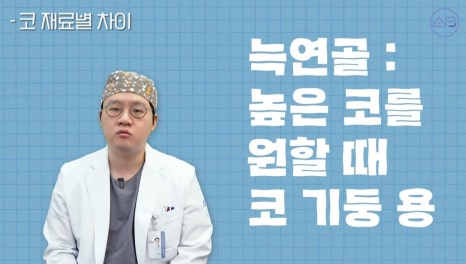

Rib cartilage is one of the firmest materials that can be used in nose surgery.
It is commonly used as material to build the nasal framework when a person wants a higher nose but has small septal cartilage.
Autologous dermis means the patient's own dermis.
If the epidermis, the outermost layer of skin tissue, is removed, only the dermis remains.
Using this material, it can be added to the nasal tip in people with thin skin to reduce the visibility of cartilage or implants.
In some cases, autologous dermis is also added to the nasal bridge itself to create height.