Hello.
I am Dr. Seo Chan-eol of AB Plastic Surgery.
When you are considering your first nose surgery, the word “osteotomy” can feel unfamiliar and somehow frightening.
Also, after going to consultations, some places may say that osteotomy is necessary, while others may say it is not, so you may end up worrying even more.
Today, I will explain what “osteotomy” actually is in nose surgery, who needs it, and what parts it can improve, focusing on the information that may be useful for you.
Simply put, “osteotomy” means “creating a microfracture to adjust the shape or position of a bone.” The idea of creating a fracture may sound scary, but since the nasal bone exists only in about the upper one-third of the nose, the risk is not very high. In nose surgery, this procedure is mainly used to remove a dorsal hump, correct a crooked nose, or correct a wide nasal bone.
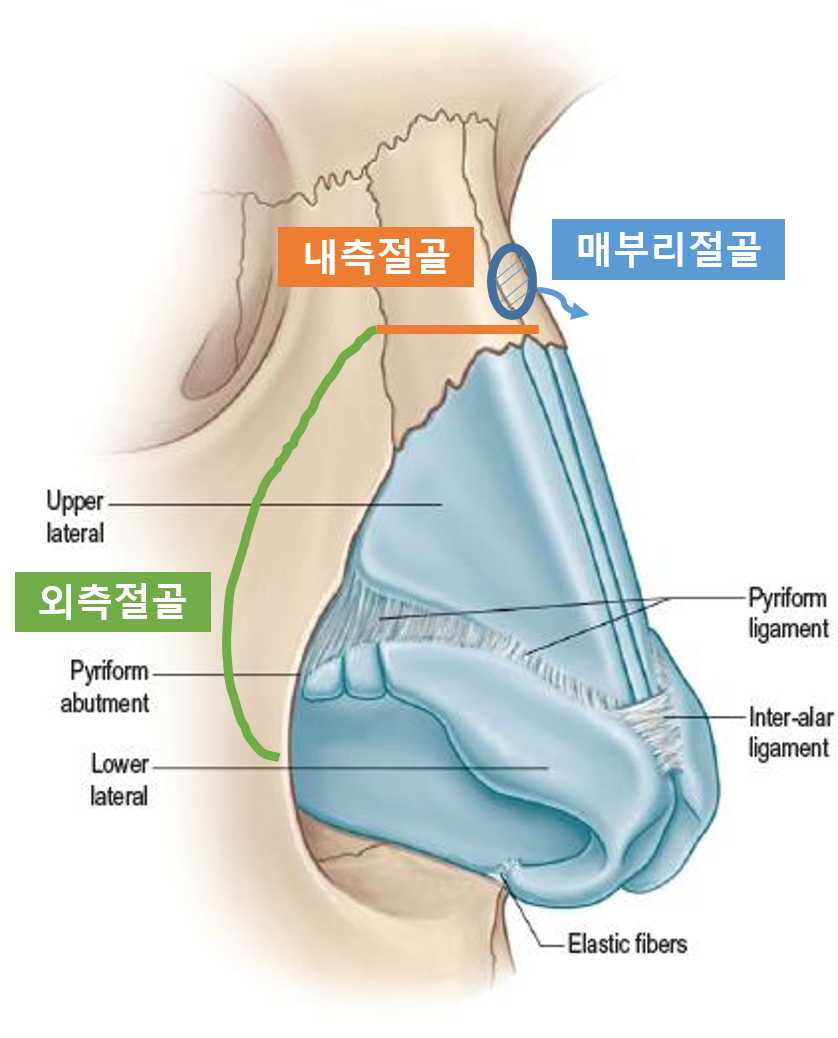
Example of the nasal bone and osteotomy lines
For example, if the nasal bones are spread wide apart, lateral osteotomy can create fine fracture lines at the boundary between the base of the nasal bone and the cheekbone, allowing the angle to be narrowed. It works on the same principle as making a small cut in thick cardboard so it folds more easily. When the angle is narrowed on both sides in this way, the overall width of the nasal base can be reduced, which may make the nose appear narrower from the front.
However, because lateral osteotomy is a procedure that manipulates the nasal bone, as shown in the figure above, it improves a wide upper nose. A wide lower nose, on the other hand, can be narrowed through manipulation of the cartilage or by reducing the width of the nostrils.
Osteotomy procedures include the lateral osteotomy described above, as well as hump osteotomy, medial osteotomy, and intermediate osteotomy. Depending on the goal of correction, several of these methods may be combined, and even within a single technique, there may be multiple osteotomy lines.
There is no single correct answer in cosmetic surgery, but in general, if the upper part of the nose is a major concern because it is too wide, or if it appears spread out compared to the width of the cheekbones, there may be room for improvement through such osteotomy procedures. Ultimately, when performed accurately with the appropriate method, it can improve the overall appearance and contour of the nose. However, depending on the osteotomy method, complications such as mucosal injury or nasal congestion may need to be considered. Also, although the procedure itself is not necessarily more painful, bruising and swelling tend to last longer, so the recovery period should be expected to take longer as well.
Osteotomy requires a skilled technique with an understanding of both nasal breathing function and anatomical structure, so it is best to consult with a specialist in detail to determine which parts can be improved and whether osteotomy is necessary. I hope this was helpful, and I will end here.