Hello, this is AB Plastic Surgery.
Today, we’ll do a revision rhinoplasty review using photos of a patient who had surgery at AB Plastic Surgery.

Today, we’ll look at before-and-after photos of a patient who had nose surgery once 10 years ago.
They said they used an L-shaped silicone implant.

At first, when viewed from the side, the original shape was fairly good.
It had a slightly straight line and then a subtle rise.
The nose already had a good shape and conditions that made it easier to refine,
and in such cases, an L-shaped implant can also produce a good shape. However, the reason this patient wanted
a second surgery was that the nose felt slightly crooked,
and secondly, it felt a little short and small, so they wanted revision rhinoplasty.
Therefore, our plan was to proceed with autologous rib cartilage, and then use silicone.
But this time, instead of an L shape, the silicone would be used from the bridge of the nose to just before the tip,
and the entire nasal tip would be set with autologous rib cartilage.
The end of autologous rib cartilage can feel too strong and firm,
so it is finished with soft cartilage, which is usually ear cartilage.

Sometimes people ask, “Why do you use both autologous rib cartilage and ear cartilage?”
The reason is that they serve different purposes.
Rib cartilage is a little harder, while ear cartilage is soft.
So for the central support axis that needs hardness and strength, rib cartilage is used, and the finishing material is covered with beautiful, soft, rounded
ear cartilage.
So these two elements, along with correcting the crooked look and making the nasal tip a bit more defined, were the key points.
The side view was also good, but we wanted a little more three-dimensionality, and in terms of shape,
we did not want it to be too sharp or too flashy. Since the patient preferred a natural yet moderately elevated,
refined look, we decided to maintain a straight-but-slightly-raised style while giving the nasal tip more support.

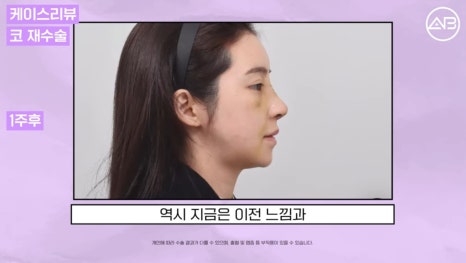
This photo was taken one week after surgery.
There had been a slight curve to the right, but now it is straight.
At one week, the bridge generally looks thick and swollen, and bruising is clearly visible.
These issues improve a lot over time. From one week to two weeks, the swelling goes down significantly.
So the swelling in the bridge, the nasal bridge, and the glabella area will gradually subside, and the nasal tip will become slimmer again.
It can take about 3 to 5 months, and the more the bulbous tip is corrected, the more gradually it improves.
The bridge area is very swollen at one week, but by two weeks it is much better, and by about one month it can be considered almost finished.
From that point, over 3 to 5 months, it naturally becomes a little slimmer,
but changes in the nasal tip need to be viewed over a longer period.

Photos taken after surgery may differ from reality due to the shooting environment, lighting, makeup, and other factors.
Results vary by individual, so please confirm the procedure result that is right for you through a detailed consultation.
From the side, the overall size already looks better.
At this stage, it may look somewhat exaggerated, but the swelling will go down more quickly from here.
Bruising and swelling improve a lot by around two weeks, and by three weeks they can be considered almost gone.
As for washing your face, you can do so after the one-week mark once the splint and stitches have been removed, so daily life is fairly manageable.
So the first week is the hardest.
From the side, compared to the previous look, the glabella area feels much more pronounced and larger,
but this is just part of the process, and the important thing is whether the flow is appropriate.
The shape at two weeks is a little more important than the shape at one week.
 Photos taken after surgery may differ from reality due to the shooting environment, lighting, makeup, and other factors.
Results vary by individual, so please confirm the procedure result that is right for you through a detailed consultation.
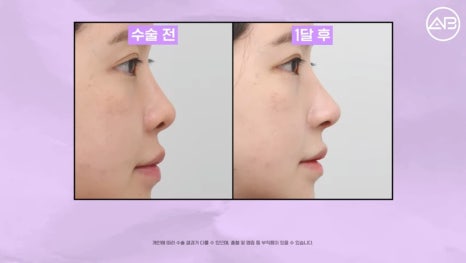
This is the one-month photo.
Compared with the one-week photo, the volume of the bridge has become much slimmer, and the feeling of heaviness in the glabella area has improved a lot.
For the nasal tip, ear cartilage was used to finish it with a slightly rounded shape so that it would not look too pointed.

 Photos taken after surgery may differ from reality due to the shooting environment, lighting, makeup, and other factors.
Results vary by individual, so please confirm the procedure result that is right for you through a detailed consultation.
From the side, the glabella area is kept natural while the emphasis is placed mainly on the nasal tip,
with the end slightly raised at a more defined angle.
The nasolabial angle has a natural projection, and overall, we can conclude that it came out nicely and elegantly, just as planned.
Today, we looked at and explained the revision rhinoplasty of a patient who had surgery at AB Plastic Surgery.
If you have any further questions, please contact the clinic. :)