Hello. This is AB Plastic Surgery!
Today, let’s take a look at severe ptosis together.
Compared with typical ptosis, this is a case where the strength to open the eyes is weaker,
and in most cases, it is due to underdevelopment of the levator muscle that lifts the eyelid congenitally.
Characteristics of Severe Ptosis
Patients with severe ptosis often have almost no strength to open their eyes, so they frequently use their forehead muscles to open them.
At first glance, it may look as though they can open their eyes well, but when the forehead is pressed down, there are many cases where they actually can barely open their eyes.
In such cases, there is usually a history of surgery in childhood, but recurrence during adulthood is also common.
This is because the muscle that lifts the eyelid itself is congenitally weak.
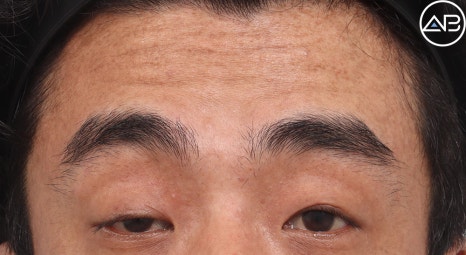
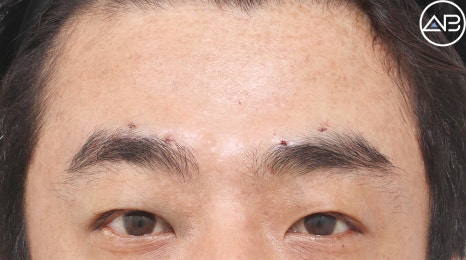
Postoperative photos may differ from reality due to the shooting environment, lighting, makeup, and other factors.
Results vary from person to person, and please confirm the procedure result suitable for you through an accurate consultation.
Is simple eyelid correction surgery not enough?!
Eyelid correction surgery strengthens the muscles used to open the eyes,
but in cases where the muscle itself is weak, such as severe ptosis, it may not produce sufficient results.
So a surgery that lifts the eyelid by borrowing the strength of the forehead muscles is needed.
Surgical Methods Using the Forehead Muscles
There are two representative surgical methods that use the forehead muscles.
◎ Forehead Muscle Transfer Surgery
This method finds the forehead muscle and connects it to the eyelid, so an incision in the forehead is necessary,
and scarring and swelling may last for a long time.
The recovery period is long, and the period during which you may be unable to close your eyes immediately after surgery may also last relatively long.
◎ Forehead Sling Surgery (Sub-brow Incision Method)
This method connects the forehead muscle to the eyelid through a small incision, so the incision range is small,
recovery is fast, and swelling is relatively minor.
For that reason, this method is often preferred these days.
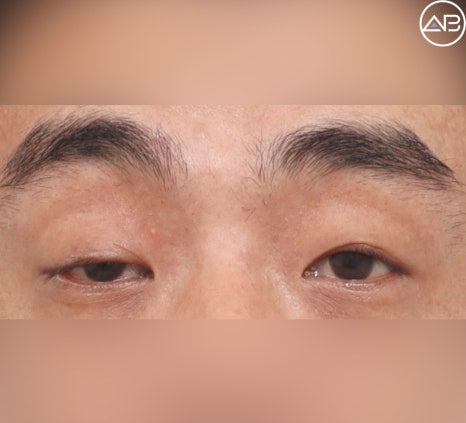
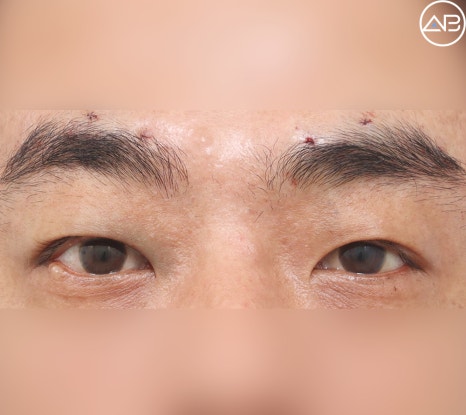
Postoperative photos may differ from reality due to the shooting environment, lighting, makeup, and other factors.
Results vary from person to person, and please confirm the procedure result suitable for you through an accurate consultation.
Postoperative care is also important!
People with congenital ptosis often fall asleep without being able to fully close their eyes,
and after surgery, this symptom may become more severe.
Therefore, wearing an eye patch and using ophthalmic ointment after surgery are essential.
They are very important for preventing dry eyes and corneal damage.
So far, we have looked at severe ptosis together—what did you think?
I hope this was an informative time, and I’ll be back with more useful content in the next post^^