Hello. This is AB Plastic Surgery.
When drooping eyelids make the eyes look smaller and make it difficult to ensure a clear field of vision,
the first surgery many people think of is “eye opening correction.”
Eye opening correction is a procedure that shortens or strengthens the muscles that open the eyes so the eyes appear more clearly opened.
However, eye opening correction is not effective for all cases of eyelid drooping.
In particular, congenital severe ptosis is a representative case that cannot be resolved with eye opening correction.
In this post, I will explain in detail the causes and symptoms of congenital severe ptosis,
and why severe ptosis is not a case for eye opening correction.
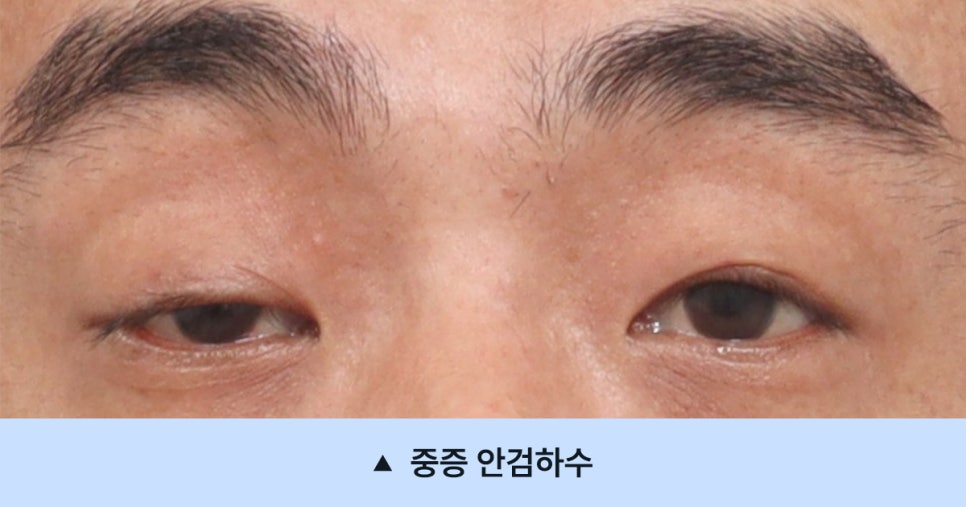
Q. What is congenital severe ptosis that cannot be improved with eye opening correction?
Congenital severe ptosis refers to a condition in which the upper eyelid is severely drooped from birth, covering the pupil and obstructing the field of vision.
In general, if the eyelid is lower than normal by more than 4 mm, it is classified as severe,
and in most cases, the muscle that opens the eye from birth, that is, the muscle that lifts the upper eyelid, has little or no function or is very weak.
As a result, the eyes cannot be opened properly, and the forehead and eyebrow muscles are overused to compensate.
This is also why congenital severe ptosis is a reason not to have eye opening correction, which is a surgery that uses the muscle that opens the eyes.
Even if it looks like the eyes are open from the outside, in many cases the forehead muscles are actually forcing the eyelids upward.
This habit causes the eyebrows to rise excessively, deep forehead wrinkles to form, and the eyelids to become stretched and sunken.
Q. Why should severe ptosis not be treated with eye opening correction?
Eye opening correction is performed on the premise that the muscle that opens the eyes can function to some extent.
In congenital severe ptosis, where the muscle does not function at all or is very weak, the desired effect is difficult to achieve even with eye opening correction,
and side effects may occur instead. In particular, people with weak eye-opening muscles often have weak eye-closing muscles as well.
Because of this, the eyes may not close fully even during sleep, making the cornea more likely to be exposed to the outside.
If the muscle is strongly fixed through eye opening correction at this time, closing the eyes becomes even more difficult, which can lead to problems such as lagophthalmos.
This is why severe ptosis is not a case for eye opening correction, and in cases of severe ptosis,
a surgical method that addresses the more fundamental cause is needed rather than eye opening correction.
Q. If severe ptosis is a reason not to have eye opening correction, how should it be improved?
The reason congenital severe ptosis should not be treated with eye opening correction is that the development of the muscles that open the eyes is insufficient,
so sufficient results cannot be expected from standard eye opening correction, and there is also a risk of side effects such as lagophthalmos.
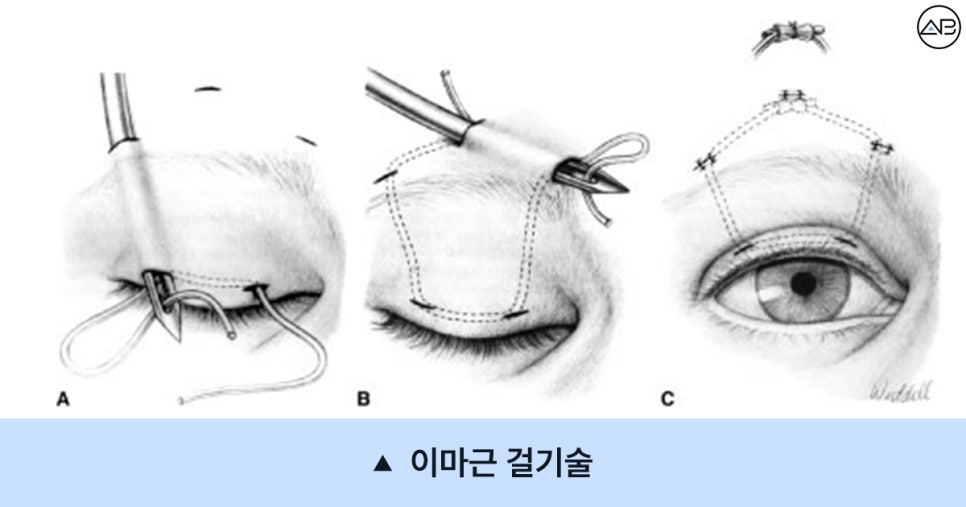
Therefore, a procedure that uses the forehead muscles to supplement the ability to open the eyes is needed, and there are several methods for this.
At this time, the most effective and stable method is the “frontalis suspension procedure,” which takes into account the movement of the eyes, eyebrows, and forehead together.
The frontalis suspension procedure connects the eyelid to the forehead muscle through a small incision,
and uses the strength of the forehead muscle to lift the eyelid and open the eyes.
Because this surgical method opens the eyes by using the strength of the forehead muscles rather than the eyebrows,
it is very effective for congenital severe ptosis.
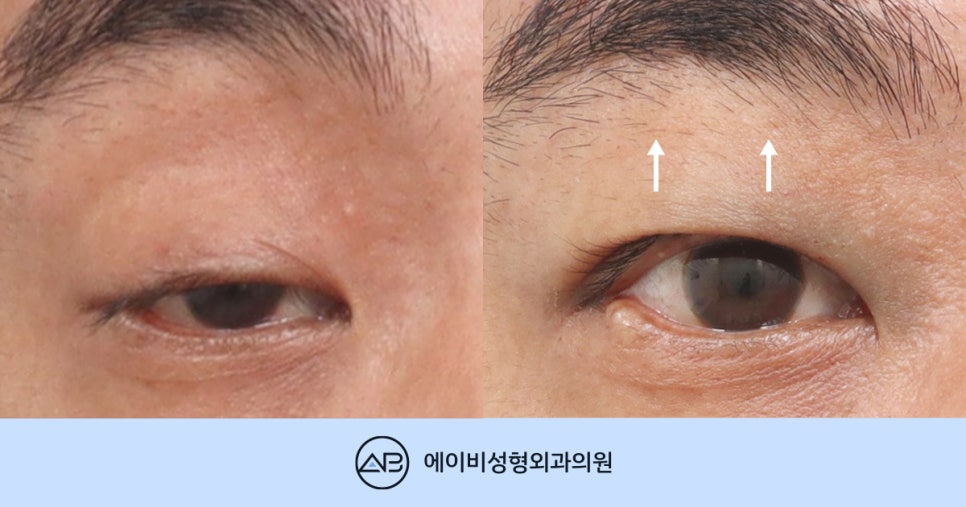
The frontalis suspension procedure also improves sunken upper eyelids, sagging skin, and forehead wrinkles.
√ Real case of severe ptosis surgery
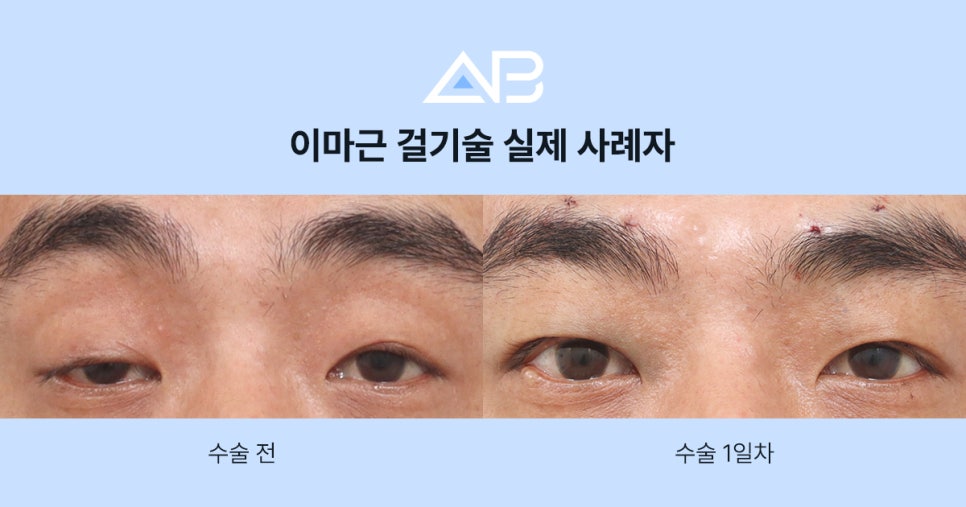
In addition, before surgery, because the eyelids could not keep up with the excessively raised eyebrows,
the distance between the eyebrows and the eyes became wider, and the eyelid skin stretched, causing a sunken appearance.
Through the frontalis suspension procedure, these changes return to normal, and the amount of iris exposure also
increases naturally, creating a clearer and more lively eye shape.
Lastly, it has the advantages of leaving little scarring and allowing a quick recovery, which leads to high patient satisfaction.
Severe ptosis is not simply a cosmetic issue, but a medical condition that directly affects visual field 확보 and eye function.
Rather than trying to solve it with simple eye opening correction, it is important to pursue a fundamental functional improvement through a customized surgical plan based on an accurate diagnosis.
Today, I explained congenital severe ptosis, why severe ptosis should not be treated with eye opening correction,
and the frontalis suspension procedure that can effectively address severe ptosis.
However, even in cases of severe ptosis, there may be situations where eye opening correction is needed,
so it is advisable to receive 충분한 상담 from a plastic surgery specialist with extensive clinical experience and proceed with the surgery that is best suited to you.
I hope this answer was helpful.
If you have any other questions, please leave them in the comments and I will answer them.
Thank you.