
Hello. This is AB Plastic Surgery.
As time passes after rhinoplasty, people often hear comments like, “The tip of the nose has lowered again” or “It has become blunter.”
Especially the nasal tip is one of the areas with the biggest variation in satisfaction after surgery,
and when the shape changes over time or the results are not as expected, many people consider nasal tip revision surgery.
Today, I will explain in detail from a specialist’s perspective the cases in which nasal tip revision surgery is needed, as well as the swelling changes and recovery process often mentioned in actual patient reviews.
- When is nasal tip revision surgery needed?
After bridge and nasal tip surgery, many people have complaints such as, “Over time, the nasal tip has lowered, become blunter, or seems to have drooped.”
This happens when the nasal tip shape changes or differs from the expected result depending on various factors such as tissue healing after the first surgery, the cartilage support structure, and skin characteristics.
[Typical Types of Nasal Tip Revision Concerns]
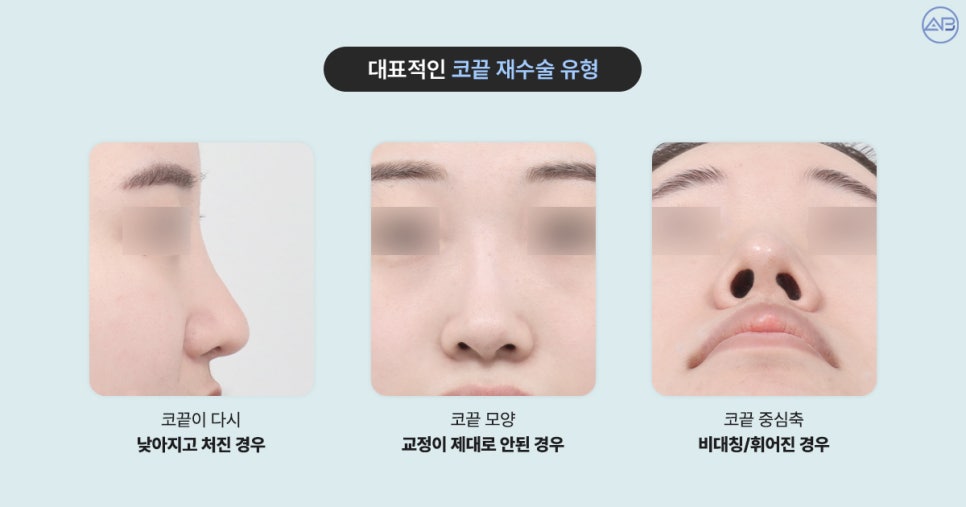
AB Plastic Surgery types of nasal tip revision
1️⃣ The nasal tip has lowered again
This occurs when the cartilage support structure is insufficient, or when support has weakened over time due to cartilage absorption or capsular contraction.
2️⃣ A blunt or spread-out shape
This is when the nasal tip contour has become unclear due to inefficient cartilage arrangement or skin thickness.
3️⃣ Nasal tip asymmetry or position changes
There may be a possibility that the center axis of the nasal tip has shifted due to unstable cartilage fixation, adhesion, or scar formation after inflammation.
These problems go beyond simply being dissatisfied with the appearance; they require precise judgment regarding the reconstruction of the anatomical design and the condition of the tissues.
So, when can nasal tip revision surgery be performed?
In general, it is safer to consider nasal tip revision surgery at least 6 months after the first surgery.
This is because it is the period when swelling of the skin and soft tissues has subsided, and internal adhesions have stabilized to some extent, making more accurate diagnosis and redesign possible.
However, in the following situations, revision surgery may be needed earlier than usual.
-
When infection or contracture has occurred and structural collapse is in progress
-
When implants or autologous cartilage have shifted significantly or protruded
-
When pain, redness, or pressure persists due to an inflammatory response
As such, the general recommended timing for nasal tip revision surgery is 6 to 12 months after surgery,
and the exact timing for surgery may vary depending on the patient’s skin thickness, tissue recovery speed, cartilage condition, and other factors.
It is important to receive an individual diagnosis through consultation with an experienced specialist.
- The most common revision among rhinoplasty procedures: nasal tip revision
Among all rhinoplasty revision surgeries, nasal tip revision is the most common.
The nasal tip is an area that requires both delicate shape changes and long-term stability, and because the structure must be redesigned on top of already operated tissue, delicate judgment and highly advanced technique are required.
[Key Considerations for Nasal Tip Revision]
🔹 Tissue condition and degree of adhesion
If the tissue has adhered or scarring remains after the first surgery, the condition must be accurately identified and the adhesions released for a stable operation.
🔹 Reconstructing the support structure
A lowered or drooping nasal tip may indicate that the support structure has collapsed.
It is essential to redesign the basic framework from the ground up, including repositioning the columellar strut and rearranging the cartilage, to stably set the position and angle of the nasal tip.
🔹 Cartilage and material selection
The support strength and shape retention depend on which cartilage is used, such as septal cartilage, ear cartilage, or rib cartilage.
In particular, when the forehead tissue is damaged, it is very important to carefully assess the condition and characteristics of the cartilage and choose the appropriate material.
Only when precise fixation skills from the medical team are added here can the nasal tip maintain a stable shape without drooping again over time.
In conclusion, nasal tip revision surgery is a procedure that requires accurately analyzing the tissue changes and structure caused by the previous surgery and then precisely redesigning it on that basis.
Therefore, consultation with a specialist whose experience and technical skill have been proven is more important than anything else.
- Nasal tip revision surgery: how do swelling changes and recovery proceed?
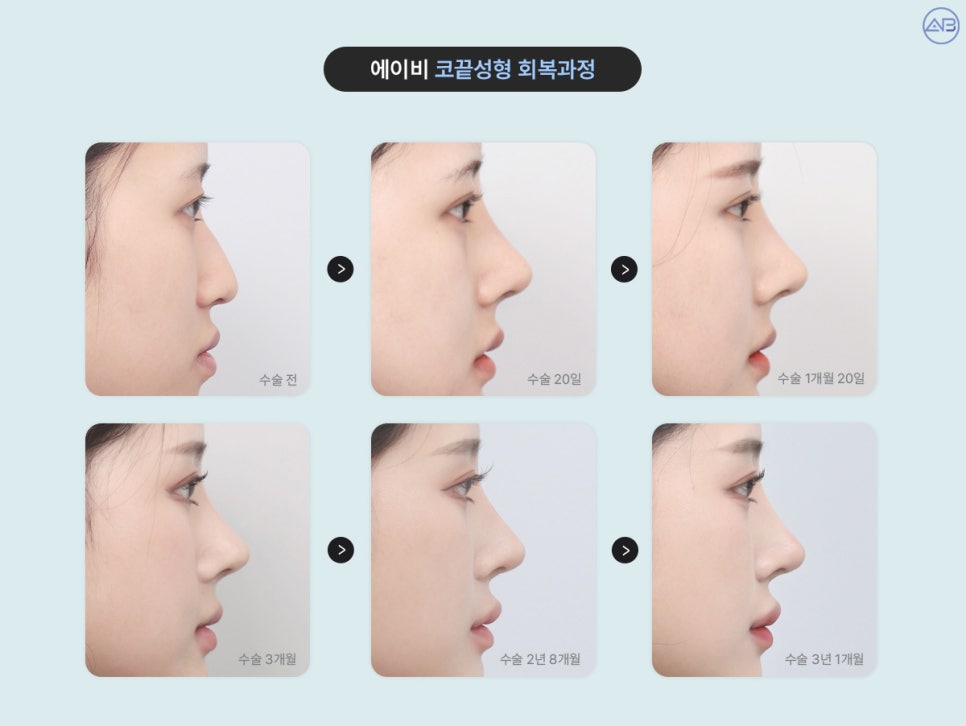
AB Plastic Surgery recovery process before and after nasal tip surgery
ℹ️ How long is the recovery period?
Recovery speed may vary depending on an individual’s skin type, whether cartilage is used, and the extent of surgery,
but generally, the first swelling reduction takes about 2 to 3 weeks, and it takes about 6 to 12 months for the overall shape to settle.
ℹ️ Why does swelling in the nasal tip last longer?
Nasal tip swelling is one of the most frequently mentioned factors in actual nasal tip revision reviews.
Although revision surgery does not necessarily mean a wider dissection area, tissue irritation can increase when adhesion release, cartilage rearrangement, or refixation is needed.
In particular, if the soft tissue is thin or the skin is thick, swelling subsides slowly, and a temporary firm feeling may remain.
ℹ️ How is swelling managed?
Because nasal tip swelling tends to last longer, interest in swelling management is also high.
Immediately after surgery, in addition to basic care such as cold compresses and avoiding excessive movement, regular follow-up care, such as Smartlux at the clinic, can help recovery. Swelling can vary greatly depending on an individual’s skin thickness, soft tissue condition, and extent of surgery, but consistent aftercare can positively affect recovery speed and satisfaction with the results.
If you have more questions about nasal tip revision surgery, you can receive more detailed consultation by calling 02-512-1288 or contacting AB Plastic Surgery via KakaoTalk.