
Hello, this is AB Plastic Surgery.
Since the nose is located at the center of the face, even a small change can have a major impact on the overall impression.
After the first surgery, many people consider revision rhinoplasty due to issues such as tip deformity, contracture, or imbalance in the columellar line.
"Revision rhinoplasty using autologous rib cartilage" is not simply a matter of readjusting the height.
It is a surgery that must be performed while comprehensively considering the condition of the existing tissue and skin, skin thickness, whether contracture is present, and the balance of the columellar line.
Autologous rib cartilage is advantageous for securing sufficient support,
and it has the characteristic of allowing a more stable design for the balance between the nasal tip and the columellar line.
Because it can stably reinforce a weakened support structure
and help create a natural nasal line, it is often considered in revision cases.
AB takes only as much as is needed, and removes it safely.
One of the important steps in revision rhinoplasty using rib cartilage is the cartilage harvesting stage.
Because the amount and strength of the cartilage needed, as well as the direction of use, must all be considered,
a precise harvesting process tailored to the individual’s condition is important.
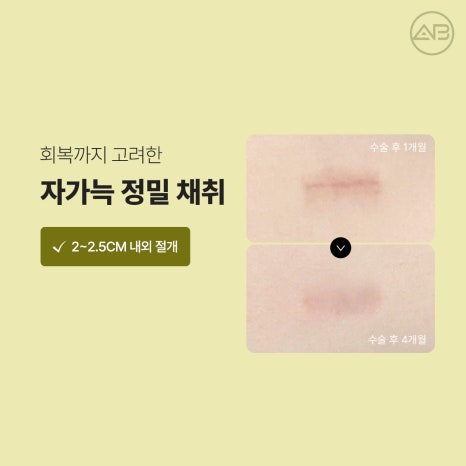
Taking scar burden into account as well, we plan the incision line according to skin type and body shape
and take an approach aimed at reducing scarring.
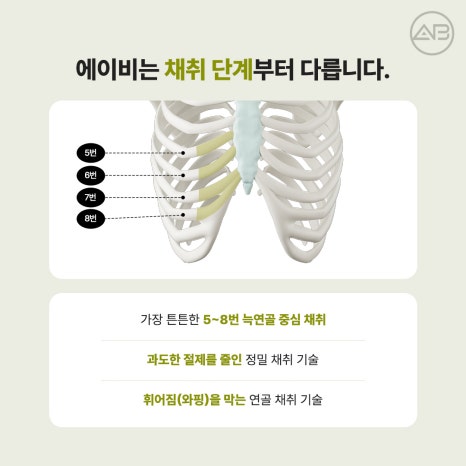
Focused harvesting from the strongest 5th to 8th rib cartilage
Precise harvesting techniques that reduce excessive removal
Cartilage harvesting techniques that prevent warping
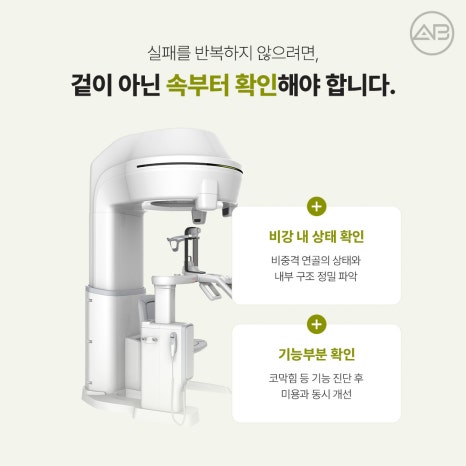
Revision rhinoplasty using autologous rib cartilage begins with precise diagnosis.
It is important to also check the inside of the nasal cavity and functional aspects.
In cases requiring delicate correction, such as revision rhinoplasty for the columellar line or columellar line correction,
the stability of the internal support structure must also be considered in order to expect both a natural line and functional balance.
The timing of revision rhinoplasty should also be determined not simply by swelling recovery,
but after sufficiently confirming the recovery status of the internal tissue and function.
Autologous rib cartilage rhinoplasty rib cartilage rhinoplasty revision rhinoplasty timing columellar line revision rhinoplasty columellar line correction
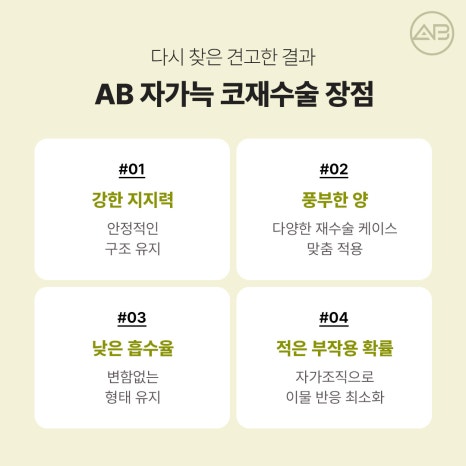
What are the advantages of AB Plastic Surgery’s revision rhinoplasty using autologous rib cartilage?
-
Strong support, stable structural maintenance
-
Ample quantity, customizable application for various revision cases
-
Low absorption rate, maintaining shape without change
-
Lower chance of side effects, minimizing foreign-body reactions with autologous tissue
Checkpoints for AB Plastic Surgery’s revision rhinoplasty using autologous rib cartilage
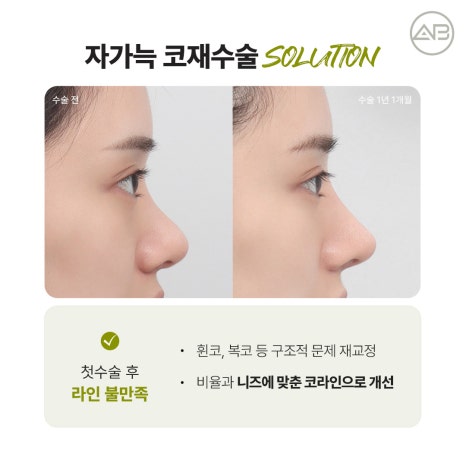
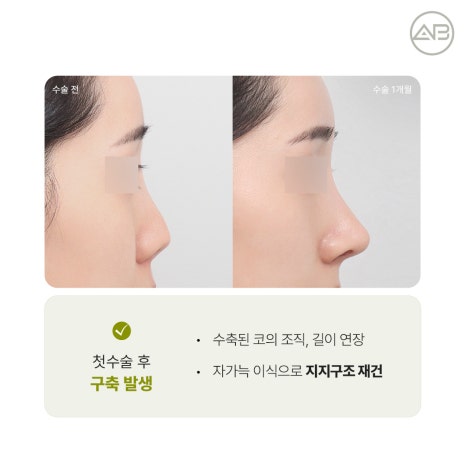
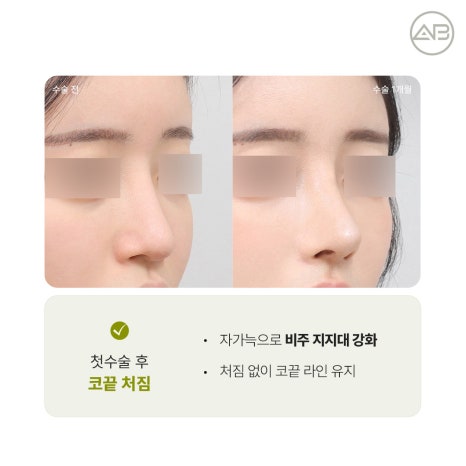
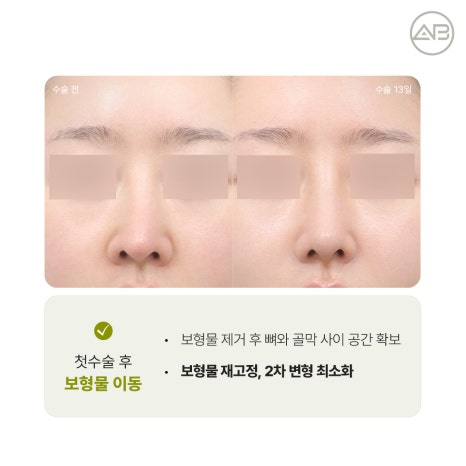
Unsatisfied with the line after the first surgery
Re-correction of structural issues such as a crooked nose or bulbous nose
Improvement to a nose line tailored to proportions and needs
Contracture after the first surgery
Correcting contracted nasal tissue and extending length
Rebuilding the support structure with autologous rib grafting
Tip drooping after the first surgery
Strengthening the columellar support with autologous rib cartilage
Maintaining the tip line without drooping
Implant movement after the first surgery
Removing the implant and securing space between the bone and periosteum
Re-fixing the implant and minimizing secondary deformity
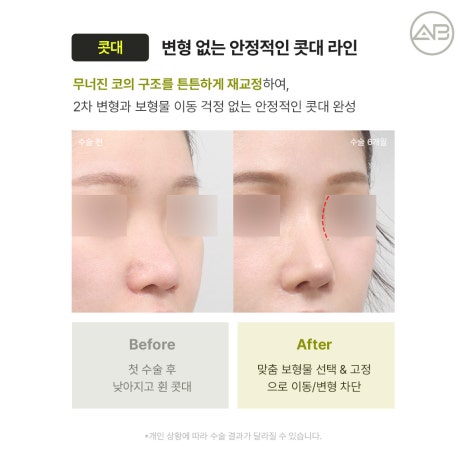
Bridge - a stable bridge line with no deformation
By strongly correcting the collapsed nasal structure,
create a stable bridge with no concern about secondary deformity or implant movement
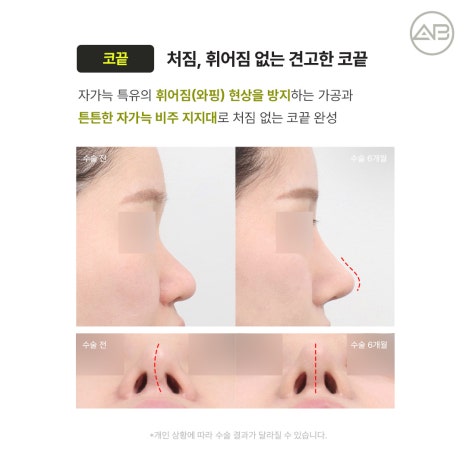
Tip - a firm tip with no drooping or bending
Prevent warping, a phenomenon characteristic of autologous rib cartilage,
and create a tip with no drooping using a sturdy autologous rib columellar support
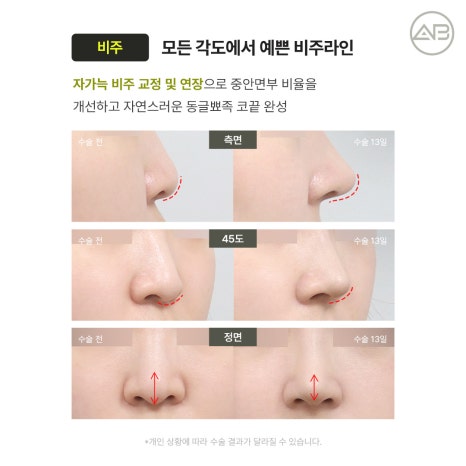
Columella - a beautiful columellar line from every angle
By correcting and lengthening the columella with autologous rib cartilage,
improve the midface proportion and create a natural, rounded, yet refined tip
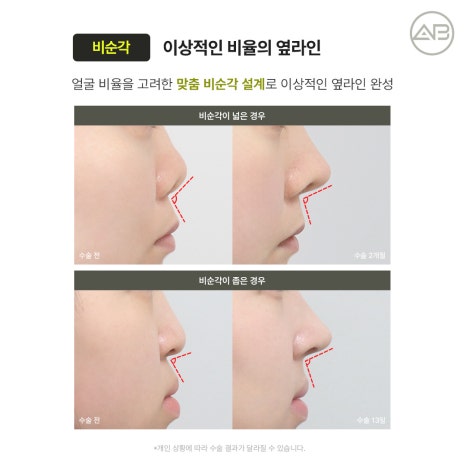
Nasolabial angle - a side profile with ideal proportions
With a customized nasolabial angle design that considers facial proportions,
create an ideal side profile

The timing for revision rhinoplasty using autologous rib cartilage is generally within about 1 to 3 months after treating inflammation if inflammation and contracture occur.
For cases where revision is desired due to dissatisfaction with shape or asymmetry,
we guide patients to about 6 to 12 months later, after swelling and tissue have stabilized.
In particular, when delicate line correction is needed, such as with revision rhinoplasty for the columellar line or columellar line correction,
it is important to check the skin condition, whether adhesions exist inside the nasal cavity,
and the stability of the support structure together.
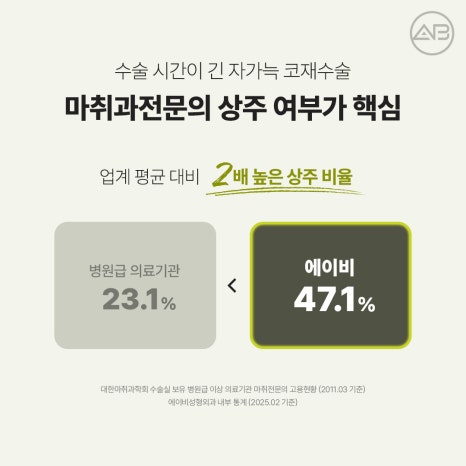
Be sure to check whether an anesthesiology specialist is on site!
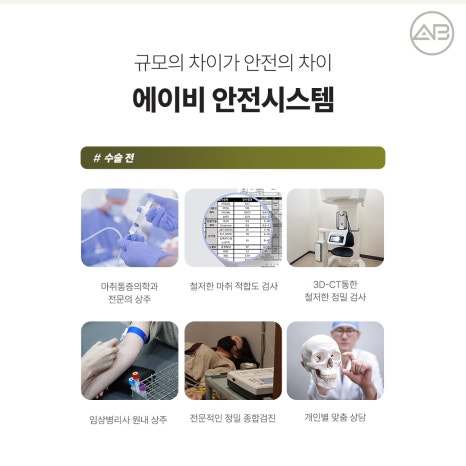
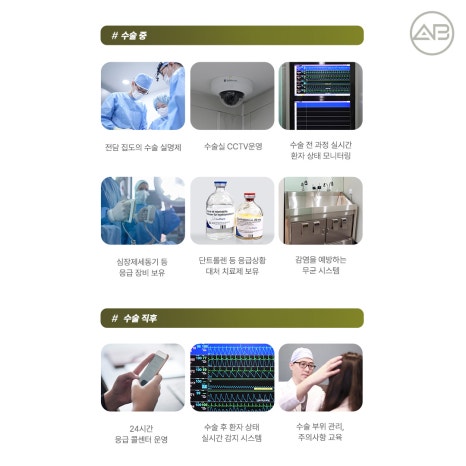
AB Plastic Surgery focuses on a more systematic surgical environment,
with an on-site rate twice as high as the industry average.
Revision rhinoplasty often involves longer surgical times and a higher degree of difficulty,
so it is important to check not only the medical team’s experience but also the safety system.
If you would like to know more about revision rhinoplasty using autologous rib cartilage, including revision rhinoplasty for the columellar line,
please contact us at 02-512-1288 or via KakaoTalk at AB Plastic Surgery for a more detailed consultation.
revision rhinoplasty timing rib cartilage rhinoplasty columellar line correction revision rhinoplasty for the columellar line