
Hello, this is AB Plastic Surgery!
Today, we will look at the different types of eye revision surgery, including before-and-after results of eye revision surgery, revision surgery for uneven eyes, and revision eyelid surgery.
Some people become concerned when, over time after double eyelid surgery, the crease loosens,
when the balance between the two eyes is uneven, or when the result differs from what they expected.
The types of eye revision surgery are very diverse, and the applicable method may vary depending on the condition of the eyes and the cause.
A more careful approach is needed than with the first surgery, and more people are considering revision eyelid surgery.
Let us take a look through actual before-and-after cases of eye revision surgery.
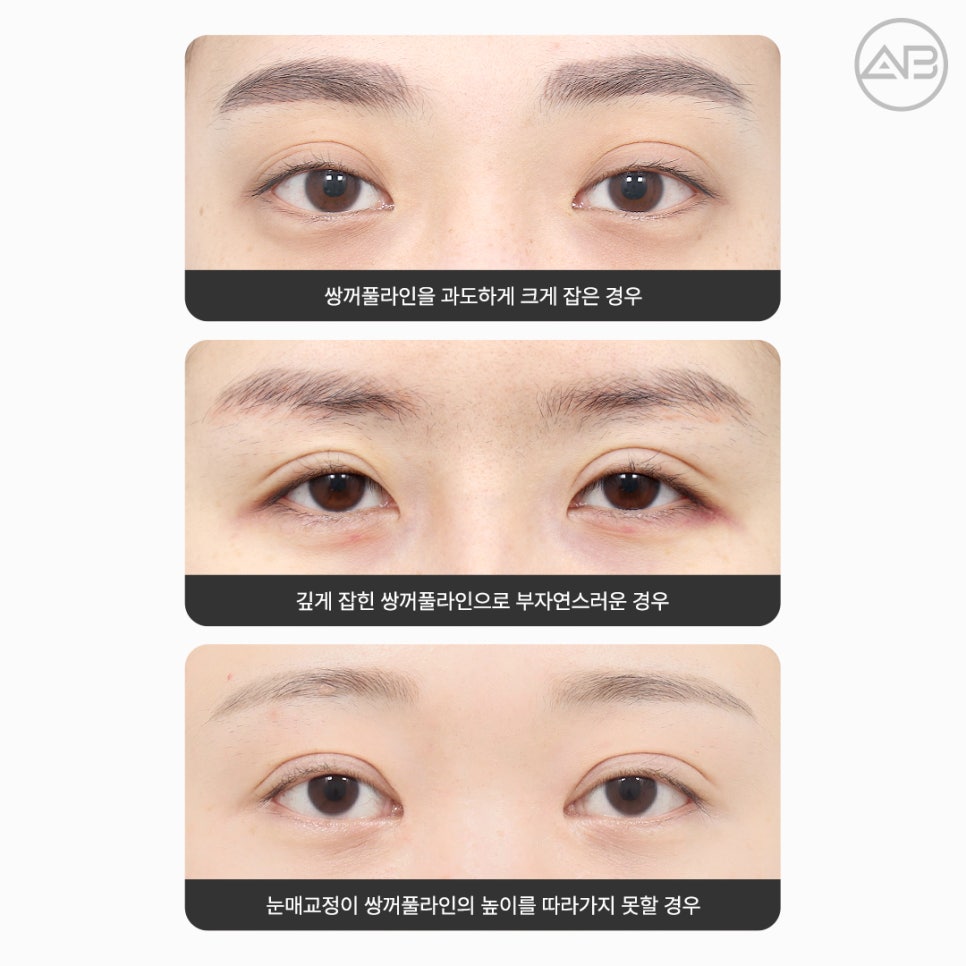
When is double eyelid revision surgery needed?
Revision eyelid surgery may be considered when the result after the first surgery differs from expectations or changes occur over time.
However, not all revision surgeries are performed using the same method. The approach may vary depending on the current condition of the eyes, the cause, and the type of eye revision surgery.
☑️When the double eyelid crease is made too high☑️
The crease may be positioned excessively high in relation to the person’s eyes, making them look unnatural or causing a heavy, uncomfortable feeling.
An overly prominent double eyelid crease may also create a burdensome appearance.
☑️When the double eyelid crease is set too deeply and looks unnatural☑️
When the crease is fixed too deeply, the eyes may have a strongly artificial appearance even when they are open.
☑️When the correction of the eye shape does not match the height of the double eyelid crease☑️
If the opening strength of the eyes has not improved, the crease and the eye shape may not be in harmony.
The eyes may look sleepy, or only the crease may stand out, resulting in uneven eyes.
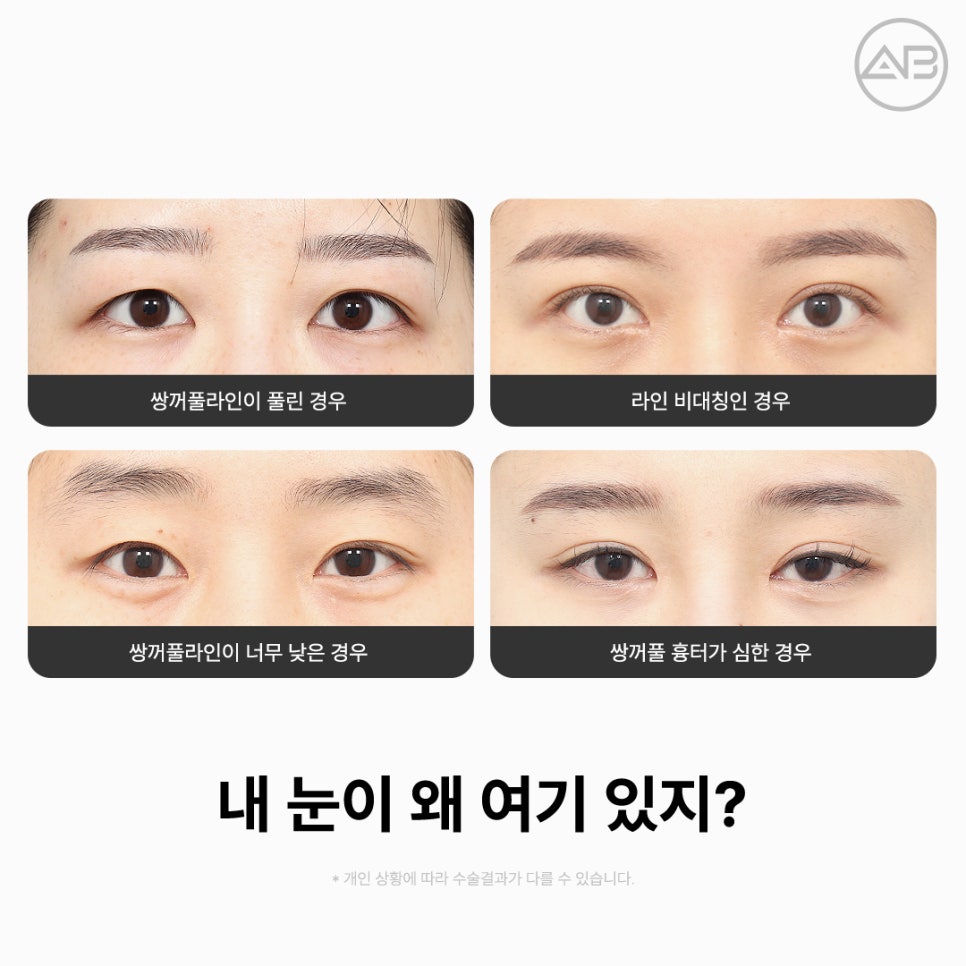 ☑️When the double eyelid crease has loosened☑️
The crease may gradually become thinner over time, or loosen on one or both sides.
☑️When the crease is asymmetrical☑️
This can be affected not only by a difference in height, but also by differences in the strength used to open the eyes and by sagging skin.
These are cases that may require revision surgery for uneven eyes.
☑️When the double eyelid crease is too low☑️
The crease may descend when there is sagging skin or when it has been weakly fixed.
☑️When double eyelid scarring is severe☑️
Revision eyelid surgery may be needed when the area around the crease remains uneven
or when noticeable scars remain.
As you can see, the types of eye revision surgery do not simply mean recreating the double eyelid crease.
Whether the crease is high or low, loose or asymmetrical, or there are issues with scarring or eye-shape correction,
the double eyelid revision surgery plan may vary depending on the various underlying causes.
Therefore, while it is important to check actual before-and-after results of eye revision surgery,
it is also important to choose a double eyelid revision method suited to the current condition.

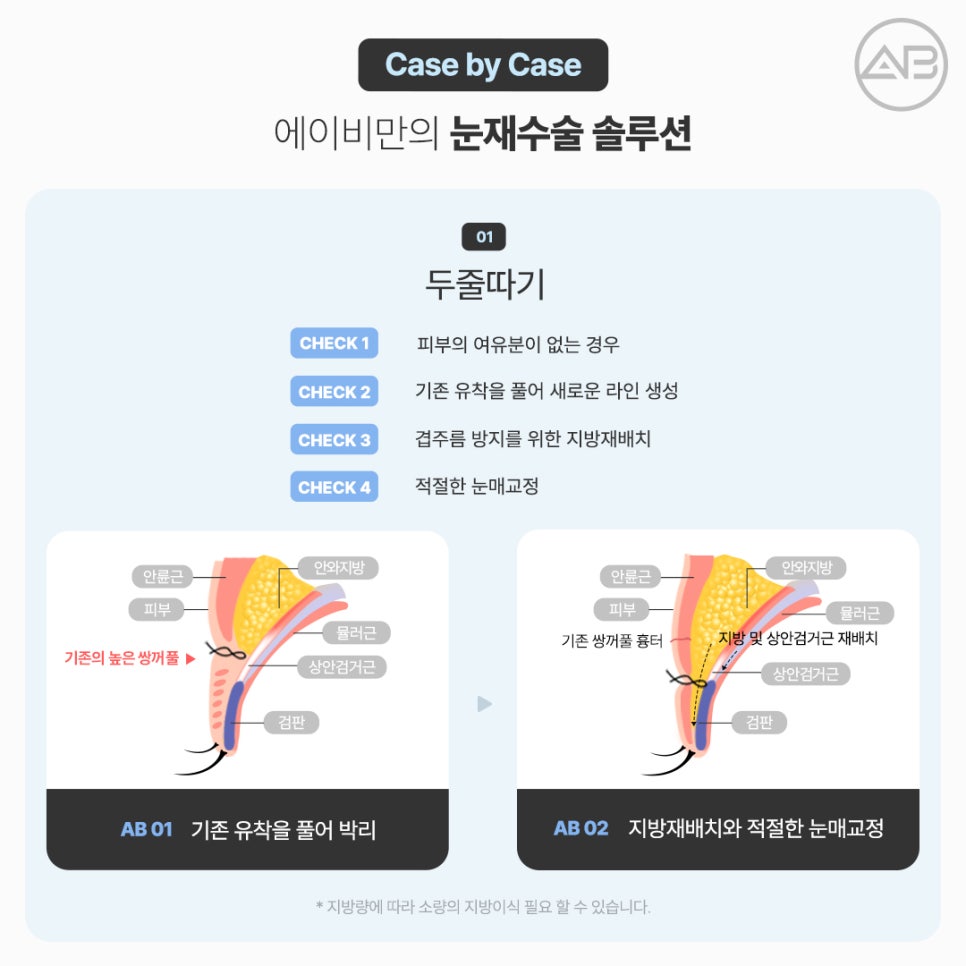
Let’s explore the various types of eye revision surgery!
- Double-Crease Technique
-
For cases with insufficient excess skin
-
Releasing the existing adhesions to create a new crease
-
Fat repositioning to prevent multiple creases
-
Appropriate correction of the eye shape
When the existing double eyelid crease has been created too high or too deeply and looks unnatural,
the existing adhesions can be carefully dissected and corrected into a natural crease
for a softer appearance.
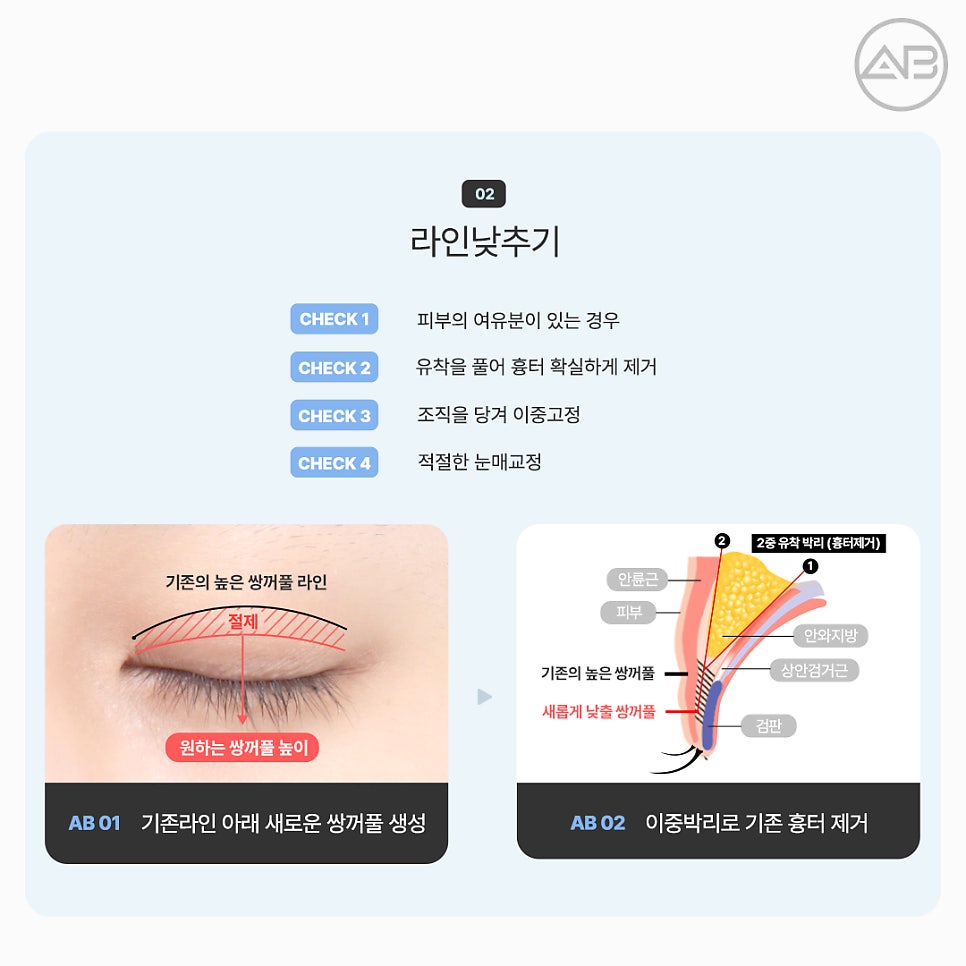
- Lowering the Crease
-
For cases with sufficient excess skin
-
Releasing the adhesions and thoroughly removing scar tissue
-
Pulling the tissue and securing it with double fixation
-
Appropriate correction of the eye shape
When an excessively high double eyelid crease creates a heavy or artificial appearance,
the crease is adjusted to a height appropriate for the individual, taking the current condition of the eyes and the available excess skin into consideration.

- Raising the Crease
-
For cases where the crease is unsatisfactory
-
Removing existing scar tissue
-
Correcting loosening, asymmetry, and uneven eyes
-
Firmly securing a loosened crease
When the crease is too low, appears loose, or is asymmetrical between the two sides,
double eyelid revision surgery is performed to create a defined yet natural crease while considering harmony with the eye shape.
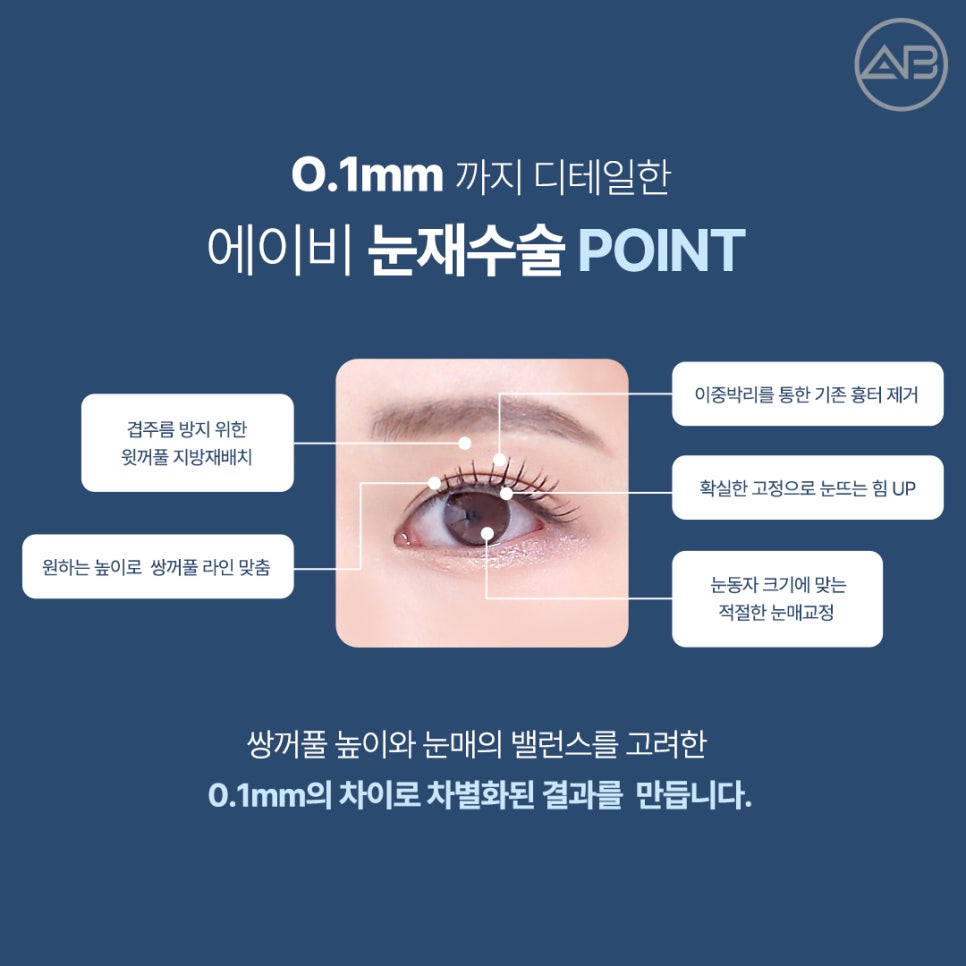
The balance between the double eyelid height and the eye shape was taken into consideration.
Double eyelid revision surgery can produce differentiated results with a difference of just 0.1 mm.
Existing scar tissue is removed through double-layer dissection,
and the surgery uses firm fixation to strengthen the force used to open the eyes.
Rather than simply making the eyes look larger,
appropriate correction of the eye shape suited to the size of the pupils is performed as well.
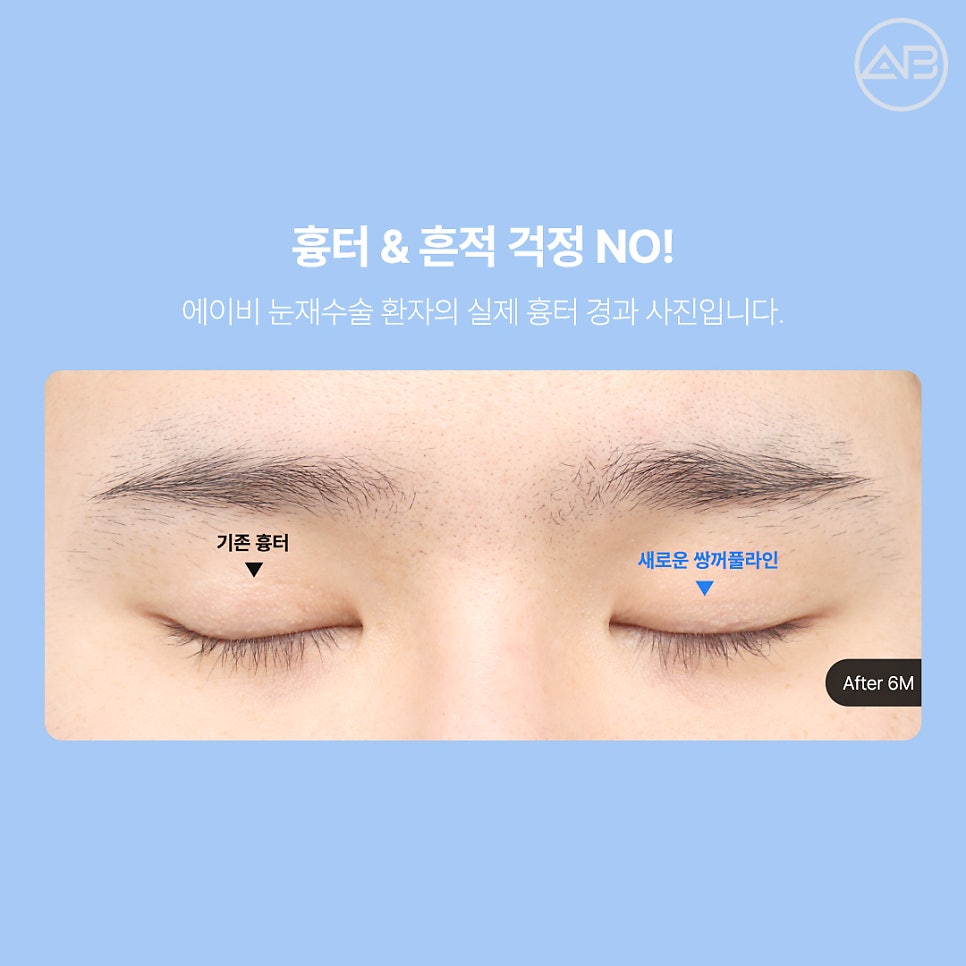
Scarring is also an important concern for many people undergoing surgery.
Compared with the previously blurred crease,
the scars after eye revision surgery using the double-crease technique were not noticeable in the before-and-after results.
Achieve successful double eyelid revision surgery together with AB Plastic Surgery!