
Hello. This is Chang Dermatology Clinic, opening a window of confidence through dermatology.
Every winter, the cold and dry air causes skin moisture to evaporate quickly, making the skin feel especially dull and rough.
Indoors, heating devices make the air hot and dry, so the skin loses moisture while also being exposed to irritation from temperature differences.
This is exactly why so many people visit a dermatology clinic in winter because their skin barrier has been damaged.
In fact, no matter how diligently you care for your skin at home, it is not easy to overcome dryness and roughness with simple moisturization alone.
Today, we will introduce in detail the winter skin care method used at Sculptra Dermatology, which directly encourages collagen regeneration within the skin.

Why is collagen regeneration important?
Collagen makes up 70% to 90% of the dermis and is a protein that plays a key role in keeping the skin firm.
It begins to decrease from the 20s, and as we age, elasticity gradually declines, becoming a major factor in sagging and wrinkles.
This is also why products applied only to the surface of the skin are hard to bring about meaningful change.
At this point, injecting ingredients that stimulate collagen production makes it possible to improve elasticity and density from within the skin.
Unlike fillers, which add external substances, this works by promoting the injected ingredients to generate collagen within the body.
Among collagen boosters that play this role, Sculptra has recently been drawing attention.
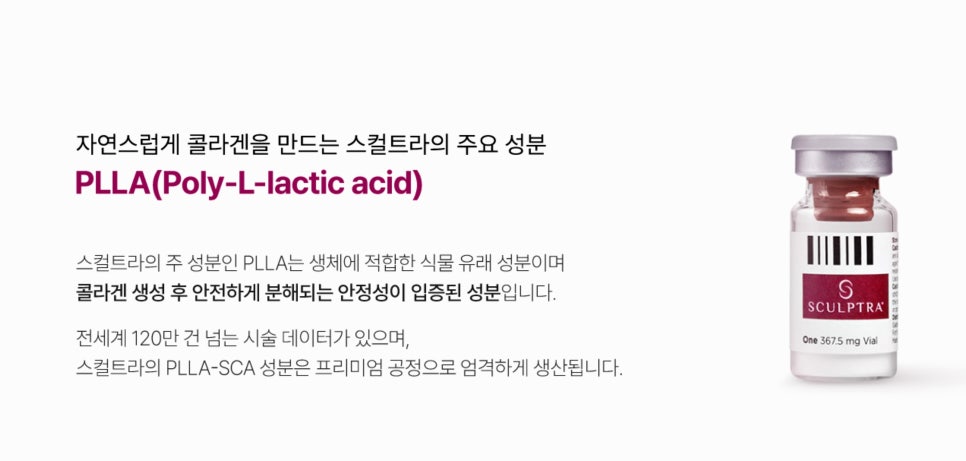
What does Sculptra do?
Sculptra is a representative collagen booster whose main ingredient is poly-L-lactic acid, commonly called PLLA.
It helps your body produce its own collagen, playing a role in increasing volume and elasticity naturally rather than artificially.
Because its particles are relatively large, it can be useful when stronger support is needed, such as for hollow cheeks or temples.
Since it works by bringing about changes from within the body, its effects become more noticeable over time rather than immediately after treatment.
After visiting Sculptra Dermatology, collagen gradually begins to build up, and noticeable changes appear after 4 to 6 weeks.
Although there may be slight differences depending on the individual, it is generally a long-lasting treatment that lasts for more than 1.5 years.
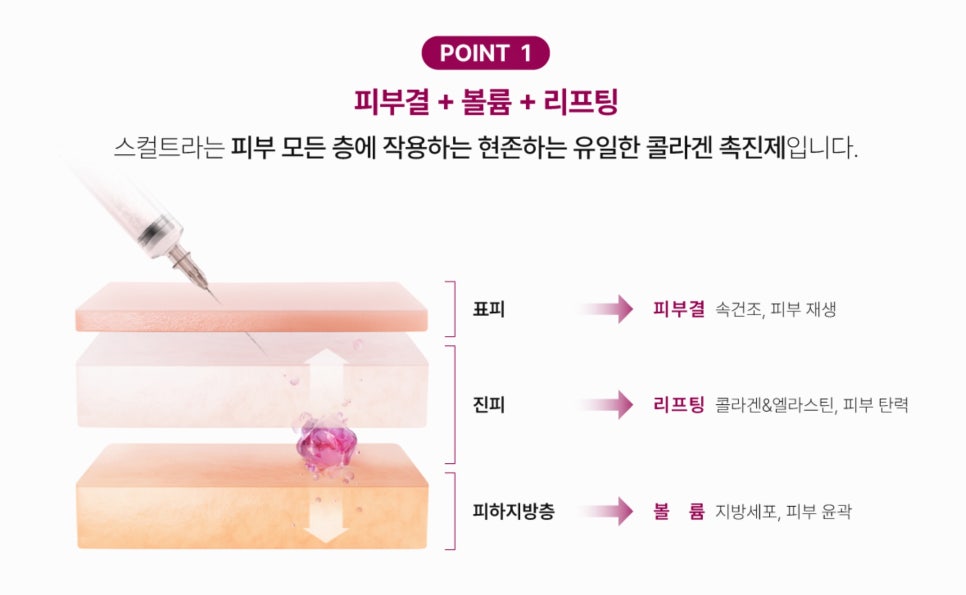
Why do so many people choose it?
Unlike fillers, which restore lost volume from the outside, Sculptra works by regenerating from within, so the age range of people visiting Sculptra Dermatology is quite broad.
In particular, winter makes the skin barrier more likely to collapse and the skin’s regenerative ability to decline, so people of various ages come in.
Since one treatment lasts for a long period of 1.5 years, it is convenient to use, which is why more people are choosing it.
In addition, improved results tend to accumulate over time, making it suitable for those who want long-term aging care beyond short-term maintenance.
This is also why many middle-aged and older adults seek it out when they enter a stage where facial volume keeps decreasing across the entire face rather than in just one specific area.

How is it different from Juvelook?
Another well-known collagen booster is Juvelook, so many people wonder about the difference between the two.
While both work by stimulating collagen production, they differ not only in ingredients but also in how they work and in the results they produce.
Juvelook combines poly-L-lactic acid and hyaluronic acid, and its purpose is collagen regeneration and moisture replenishment.
You can feel moisture replenished right away, and it is characterized by its suitability for improving skin texture and fine lines.
On the other hand, if you need long-term care due to volume loss and reduced elasticity, it is advisable to visit Sculptra Dermatology.

Can it be applied to the body?
If you have visited Sculptra Dermatology for ongoing aging care, you are likely also concerned about the elasticity of your body, not just your face.
In the past, it was mainly used to improve volume loss in the face, such as the cheeks, temples, and nasolabial folds.
Recently, however, it has also been widely used not only on the face but also on areas of the body where elasticity has decreased or volume has diminished.
Cases of applying it to large areas such as the arms, abdomen, buttocks, and thighs to help refine body shape are also gradually increasing.
Because this approach seeks long-term structural change rather than short-term visual change, it can be carried out more stably.