
Hello. We are Chang Dermatology, your beauty partner dedicated to protecting youthful, healthy skin.
When looking into skin elasticity procedures, many people find themselves wondering whether to choose Ulthera or Ulthera Prime.
Although the names are similar, these are devices with technical differences, so it is important to understand those differences before deciding.
Today, we will summarize the key points, focusing on the differences between Ulthera Prime and Ulthera.
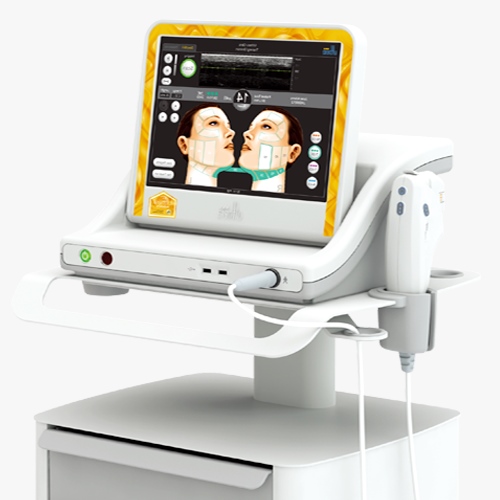
Ulthera Prime vs. Ulthera: Is the basic principle the same?
Both procedures use high-intensity focused ultrasound (HIFU) to deliver thermal energy to the deeper layers of the skin.
In other words, the basic principle is the same: stimulating the SMAS layer to induce collagen production.
However, the difference between Ulthera Prime and Ulthera starts with how precisely the energy is delivered.
Even with the same principle, differences in the precision of the device can affect the uniformity and safety of the results.

What has been improved in Ulthera Prime?
The biggest changes are in precision and screen technology.
Ulthera Prime has improved the resolution of the ultrasound imaging used to check the inside of the skin, allowing the structure to be seen more clearly.
In addition, the observable depth has expanded from about 4.5 mm in the past to up to 8 mm, making it possible to respond to various skin thicknesses.
These changes are the most important points when understanding the difference between Ulthera Prime and Ulthera.

Is there also a difference in treatment time and pain?
Ulthera Prime has a shorter treatment time thanks to improved device processing speed.
It is also designed so that energy is distributed more evenly, which makes the procedure relatively less painful.
The existing Ulthera has good results, but some people felt burdened by the pain, so this aspect can be seen as improved in the Prime version.
This is also one of the factors people notice when comparing Ulthera Prime and Ulthera.

How is the energy delivery method different?
Ulthera Prime is characterized by improved uniformity and accuracy in energy delivery.
Because depth can be adjusted more precisely according to the skin’s condition and structure, it is possible to reduce unnecessary stimulation while delivering energy intensively to the needed areas.
By contrast, the existing Ulthera delivered energy at a relatively fixed depth.
This difference is also connected to the naturalness of the results among the differences between Ulthera Prime and Ulthera.

Is there also a difference in how the effects appear or how long they last?
Both procedures are structured so that collagen production increases over time rather than producing immediate changes.
In general, changes appear gradually a few weeks to 2–3 months after the procedure, and after that, improved skin elasticity can be expected.
With Ulthera Prime, the more precise energy delivery makes it possible to expect a more even pattern of results.
However, the duration of the effect can vary depending on the individual’s skin condition and care routine.

In what cases might you consider choosing one?
These two procedures are not so much in competition as they are options that may be chosen depending on the situation.
| ✓ When you are sensitive to pain and want a relatively comfortable procedure ✓ When you want a more precise customized procedure ✓ When skin thickness or structure varies and a more detailed approach is needed |
In such cases, Ulthera Prime may be worth considering.
On the other hand, if you prefer lifting based on stronger stimulation, the existing Ulthera can still remain an option.

Ultimately, what should you use as the 기준?
The difference between Ulthera Prime and Ulthera goes beyond simply whether the device is newer; it can extend to differences in precision and treatment experience.
In particular, how accurately the skin structure can be examined and how precisely energy can be delivered to the needed depth become important criteria.
While device differences are important, a natural result also depends on whether the approach is tailored to the individual’s skin condition.
It may be helpful to compare them based on your current skin condition and the direction you want to take.