
| [What You Can Learn from This Article] |
|---|
| 1. How AllTight Lifting works |
| 2. The process of improving skin elasticity |
| 3. Who the procedure is for and selection criteria |
| 4. What to check during your consultation |
Hello. We are Chang Dermatology, your beauty partner dedicated to helping you maintain youthful, healthy skin.
When looking into lifting procedures, you may sometimes be more curious about how they improve skin elasticity than about which device is best.
In particular, understanding how a procedure works can help you determine whether it is suitable for your skin concerns.
Because each lifting device delivers energy differently and targets different layers of the skin, it is important to fully understand its characteristics.
In this article, we will take a detailed look at what changes occur within the skin, focusing on the principle behind AllTight Lifting.


Q. What changes occur within the skin?
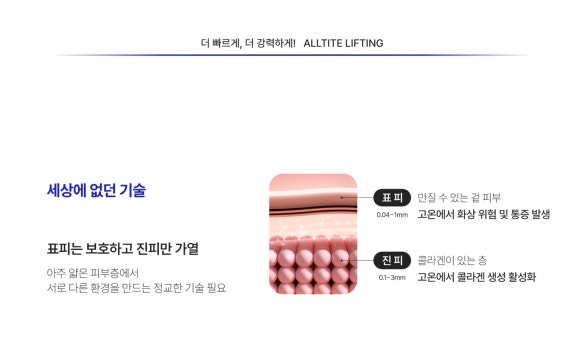
AllTight Lifting uses the principle of delivering ultrasound energy to the target layers within the skin to create thermal coagulation points in the areas that require treatment.
This process is designed to minimize damage to the skin’s surface while supporting improvements in elasticity, primarily in the dermal and SMAS layers.
As tissue exposed to thermal stimulation undergoes a recovery process, new collagen is produced, and skin elasticity may gradually improve over time.
Understanding the principle behind AllTight Lifting shows that it is not simply a process of pulling the skin upward, but one that induces changes in the internal skin environment.
Q. Why is collagen production important?
Collagen plays an important role in maintaining skin elasticity.
As we age, collagen production decreases and existing tissue can become looser, which may lead to sagging skin or reduced elasticity.
Taking these factors into consideration, AllTight Lifting delivers appropriate stimulation within the skin and may help promote the production of new collagen during the recovery process.
The principle behind AllTight Lifting also explains why gradual changes may appear over time rather than immediately after the procedure, as this is related to the recovery process.
| Checklist |
|---|
| - Check the degree of skin sagging |
| - Analyze the target skin layers |
| - Create a customized plan for each area of the face |
| - Take individual elasticity levels into consideration |
Q. Is the same approach used for everyone?
The causes behind the need for lifting can vary depending on factors such as skin thickness, degree of sagging, amount of facial fat, and face shape.
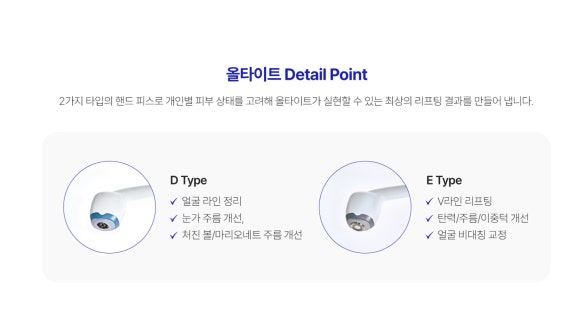
Even when the same device is used, the energy intensity, treatment range, and procedure plan may vary according to the individual’s skin condition.
Therefore, it is important to identify the current causes of reduced elasticity through a thorough consultation and skin assessment, then establish an appropriate treatment plan.
To make proper use of the principle behind AllTight Lifting, a customized approach tailored to each person’s skin characteristics is also necessary.

Q. What should you consider when choosing a lifting procedure?
Rather than deciding based only on the name of the device, it is important to consider both your skin condition and your improvement goals when choosing a lifting procedure.
Accurately analyzing the skin layers and receiving an explanation of the treatment approach suited to your current concerns can help you make a more informed choice.
In addition, receiving sufficient guidance on care before and after the procedure, as well as the process of changes you can expect, may contribute to greater satisfaction.
By fully understanding the principle behind AllTight Lifting and establishing a treatment plan suited to your skin characteristics, you may be better able to achieve natural-looking, satisfying lifting results.