
To raise a low, short nose and increase its length, artificial implants or autologous tissue are inserted inside the nose to improve its shape. At this time, an incision is made to insert the implant or tissue, and depending on the incision site, nasal surgery is divided into open and closed rhinoplasty. In the case of the closed procedure, which appears frequently in ATOP Plastic Surgery reviews, the incision line is inside the nose rather than outside, so you can worry less about scars. This is a method that can be considered by people whose skin is sensitive and scars easily, or by those who want to keep their cosmetic surgery private while still seeking a natural-looking improvement.

A non-open technique, closed rhinoplasty
Closed rhinoplasty is a surgical method that improves the shape of the nose while making external scars on the nose almost unnoticeable. By making an incision inside the nose rather than on the outside, the shape of the nose is corrected by inserting an implant or autologous cartilage. Because no external incision is made, scars are hardly left on the outside, and recovery is relatively quick. Swelling is less, natural results can be expected, and the recovery period is short. It can also lower the risk of inflammation and contracture.
Because this requires a high level of technical skill from the medical team, it is a difficult surgical method. The procedure should be performed at a plastic surgery clinic where the surgeons are experienced in non-open techniques and have sufficient clinical experience.
Differences between open and closed methods
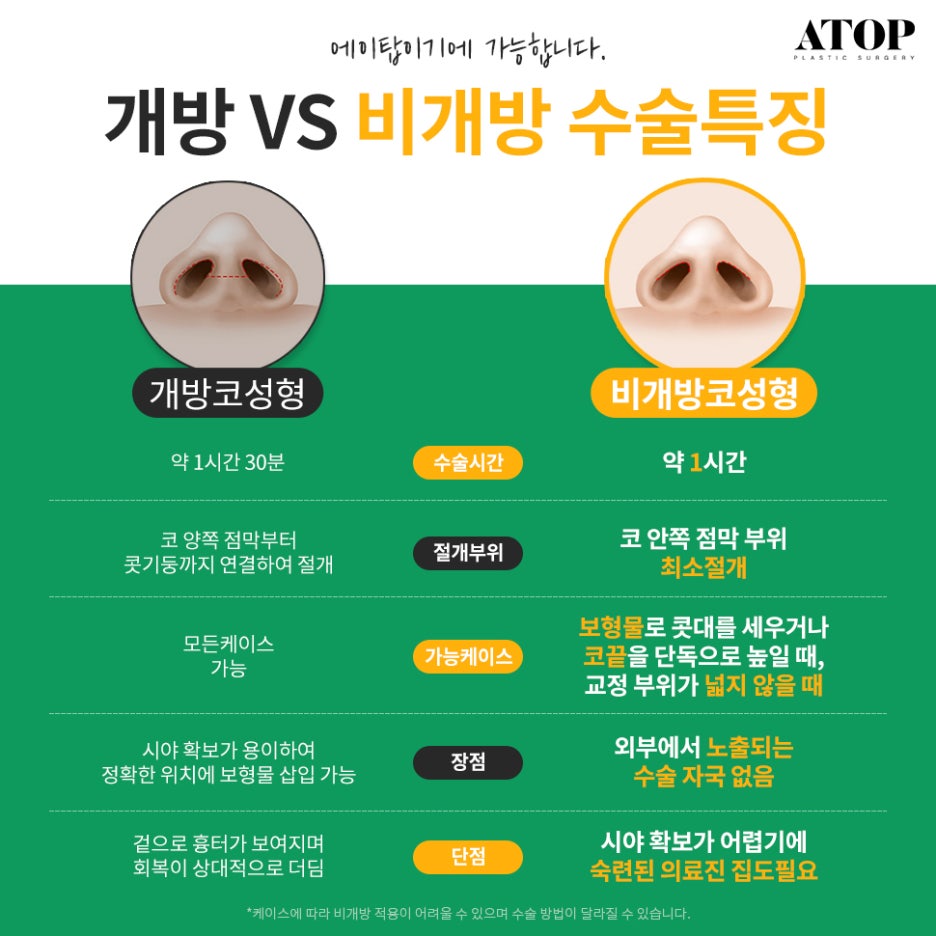
Rhinoplasty methods are divided into open and closed types depending on which area is incised. There are several differences, such as incision location, applicable cases, surgical method, cost, and whether scars remain, so please check the differences between the two surgical methods.
Open rhinoplasty is a method that incises the line connecting the mucosa on both sides of the nose and the columella, called the columellar line. Since the nose is fully opened, the medical team can directly view the internal structure of the nose and perform the surgery with a clear field of vision. At the same time, one advantage is the high accuracy of implant placement. It is a surgical method that can be applied to various nose shapes, but the downside is that the incision site may be visible from the outside and the recovery period is relatively long.
Closed rhinoplasty has a relatively shorter operation time than open rhinoplasty. It involves making a minimal incision inside the nostril mucosa, and because the internal tissue is not exposed externally, the range of cases it can be applied to may be somewhat more limited than with open rhinoplasty. However, after consultation with medical staff who have sufficient experience and know-how in closed rhinoplasty, surgery can also be tailored to your nose type.
This method can be used for cases where the bridge of the nose needs to be raised or only the tip needs a slight lift, or when the range of correction is not extensive. Because it does not involve an external incision, one advantage is that scars are hardly visible from the outside, allowing for a natural-looking result. However, because the internal nasal tissue cannot be directly seen as in open surgery, obtaining a clear surgical view is relatively more difficult. That is why it is important to choose experienced surgeons.

Closed rhinoplasty, a hidden internal incision
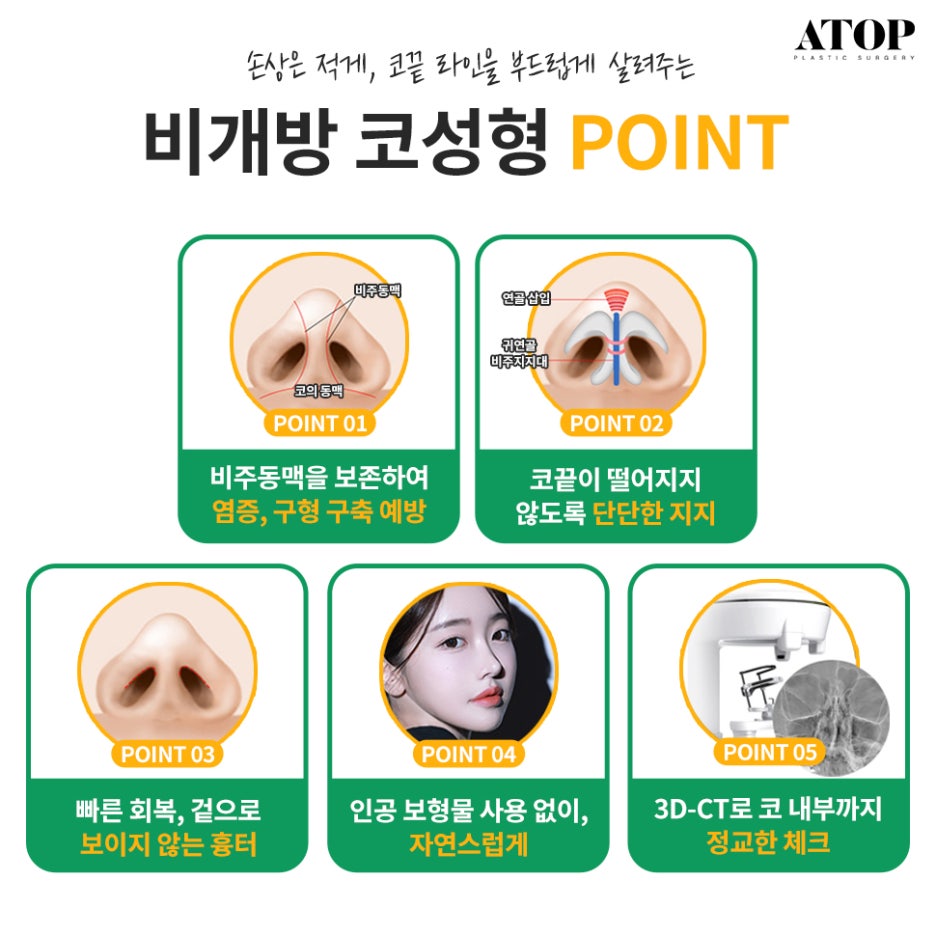
A feature of closed rhinoplasty, which does not involve opening the nose, is that the incision is made inside the nostril. Because the incision is not made on the alar or columella area, it can be expected that almost no noticeable external scar remains, allowing for a natural result after surgery.
Since the incision is made minimally inside the nostril, swelling and bruising are also reduced, and the recovery period is shorter. The operation time is also relatively shorter than with open surgery. In particular, because the columella is not incised, blood flow is maintained smoothly, lowering the risk of inflammation, tip drooping, and contracture. After surgery, if the mucosal incision site is carefully sutured and heals within a few days, a naturally corrected, beautiful, high nasal bridge line can be created.

A soft, not stiff, nose tip line
After plastic surgery, everyone wants a natural result. If surgical marks or scars are visible, others may realize that you had cosmetic surgery, so in that respect, closed rhinoplasty can be helpful. Because it has a lower risk of tissue damage and can create a more natural nose tip line, satisfaction can be increased.
Open rhinoplasty is a method in which the columella is incised and scars are exposed externally, whereas closed rhinoplasty does not incise the externally visible area, protecting the columellar artery and allowing smooth blood flow all the way to the nose tip. As a result, swelling and bleeding are reduced, and the likelihood of complications that can occur after nose surgery, such as inflammation or contracture, is lowered.
When nasal surgery is performed with a closed method, an alar cartilage graft is used to form a columellar strut. The columella can be lengthened without making a columellar incision. Because of this surgical method, drooping of the nose tip is hardly seen even as time passes, and since autologous cartilage is used for lengthening, an artificial or overly pointed appearance can be reduced, improving the nose into a balanced and natural shape.
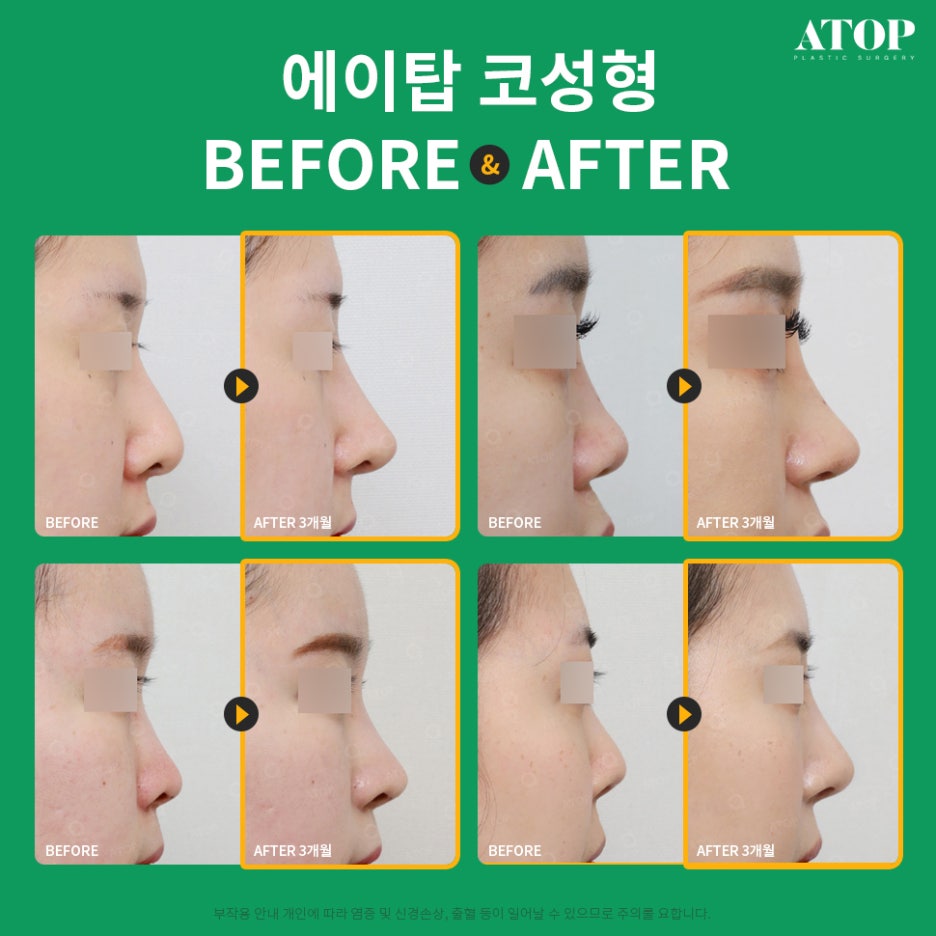
Even without an open method, various nose lines can be corrected. However, this requires sufficient experience and know-how from the medical team. Because the nose cannot be seen directly from the outside and the field of view is limited, surgeons without enough experience may be able to handle only a limited range of nose types. So I hope you will refer to the medical staff in the ATOP Plastic Surgery reviews, who have extensive knowledge of nose surgery and abundant experience with closed rhinoplasty, and establish your surgical plan.










 Previous image
Next image
Previous image
Next image










Previous image
Next image