
Many people focus on raising a low nasal bridge and lifting a drooping nasal tip when undergoing rhinoplasty. What is easy to overlook here is the columella and the nasolabial angle. Completing a straight, high nose is influenced not only by the bridge, but also significantly by this area. In reviews of A-TOP Plastic Surgery, there are recently people who have also undergone columella surgery, and in most cases, the midface appears fuller and the face looks more three-dimensional, leading to high satisfaction. We hope you can achieve even greater satisfaction not only through the rhinoplasty you already know, but also by combining it with columella surgery.

Columella surgery that conceals the nostrils and lengthens a short nose
Many people do not know exactly where the columella is or what role it plays in the face. It is the column-like area connecting the nasal tip and the philtrum, and from the front it is a small area that is almost barely visible. This area, located between the nostrils, can make the tip of the nose look different depending on its length and width.
In other words, columella surgery can be understood as correcting the line that runs from the tip of the nose to the lips. Lowering a recessed columella or lifting one that hangs too far downward can help improve the overall facial proportions. In this way, the midface gains volume, creating a more three-dimensional and balanced facial line. As the face looks more three-dimensional, it may also appear smaller, and an effect of correcting a protruding mouth may also be expected.
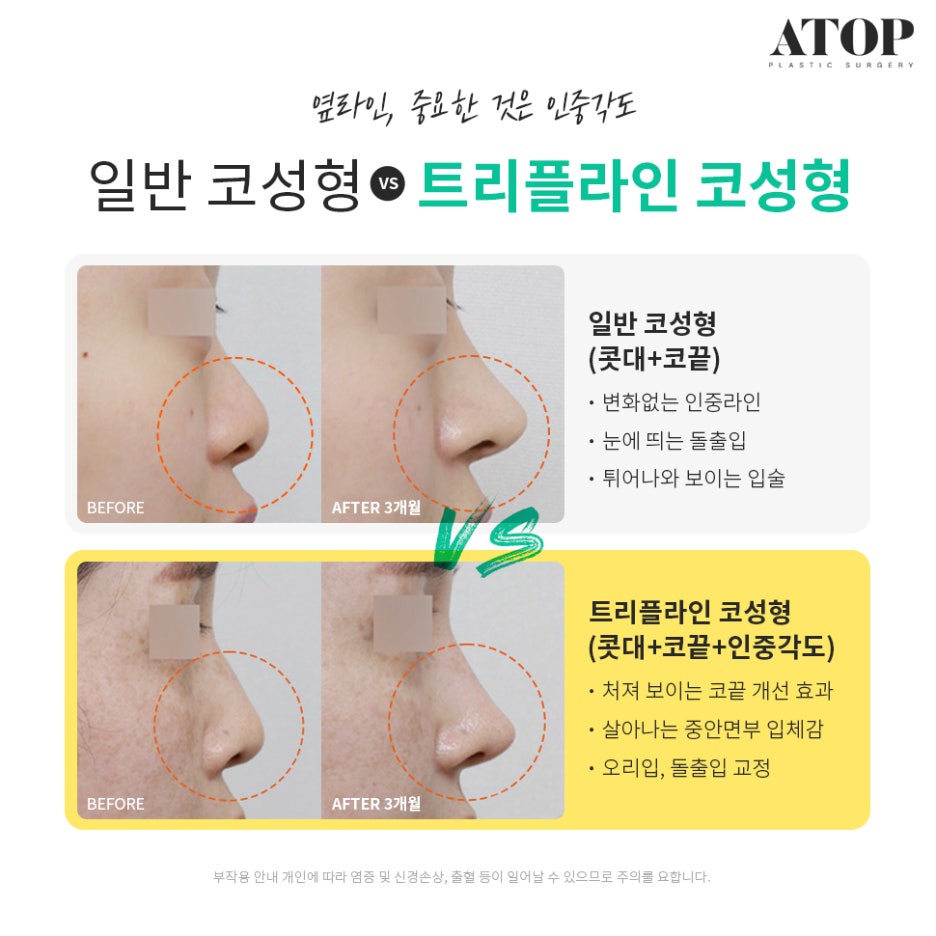
The ideal angle of the columella
When we see a pretty nose, we describe it as having a high bridge or a beautiful line. However, we do not usually say that the columella itself looks pretty. That is because the nasolabial angle formed between the columella and the philtrum is important. That is why the key thing to consider in columella surgery is the ideal angle.
To summarize, when viewed from the front, the width of the nostrils should be about one-fifth of the total facial width, and the tip of the columella should sit about 2 mm lower than the nasal tip, forming an angle of 10 to 15 degrees with the alar rim. In truth, this may be difficult to understand from an explanation alone, so it is better to check with photos. Even better, since the ideal columella angle differs according to each person’s facial proportions, it is best to receive a consultation at a plastic surgery clinic. In reviews of A-TOP Plastic Surgery as well, you can see that the before-and-after appearance is different, so please refer to that and discuss how it would be best applied to your own nose.
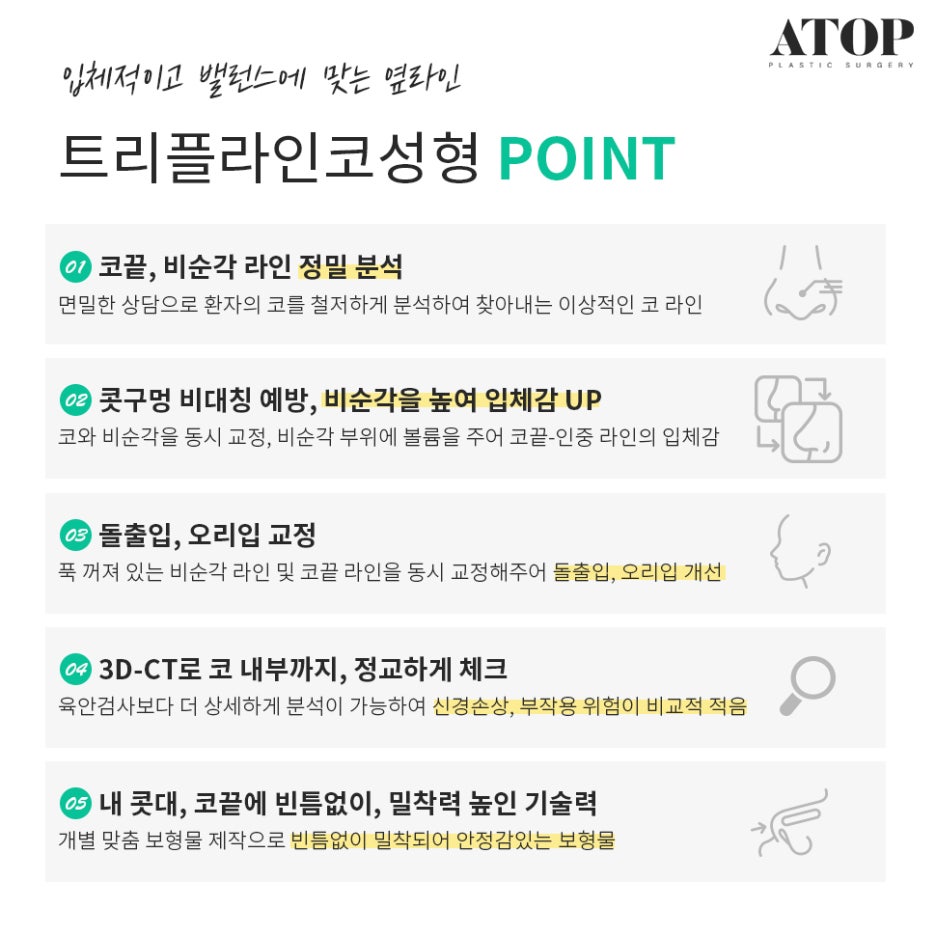
Columella surgery by type
Just as rhinoplasty is planned according to each type, such as a nose with a low bridge or a drooping nasal tip, the same is true for columella surgery. Broadly, it is mainly divided into two types. First is the case of a recessed nasal column. This applies when the columella is overly set back or the alar rim is significantly drooped, and in this type, surgery should be performed by carrying out septal extension, grafting cartilage, and then advancing and fixing the medial crus of the alar cartilage. This can bring the recessed columella forward and create a more three-dimensional nose.
The type involving a drooping nasal column applies when the columella hangs too far downward, making the nose look longer. The medial crus of the alar cartilage located near the columella is moved backward and fixed to the septal cartilage, lifting the drooping columella upward. Alternatively, some of the septal cartilage can be removed to reduce the drooping area slightly and improve it.

Precise analysis and design with 3D-FIT rhinoplasty
Although the columella is only a small area, when performing columella surgery as well as rhinoplasty, both the exterior and the interior of the nose must be examined in detail. Some parts can be judged by the naked eye, while the complex internal structure cannot be seen, so it is necessary to check it through 3D-CT imaging before surgery.
With 3D-CT imaging, it is possible to analyze the patient's bones, skin, cartilage, nasal shape, and even functional issues that could not be seen with the naked eye. Based on the results, an implant is made and a surgical plan is established to apply a 1:1 customized signature nasal line suited to each individual. Because a beautiful nose that fits closely to the face is created, concerns about side effects can be relatively reduced, and concerns about a dropped nasal tip can also be eased.
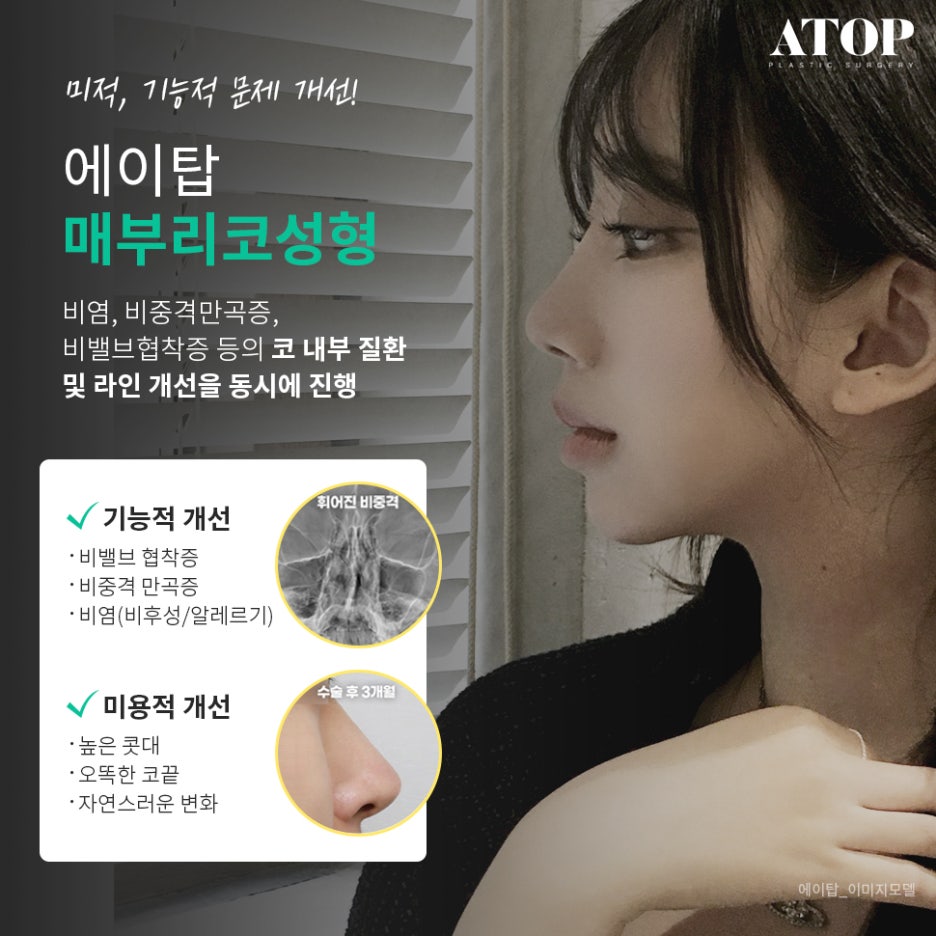
Applying this method is what 3D-FIT rhinoplasty is about. It means creating a nose that fits through 3D-CT imaging, making customized surgery possible according to each person’s nose shape. After precisely analyzing each type, such as a low nose, short nose (upturned nose), long nose, crooked nose, or bulbous nose, the appropriate surgical materials and methods are selected and performed. Of course, some aspects of columella surgery can be judged from the outside, but problems and shortcomings of the nose are not limited to the exterior, so it is better to proceed more precisely and carefully through 3D-FIT rhinoplasty.
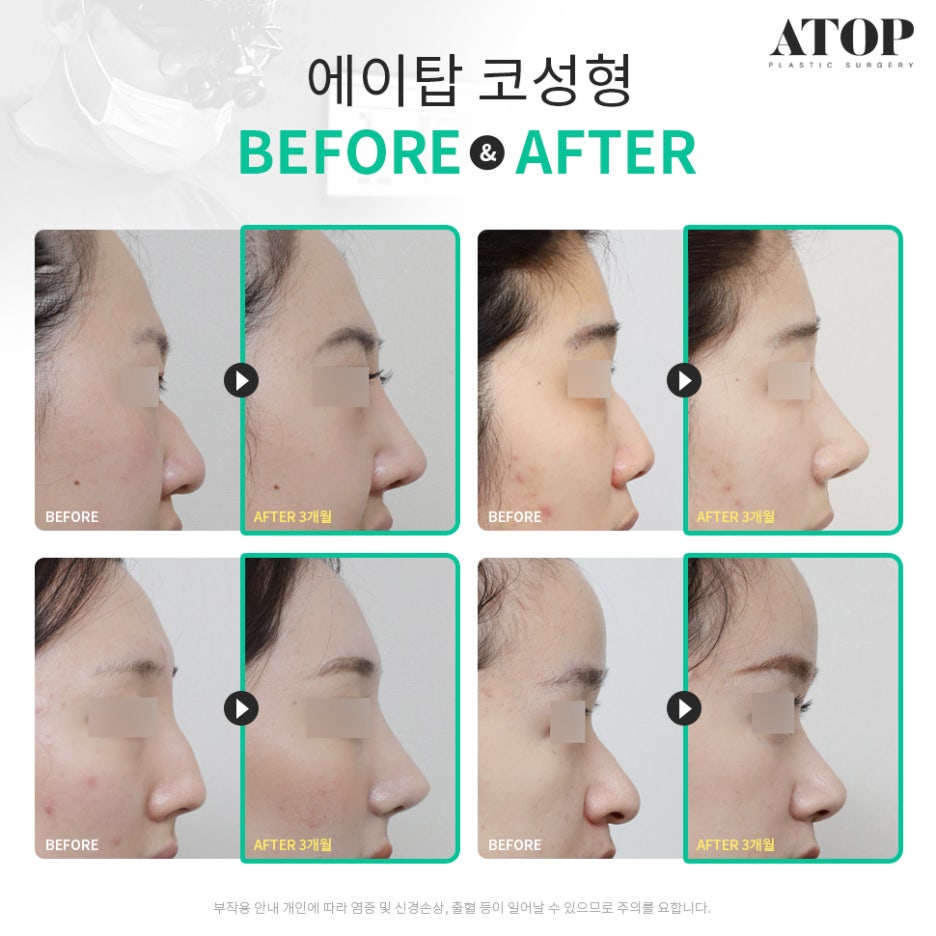
The reason many of the reviews of A-TOP Plastic Surgery describe a natural and beautiful nose without any foreign-body sensation is the result of this 3D-FIT rhinoplasty. It is because the nose is designed into the desired line and helps create a three-dimensional face that fits me best and suits me best. We hope you can have a natural and beautiful ideal nose that others want to emulate, rather than a nose that simply copies someone else.










 Previous image
Next image
Previous image
Next image









 Previous image
Next image
Previous image
Next image