
The “philtrum,” located in the midface, is not a functional area like the eyes, nose, or lips. However, depending on its length and shape, it affects facial harmony and the overall impression of the face. If it is excessively long, the face itself may appear longer and the proportions may look unbalanced. For this reason, there are reviews of ATOP Plastic Surgery that mention midface reduction for aesthetic improvement. The goal is to reduce this area to enhance three-dimensionality and improve facial proportions, but rather than simply shortening the length, it is important to preserve the concave contour line properly so that the overall impression looks lively and the proportions appear balanced.

For balance, aim for an ideal philtrum ratio
The midface, which is the center part of the face, is one of the key elements that determines the overall impression and proportions. If this area is relatively long, the face can appear vertically elongated. Since the philtrum is the area connecting the midface and lower face, facial balance and harmony can change depending on its length. If it is long, you may look older than your actual age, and surgery to shorten this area can be performed for midface reduction.
However, because the philtrum is clearly visible from the front, the scar must be concealed after surgery. This is why the surgical method and technique matter. If a fine incision is made along the line under the nose and the procedure is finished with delicate suturing, it can be completed with almost no noticeable scar. Through this, the facial proportions and sense of length can also be improved together.
The ideal proportion and length can vary slightly from person to person. Still, there is a general standard, and surgery performed in line with it can produce a natural improvement. Aesthetic guidelines suggest that the philtrum length should be balanced at a 1:2 ratio from the base of the columella under the nasal tip to the upper lip, and from the lower lip to the tip of the chin, in order to expect the effects of midface reduction. If this is longer than the standard, the midface may appear elongated, so reducing an excessively long philtrum can improve facial balance as well.
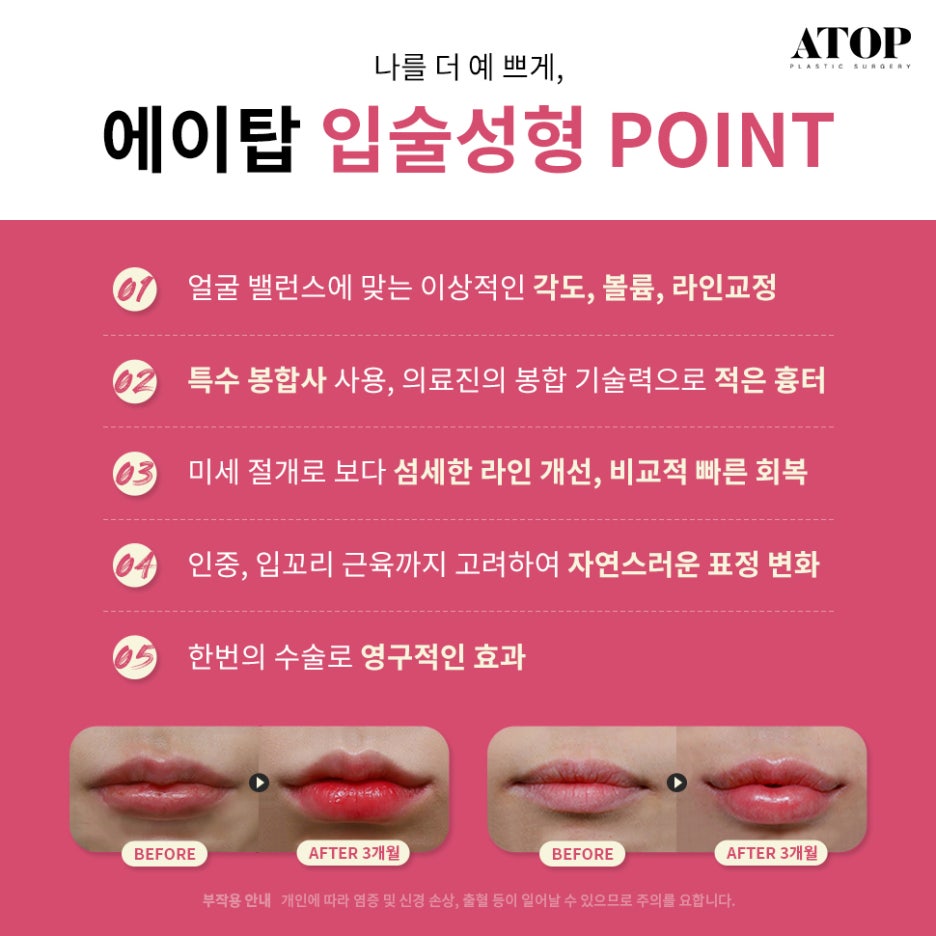
Midface reduction surgery with minimal incision area
To shorten the philtrum, a reduction surgery that directly shortens its length is necessary. Recently, procedures that emphasize the ears to make the midface look shorter have also become popular, but these create a visual effect and do not directly reduce the philtrum length itself. If you want more substantial change beyond a certain range, a surgical approach that directly reduces the length through an incision is needed. At this point, the important thing is that the incision line and scar should be made as inconspicuous as possible.
When reducing the midface, the incision is made along the curved line at the lower part of the columella, which is the structure beneath the nose. Because it is under the nose, it is shadowed and not easy to see, so even if there is an incision line, the scar is not directly exposed, and since it is a boundary line, the trace is not very noticeable. Above all, careful and detailed suturing is important. If the area is sutured tightly and recovery proceeds well, the length of an elongated philtrum can be shortened and the facial proportions can be improved harmoniously.
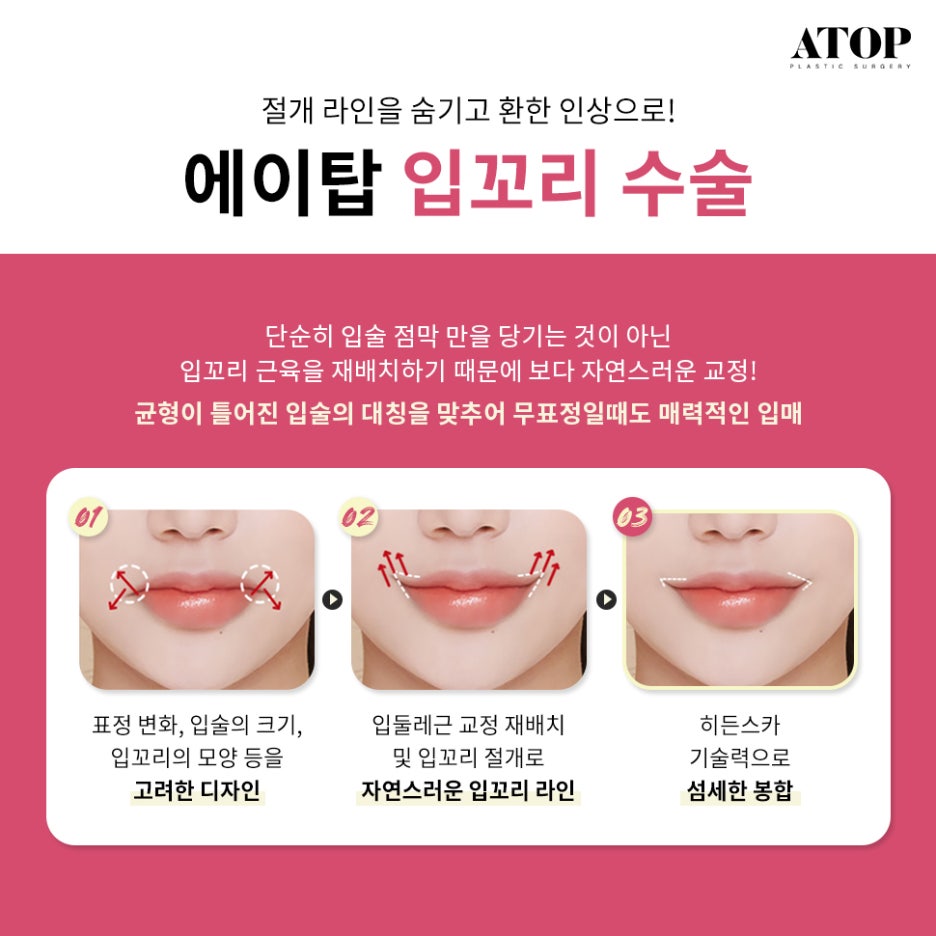
Philtrum reduction surgery tailored to individual facial features
When reducing the philtrum, at least about 10 to 10.5 mm of length should remain so that the midface is not reduced too much. If it is shortened too much, the upper lip may become excessively thick, and if the lip appears pointed into a triangular, mountain-like shape, the corners of the mouth may look drooped. Excessive shortening may also over-lift the upper lip, making the teeth more visible, and if the chin length and proportions do not match, the lower face may appear longer.
To minimize these side effects and dissatisfaction, the surgery should be decided carefully while considering the individual's facial characteristics. A certain length must be preserved, and the surgical plan should be established according to the length and proportions that suit the patient.
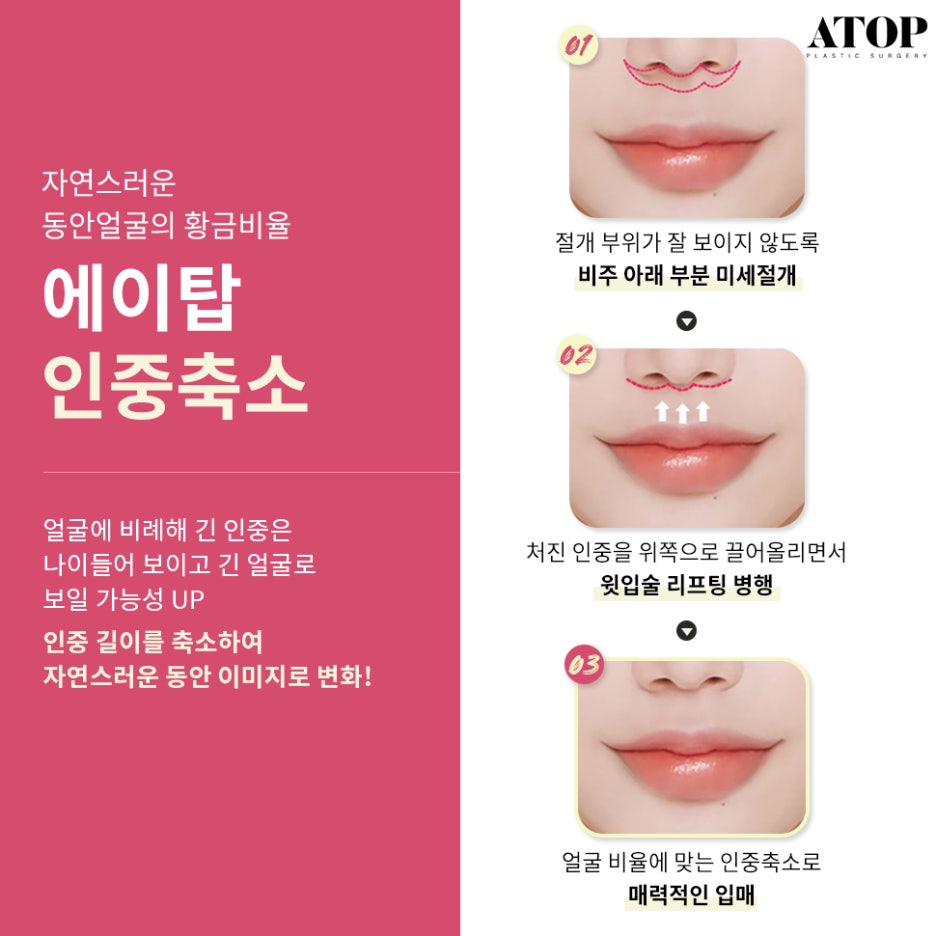
In addition, if the design takes lip shape and the cupid’s bow line into account, both the midface and lower face can be improved together. If the philtrum is reduced appropriately while slightly combining upper lip lifting so that the cupid’s bow does not become too pointed, you can expect not only the effects of midface reduction but also lips with a moderate amount of volume.
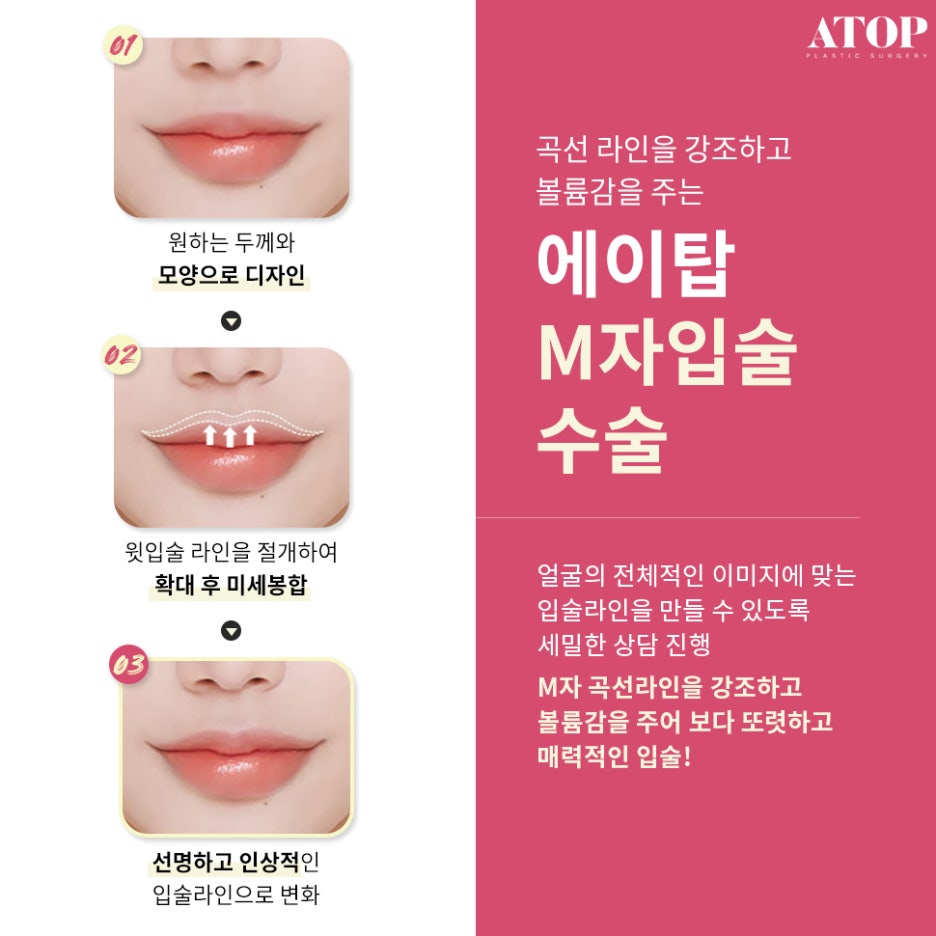
Performing both inner and outer philtrum reduction together
Both the inner and outer philtrum should be reduced together for the lips to be balanced and for a natural improvement to be achieved. In general, the inner reduction procedure involves making an incision along the lower line of the nose and pulling upward for suturing, while the outer area refers to the parts at both ends of the philtrum. If the outer area is also shortened, the corners of the mouth, which may look drooped, can be slightly lifted and improved into a more smiling appearance.
The inner philtrum is the area directly below the nasal tip, and the outer areas are the parts on both sides of it. In other words, if only the inner area is reduced, it can affect the shape of the lips, so reducing both the inner and outer areas together allows for a more natural midface and lips. While undergoing midface reduction, the lip line is also improved at the same time, allowing for a more refined mouth shape.
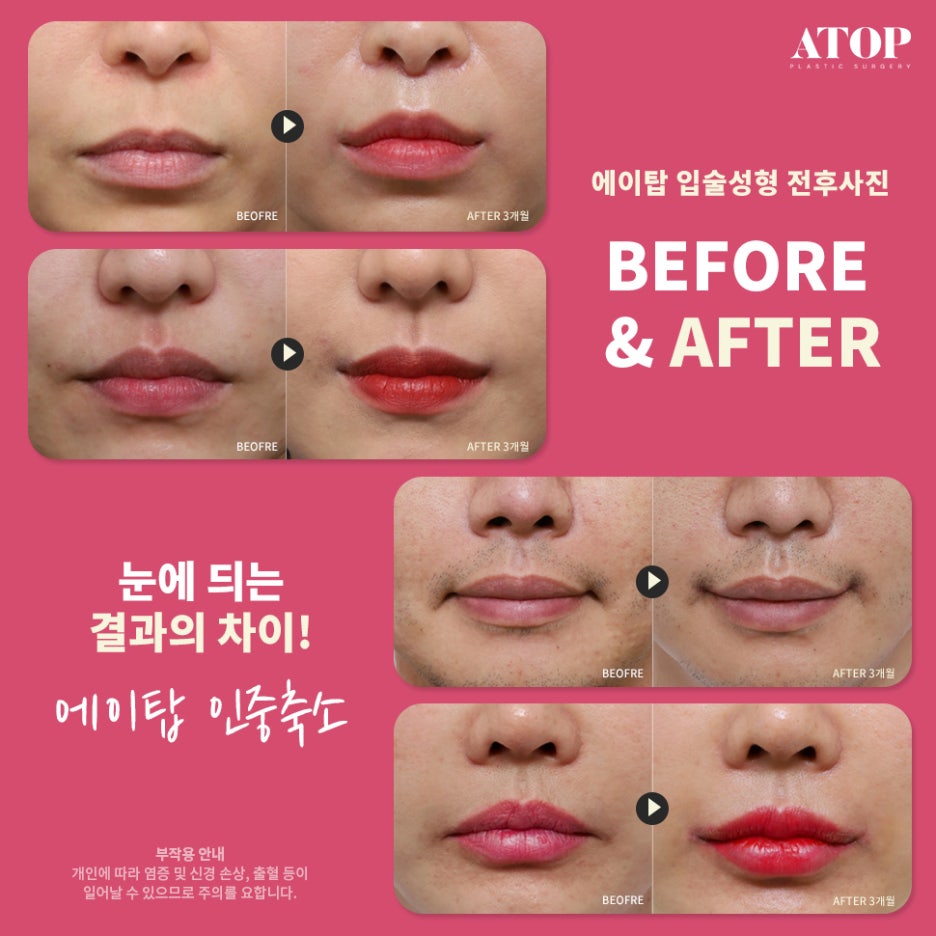
If the philtrum is long and the corners of the mouth are also downturned, reducing both the outer and inner areas together can create a more harmonious and natural look, so please consider this when designing the procedure. There are also many review cases of ATOP Plastic Surgery, so if you compare them with your own appearance and improve your features while considering your overall facial proportions, you can expect a satisfying result.










 Previous image
Next image
Previous image
Next image









 Previous image
Next image
Previous image
Next image