
Facial shape consists of three elements: the cheekbones, the square jaw, and the chin. The width of the face and its overall lines are influenced by the cheekbones, while the jawline extending from below the ears to the front determines the overall contour. In reviews of ATOP Plastic Surgery cases involving square jaw reduction surgery or osteotomy, it is common for these procedures to be performed together with square jaw surgery, because the facial bones are organically connected and linked to one another, allowing for synergy when surgery is performed together.
A V-cut square jaw surgery that preserves balance well
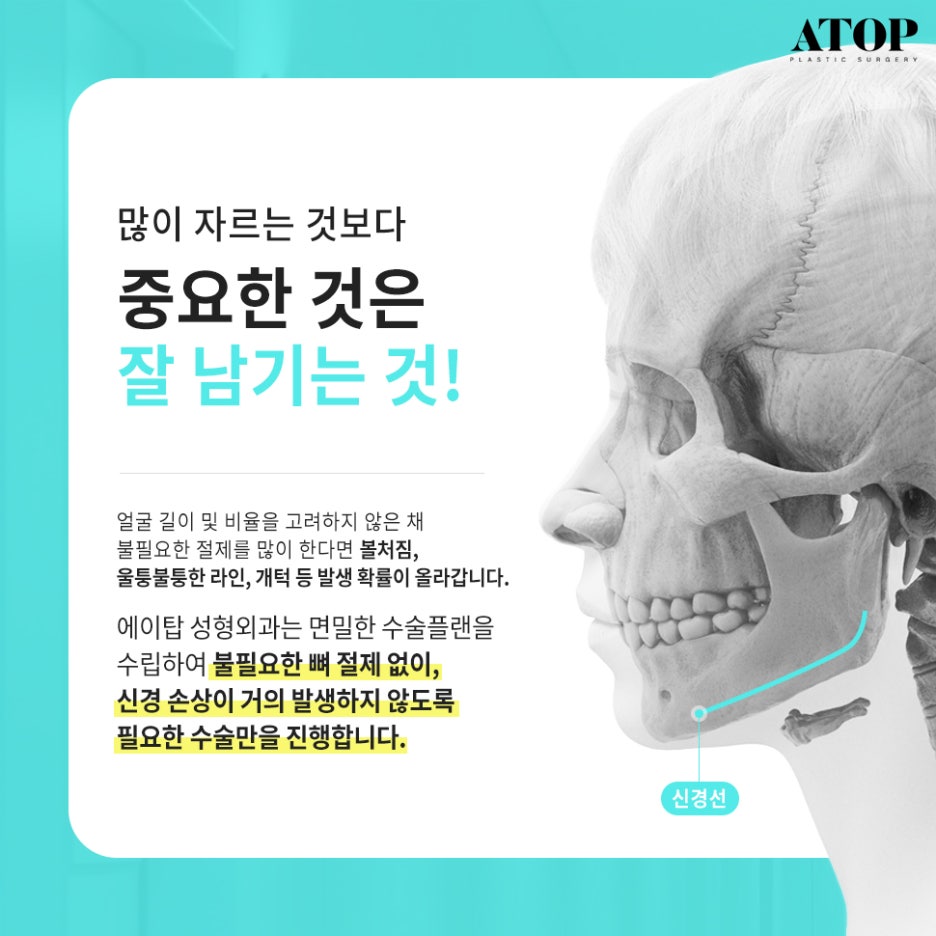
When undergoing contour surgery to make the face slimmer by trimming the jaw, many people think that more bone must be shaved down to achieve a beautiful face shape. However, once bone is removed, it does not regenerate, so great caution is needed. More important than removing a lot is 'preserving well.' By removing the jaw below the ears and the area of maximum jaw volume, the face shape can be completed, and if necessary, square jaw reduction surgery or chin T-osteotomy, or advancement/recession surgery, can be performed.
Many people think that a lot of bone must be removed for a smaller face and a slim V-line, but shaving closer to the bone does not necessarily make the face shape prettier. Only when the length and proportions are considered and the design is planned properly can unnecessary removal be prevented, and side effects such as cheek sagging, a bumpy contour line, and a gap jaw can also be prevented.
In addition, if too much bone is removed, the surgery gets closer and closer to the nerve line, and nerve damage can occur. If the nerve is damaged, sensation decreases and movement becomes uncomfortable, so square jaw reduction surgery and similar procedures can be combined to minimize bone removal while preserving a beautiful shape so the jaw can become a V-cut jaw.
Square jaw surgery that is properly shaved
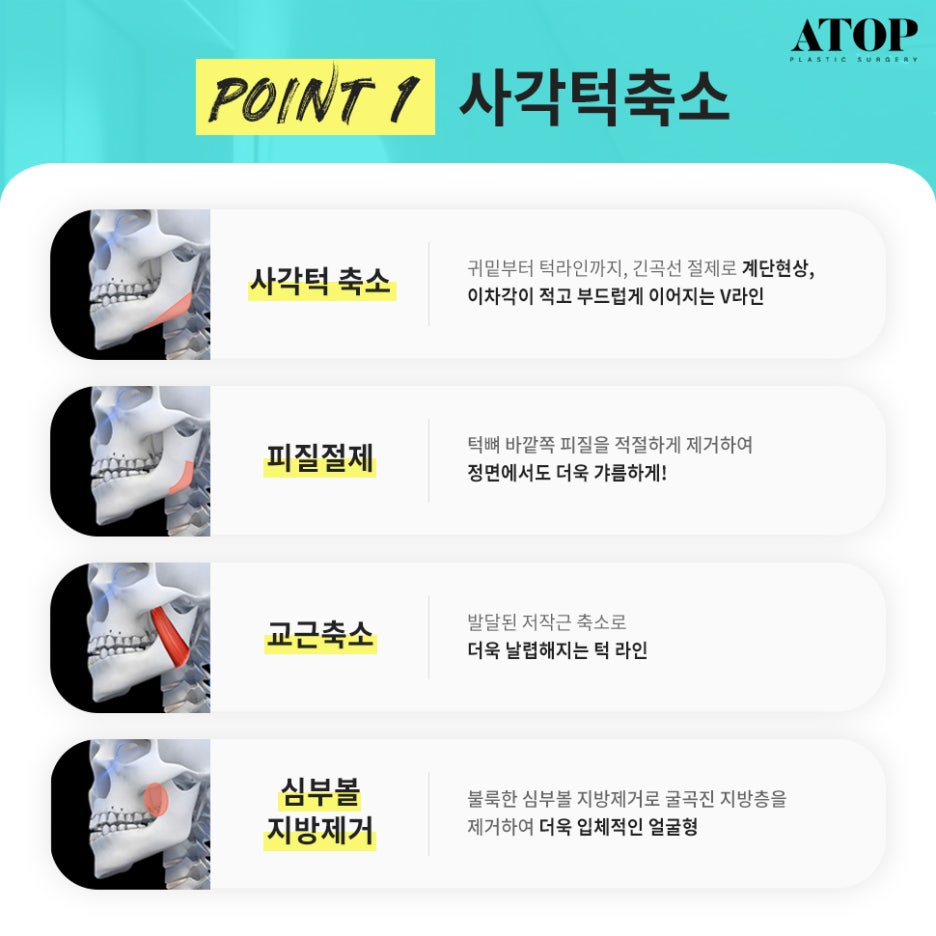
Square jaw surgery is not simply the removal of the protruding square jaw below the ears. If only that part is removed, a secondary angle can form, creating a bumpy appearance like stairs. This is called the step phenomenon, and it is one of the representative side effects of square jaw surgery. The method to prevent this is 'long curved resection,' which trims the bone in a long, smooth curve all the way to the front line of the jaw. Since the bone starting below the ears extends all the way to the chin, if this line is resected continuously in a curved shape, the possibility of a secondary angle can be reduced and a natural face shape can be achieved. The insufficient front chin area can be improved through square jaw reduction surgery or osteotomy.
The reason a square jaw appears prominent is not only the shape of the bone, but also the thickness of the bone itself. If the outer cortical bone located on the outer side of the mandibular body is thick, the face may appear bulky and angular, so if this area is trimmed and the connecting line to the chin is refined naturally, a smooth jawline can be maintained.
A square jaw developed by muscle and fat
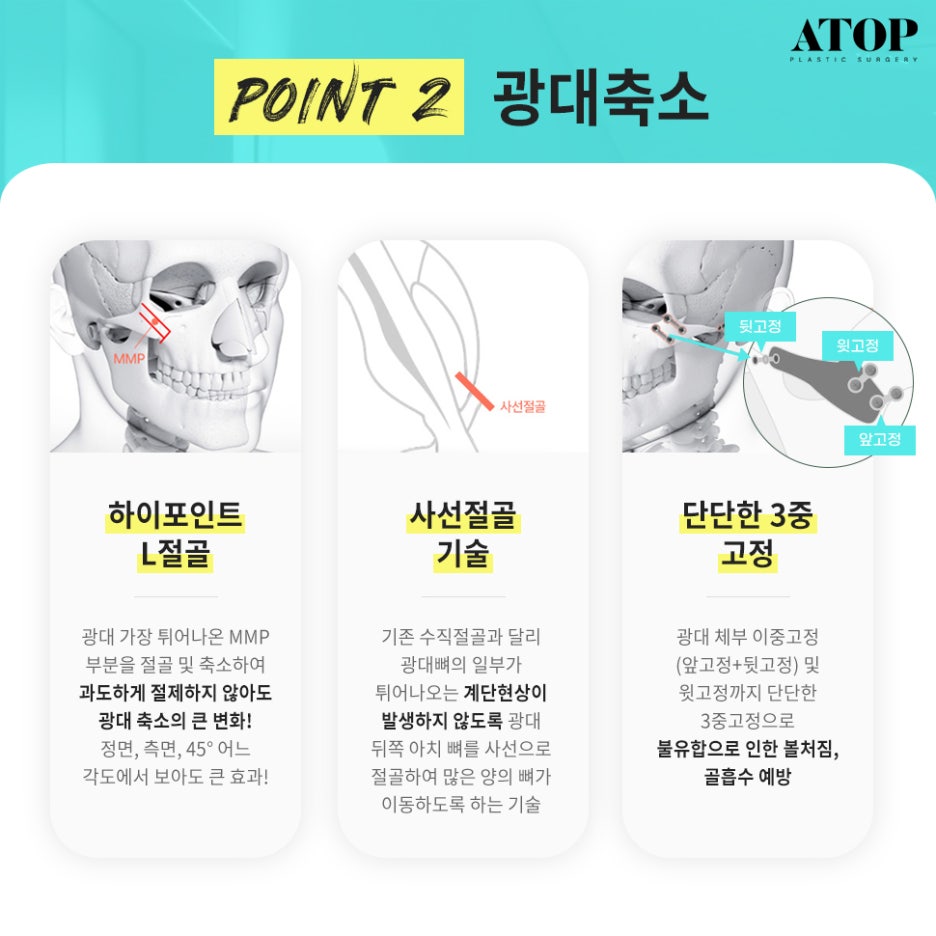
Not all square jaws are caused only by bone development. The jaw also contains other tissues such as muscle and fat, and when these tissues are developed, the face can appear angular. If a 3D-CT scan shows that the cause is not the bone but another area, it can be improved with surgery to reduce and remove that tissue, and if necessary, the facial shape can be completed with square jaw reduction surgery or osteotomy.
The muscles on both sides of the jaw are called the masseter muscles, and they are mainly used when chewing food. If these muscles become excessively large, even if the bone is reduced, the muscles remain protruding, so the face may still appear angular. Masseter reduction surgery is a method that semi-permanently reduces these muscles, allowing for a slimmer contour line.
Among people whose faces are especially fleshy, some may appear angular due to fat. For those whose cause is the buccal fat deep in the cheeks, removing it can improve the bumpy facial shape into a smoother and softer one.

Chin surgery with high synergy when done together
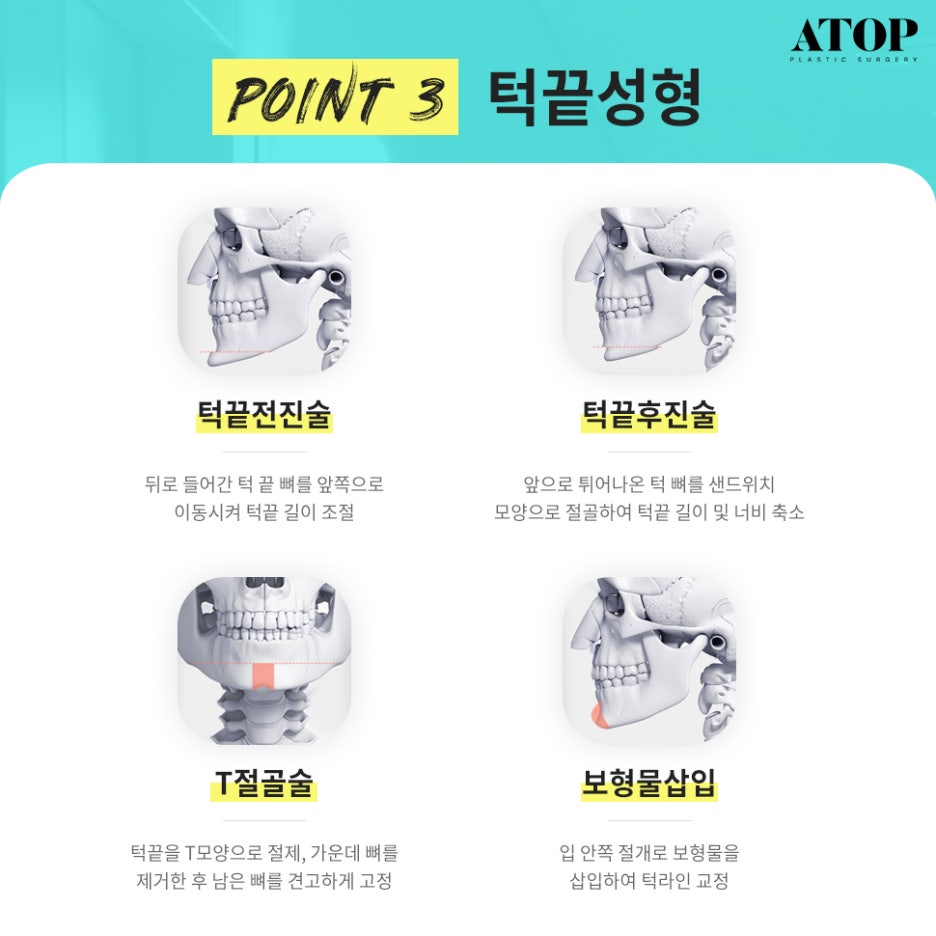
From the cheekbones to the square jaw and chin, the facial contour bones are all connected. Some people are concerned about only one area, but in most cases, two or three areas are problematic together, so there are people who undergo two- or three-part facial contour surgery. If you are concerned not only about the square jaw but also about the chin that extends to the front of the face, you can improve it into a beautiful face shape suited to your type through chin advancement, recession, T-osteotomy, square jaw reduction surgery, and similar procedures.
Chin advancement surgery moves a recessed jawbone forward to adjust the length, while recession surgery reverses this by cutting the protruding bone backward and reducing the length and width. T-osteotomy is performed when the front chin is significantly developed, making it wide and angular. The chin is cut in a T shape, the central bone fragment is removed, and the remaining bone is firmly brought together and fixed. It is completed into a natural and narrow jawline, resulting in a slimmer face shape.
When the chin appears flat due to a weak chin, it can be improved by making an incision inside the mouth and inserting an implant through square jaw reduction surgery. For people who have difficulty improving through advancement surgery or when bone development is insufficient, dimensionality can be increased with an implant, resulting in a natural ATOP Plastic Surgery review.

Facial shapes differ from person to person, and the areas where bone is developed, the degree of development, shape, and size all vary as well. Because the surgical method and design must differ accordingly, it is important to receive sufficient consultation and then undergo a 3D-CT scan to identify the cause within the internal tissues and establish a surgical plan. I hope you can achieve a natural, slim, and beautiful facial shape.











Previous image
Next image










Previous image
Next image