Hello. I am Dr. Junseong Kwon, a board-certified plastic surgeon at A-TOP Plastic Surgery.
Today, we will take a look at the newly upgraded second-generation dual-plane endoscopic forehead lift.

Wrinkles on the forehead and between the eyebrows do not occur simply because the skin becomes loose. As the muscles of the forehead and glabella repeatedly move during facial expressions, wrinkles become deeper. Over time, when the tissues around the forehead and eyebrows sag, the eyes may appear heavy and constricted.
In such cases, an endoscopic forehead lift may be considered. This procedure uses small incisions to dissect the tissues around the forehead and eyebrows and move them upward, improving the position of the sagging forehead and eyebrows.
However, even with the same endoscopic forehead lift, the surgical method may differ depending on where the tissues are dissected and in which direction they are moved.
Considering these factors, A-TOP Plastic Surgery has recently adopted the second-generation dual-plane endoscopic forehead lift, an advancement of the conventional single-plane dissection method.
1. Why is an endoscopic forehead lift needed?
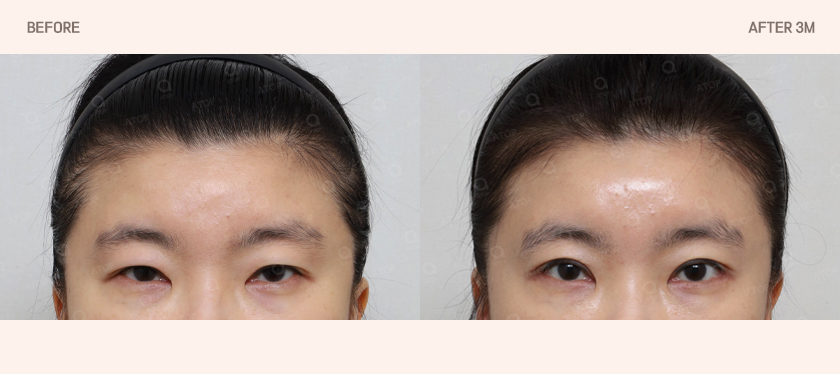
As we age, the tissues around the forehead and eyebrows may gradually sag downward under the influence of gravity and repeated movement.
In particular, when the eyebrows descend, the double-eyelid crease may droop, making the eyes look smaller and more constricted. Forehead and glabellar wrinkles may also become more pronounced, contributing to an older-looking appearance.
In such cases, rather than simply pulling the skin upward, it is important to adjust the position of the soft tissues and muscle layers around the forehead and eyebrows.
2. The 5-point incisions remain the same, but the dissection planes have changed
The important change in endoscopic forehead lifts is not the location of the incisions, but the change in the planes where dissection is performed.
In the conventional method, dissection was primarily performed in the subperiosteal plane between the frontal bone and the periosteum through five incisions. In the dual-plane method currently used, the dissection plane is divided according to the location on the forehead.
Dissection method for the second-generation dual-plane forehead lift
① Upper forehead → Subperiosteal dissection
In the upper forehead, dissection is performed in the subperiosteal plane, as in the conventional method.
By moving the tissues along the space between the periosteum and bone, this method secures a sufficient dissection range across the forehead and allows the tissues to be moved upward.
② Lower forehead → Subgaleal dissection
In contrast, in the lower forehead, approximately 3 cm above the brow bone, dissection is performed in the subgaleal plane—that is, the plane above the periosteum.
The key feature of the second-generation dual-plane endoscopic forehead lift is that it uses two different dissection planes according to the location on the forehead, rather than using only one plane.
In other words, the upper forehead is dissected in the subperiosteal plane, while the lower forehead is dissected in the subgaleal plane, utilizing the anatomical characteristics of each area.
3. Why the second-generation dual-plane forehead lift may help protect sensory nerves
One of the structures that must be carefully considered during a forehead lift is the sensory nerves.
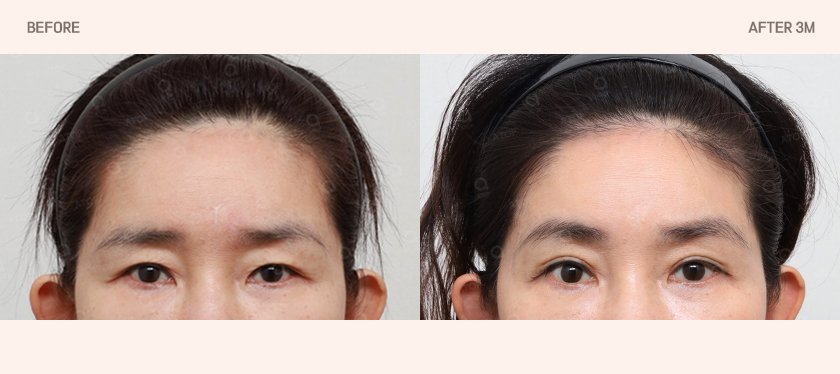
Because sensory nerves pass through the forehead and scalp, temporary reduced sensation or discomfort may occur as a result of the surgical process.
With conventional dissection alone, when access is extended to the lower forehead, the tissue that can support the underside of the nerves may become relatively insufficient as the tissues are pulled upward.
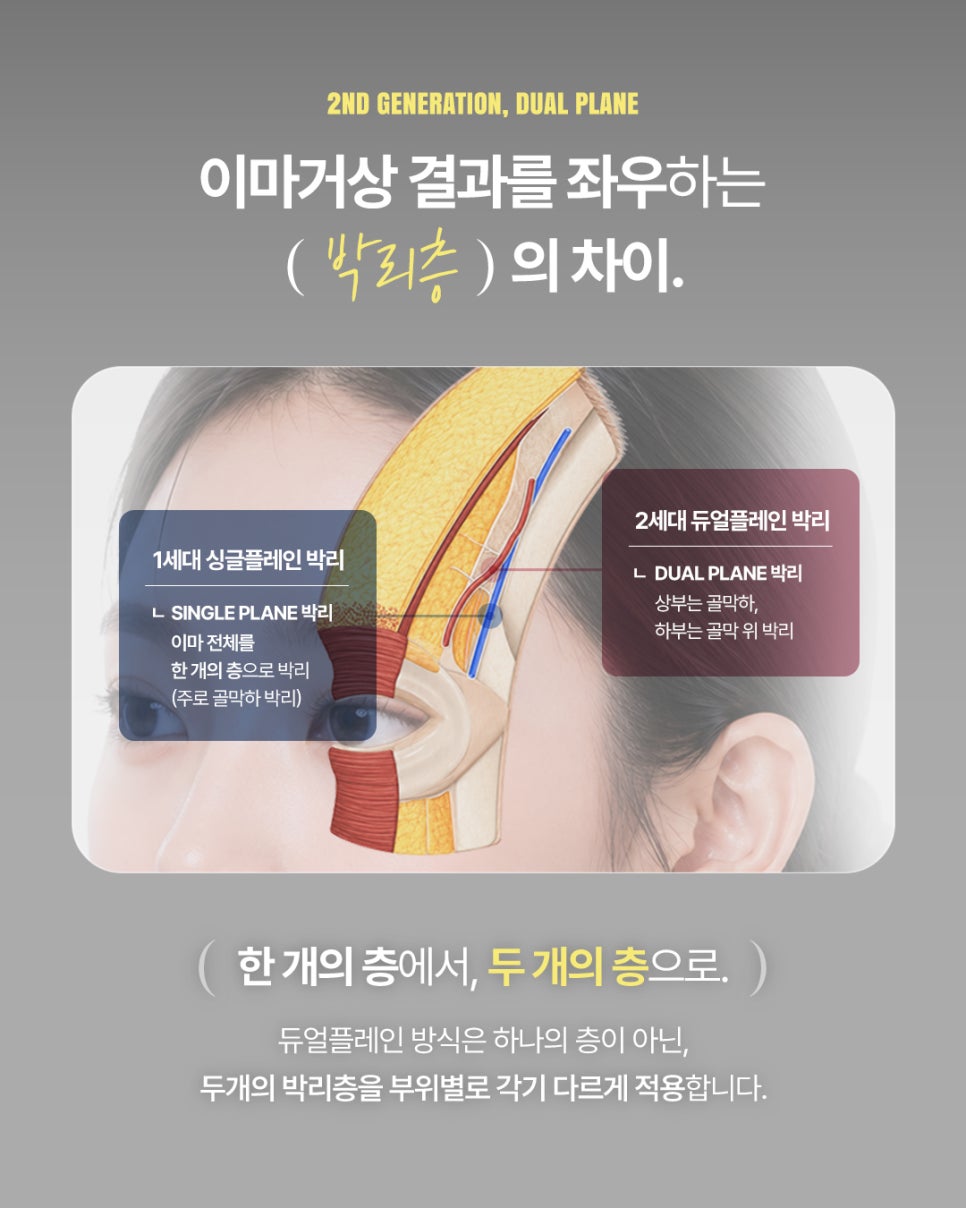
In contrast, with the dual-plane forehead lift, the lower forehead is dissected above the periosteum, in the subgaleal plane.
The key is to leave the periosteum and soft tissue beneath the sensory nerves so that they can serve as a type of cushion. This process may help reduce direct stimulation of the nerves, and the technique aims to reduce postoperative sensory changes and pain.
However, the degree of sensory change or pain may vary depending on individual characteristics and the extent of surgery. Therefore, it cannot be stated that the same degree of change will occur in every patient or that it will be completely prevented. A thorough consultation with a specialist is recommended before proceeding.
4. More precise work through direct visualization of the tissues around the eyebrows
Another feature of the dual-plane method is that the lift can be performed while more directly visualizing the soft tissues around the eyebrows.
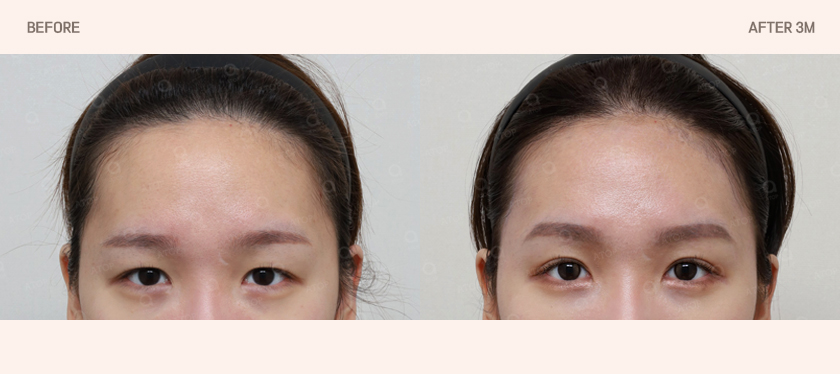
In particular, various soft tissues, including fatty tissue, are present beneath the eyebrows. As a result, it may be difficult to achieve the desired eyebrow position and shape by simply pulling the tissues upward from above.
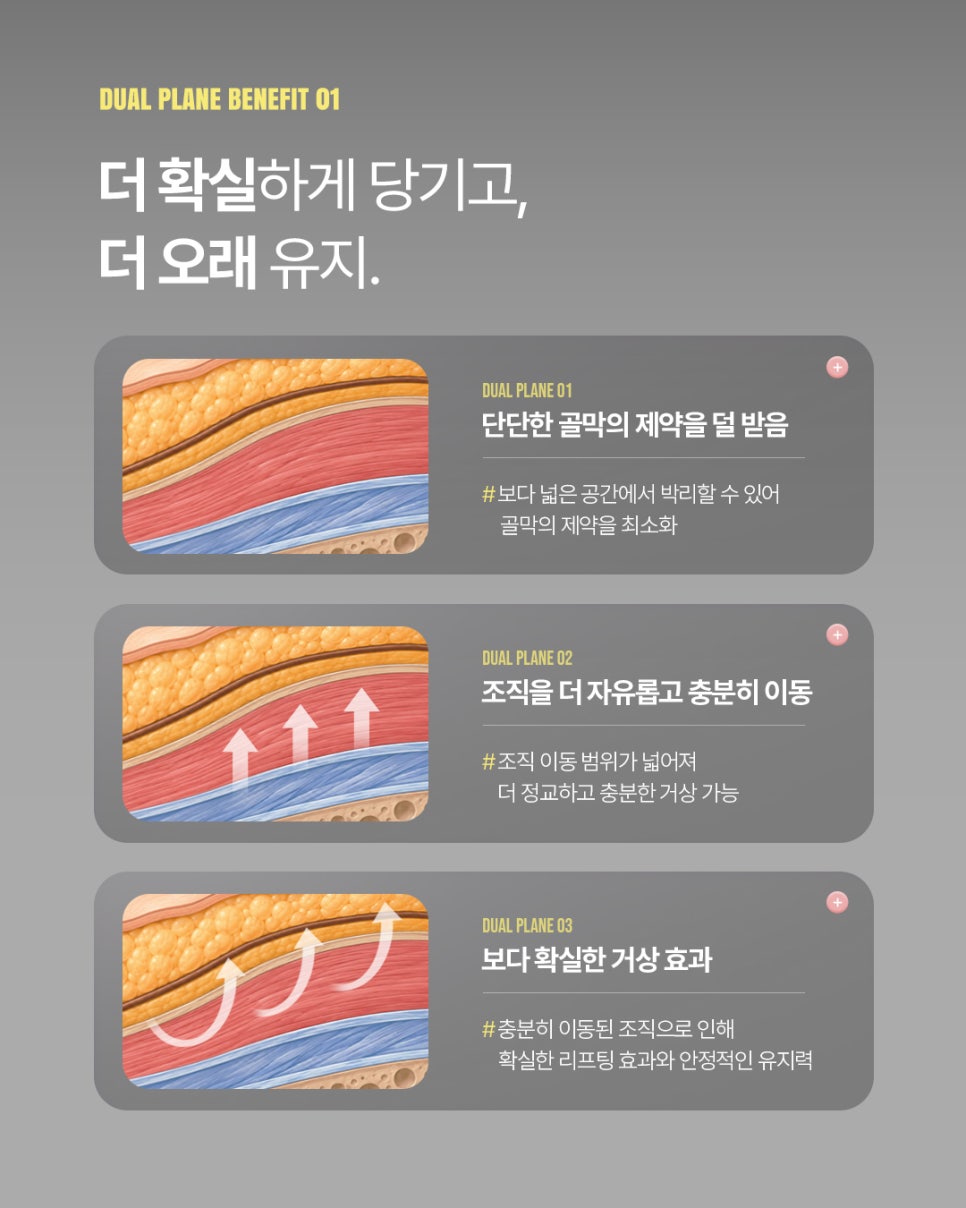
Because the lower forehead is approached through the subgaleal plane, it is possible to directly examine the soft tissues around the eyebrows, refine the necessary areas, and move them upward.
Another feature is that, in the lower forehead, the soft tissues can be moved more flexibly while avoiding limitations on the lift caused by the firm periosteum itself.
As a result, the goal is not simply to raise the eyebrows, but to perform a lift that takes into account the height and shape of the eyebrows and the overall balance extending from the forehead to the eyebrows.
5. Ultimately, what matters is not “how forcefully the tissues are pulled”
It is easy to think that the tissues must be pulled strongly to increase the lifting effect of a forehead lift.
However, in actual surgery, what matters more than how strongly the tissues are pulled is which plane is dissected and which structures are preserved while the tissues are moved. At A-TOP, we have adopted the second-generation dual-plane endoscopic forehead lift, which uses different dissection planes suited to the anatomical characteristics of each area rather than dissecting the upper and lower forehead in the same plane.
Through this approach, the goal is to secure a sufficient dissection range while leaving the periosteum and soft tissue beneath the sensory nerves to reduce stimulation to the nerves and pull the tissues around the eyebrows more delicately.
An endoscopic forehead lift is not simply a procedure that pulls the forehead skin upward. It is important to understand the anatomical structures around the forehead and eyebrows, select the appropriate dissection planes, and move the tissues to the desired position.
In particular, the second-generation dual-plane method considers both lifting and nerve protection by using different dissection planes: the subperiosteal plane in the upper forehead and the subgaleal plane in the lower forehead.
Therefore, the goal is not simply to raise the eyebrows high, but to seek a more reliable lifting effect and lasting maintenance while reducing stimulation to the sensory nerves and the burden of pain.
However, the degree of sagging in the forehead and eyebrows, skin elasticity, and the shape of the bone structure and soft tissues vary from person to person. The actual surgical method and extent of the lift must therefore be determined through a detailed evaluation by a specialist.