Everyone has something precious to them.
And people tend to make every effort to protect it. Even if those around you keep saying that something does not seem good for you or does not suit you, in reality, those words often do not sink in. That is how precious everyone’s feelings are, and no one wants to be hurt. If even a scratch happens, it can become unbearably painful and difficult.
Perhaps people looking around for a breast lift because they hope to correct sagging breasts are in a similar situation. No matter how much someone says that, of course, our bodies cannot stay healthy and strong forever, and that naturally, at some point, elasticity decreases and things begin to sag and droop, and that you should not worry about it, if the situation feels serious to you and your body, including your breasts, is extremely precious and important, then it is understandable that such words would not easily register.

So, is it really natural for a woman’s breasts to sag?
If we have to answer that, it would probably be fair to say that it is not something wholly unnatural or strange. As our bodies age, the strength of parts that maintain the original condition of the human body—such as skin, muscles, and ligaments—gradually weakens, and changes occur in which elasticity decreases and things become loose and sag. Of course, the breasts are included in that.
Breasts are actually a body part made of tissue with volume and weight.
As the structures supporting this heavy tissue lose strength and stretch with age, the breasts can also take on a sagging shape. They can also droop through pregnancy and childbirth. Recently, more research and discussion have been emerging about how much pregnancy and childbirth change a woman’s body, and the breasts are one of the physical changes that come with that.
That is when milk fills the mammary glands so the breasts become fuller and larger in order to feed a newborn baby, but after childbirth and breastfeeding, as that swelling subsides, there are often cases where the breasts do not return to their original shape and instead lose elasticity and sag like a deflated balloon. Repeated yo-yo dieting can also be a similar cause.

In the past, people often did not think much about dealing with sagging breasts through a lift.
To begin with, people did not tend to think about living long lives in a youthful, healthy, and attractive appearance as much as they do now. Once people reached a certain age, it was generally considered desirable to focus more on supporting their spouse and children as a family, and especially for women, there was a strong tendency to place greater emphasis on their roles as wives, mothers, and daughters-in-law. For that reason, many people probably did not seriously think about taking care of and maintaining themselves.
But over time, it became more apparent that breast sagging is not only something that looks bad and is bothersome, but also something that significantly affects the ability to go through everyday life in a bright and healthy way. In fact, when breasts sag like this, if they still have some volume, their weight pulls downward and can cause pain in the shoulders or upper and lower back. As they sag, they can also block airflow under the breast fold and cause skin irritation, leading to chafing and raw skin, so they can create inconvenience in more practical ways as well. That is why people want to improve sagging breasts.
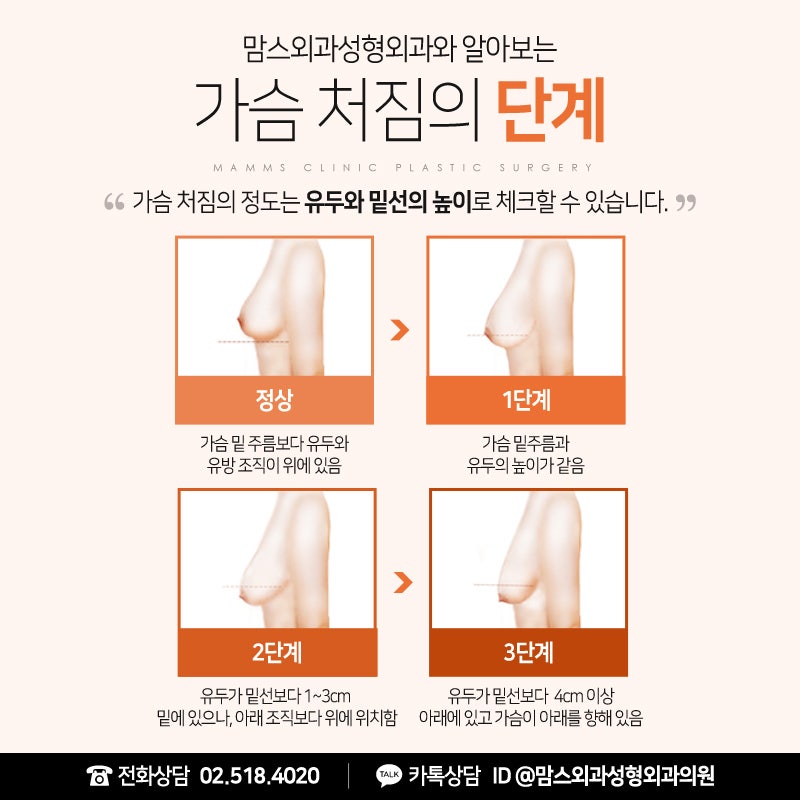
Keeping in mind that this kind of change can happen, there was also a way to check whether one’s breasts were truly looking bad and feeling uncomfortable because of sagging or whether another issue was the cause.
Sagging is judged not simply by whether the breasts look drooped and loose to the eye, but by comparing the height of the nipple and the inframammary fold. In a firm, normal breast that is not sagging, the nipple should be positioned above the inframammary fold.
That is why sagging is considered to begin when the inframammary fold and the nipple are at the same height. When they are at the same height, it is considered stage 1, and the farther the nipple drops below that point, the more advanced the degree of sagging is regarded as being. The reason this check is important is that you need to determine whether what this breast really needs is a breast lift or something else.
When there is actual discomfort, saying, “Why would you even do that?” or insisting that it is only something that bothers you when you look at yourself, that it is not that noticeable once you put on clothes, and that other people do not pay that much attention to every little detail, is nothing more than speaking without understanding.
In any case, someone whose breasts are currently sagging would likely find the situation quite uncomfortable and would only feel satisfied and at ease once it is improved in some way. Telling them that it is unnecessary would be an inappropriate response. It would be better to help them find a way to restore their breasts to a firmer, fuller, and more attractive shape.

So then, what exactly is needed or should be considered for a breast lift?
First, we should look at what people tend to think of first when trying to correct sagging. In this situation, many people first think of implants. Implants are used to increase size, but ultimately, people think that if they use them, the breast shape will be maintained and become pretty again.
That could be called a natural train of thought. However, a problem should not be solved with such a vague idea. There are cases where implants are actually needed, and cases where they are not. Even in the process of improving sagging and lifting the breasts to create a fuller shape, implants are not necessarily something that needs to be considered.
This depends on the characteristics of each person’s breasts. It is necessary to understand how much the skin and tissue have stretched, how much breast tissue remains, and what the original volume was, and then carry out a solution that fits those specifics.

There are two major points to think about in the process of correcting sagging breasts.
When breasts have become sagging because elasticity has decreased, the skin can be seen as having stretched out a great deal, so after pulling it up into a more attractive shape, the remaining loose skin is trimmed. It is easy to think of this as reducing the expanded area.
And the nipple and areola that have moved downward must be properly lifted to the appropriate height and closed with sutures.
At this time, care must be taken so that the nipple does not suffer any problems or damage.
This process can look somewhat similar to breast reduction. In fact, when the breast size is large and needs to be adjusted, this process is sometimes performed together with reduction. After lifting and correcting in this way, there are also cases where implants are used to further improve the volume and shape. There are methods suited to each person.

In conclusion, if we think about the methods used for a breast lift, they can largely be divided into three types.
Basically, once the sagging breasts are lifted, it is good to look at what additional steps follow. In cases where the volume is adequate and the amount of tissue remaining is also appropriate, and the only problem is the sagging itself, a lift alone can be enough to improve the shape nicely.
If there is some volume but it is small and the amount of tissue is also limited, it may help to lift the breasts and then add implants to supplement the volume and further improve the shape.
On the other hand, if the breasts are large, the amount of tissue is very abundant, and the sagging is severe, reduction can be performed together to create a more attractive breast shape and also improve various inconveniences in daily life. It is best to have a detailed consultation about which method is appropriate.

No matter which method is chosen, we must not forget that the ultimate goal is to create the ideal breasts we want and resolve our own concerns.
That is why solutions for breasts, not only sagging breasts, must always be carefully analyzed and performed accurately. It would be good to look closely and decide where such work can be done more thoroughly and precisely.