Since aesthetic standards are different for everyone,
it seems difficult to say that any one thing is the right answer.
So people usually try to meet the image they personally think is pretty and beautiful. If something does not look pretty to me, then no matter how beautiful or impressive other people say it is, or even if they look at me with envious eyes, I won’t feel happy at all, and instead only my dissatisfaction will grow.
Thinking about how much the average cost of breast reduction surgery would be, and what needs to be prepared for this option, can be seen as coming from the same context. When discussing the ideal body shape for women, large and full breasts have generally been included, so one might casually think that bigger is better, and that larger breasts emphasize femininity and look more attractive. However, for someone whose breasts are truly so large that they are excessive, they would say it is simply bothersome.
For people who worry a great deal because of excessively large breasts and who actually experience pain in their bodies and many inconveniences in daily life, large, heavy breasts are only one of the factors making life difficult and painful.
And when the size is this excessively large, the weight is inevitably greater as well, so the breasts are much more likely to sag downward, and the balance of the whole body is easily disrupted. As a result, they are by no means pretty or attractive, contrary to what others may casually imagine. Because this weight keeps putting strain on the body, there were also cases where pain continued from the neck to the shoulders and lower back.
In some cases, body shape changes and posture becomes crooked because of this,
and as time passes, the body becomes more and more painful.
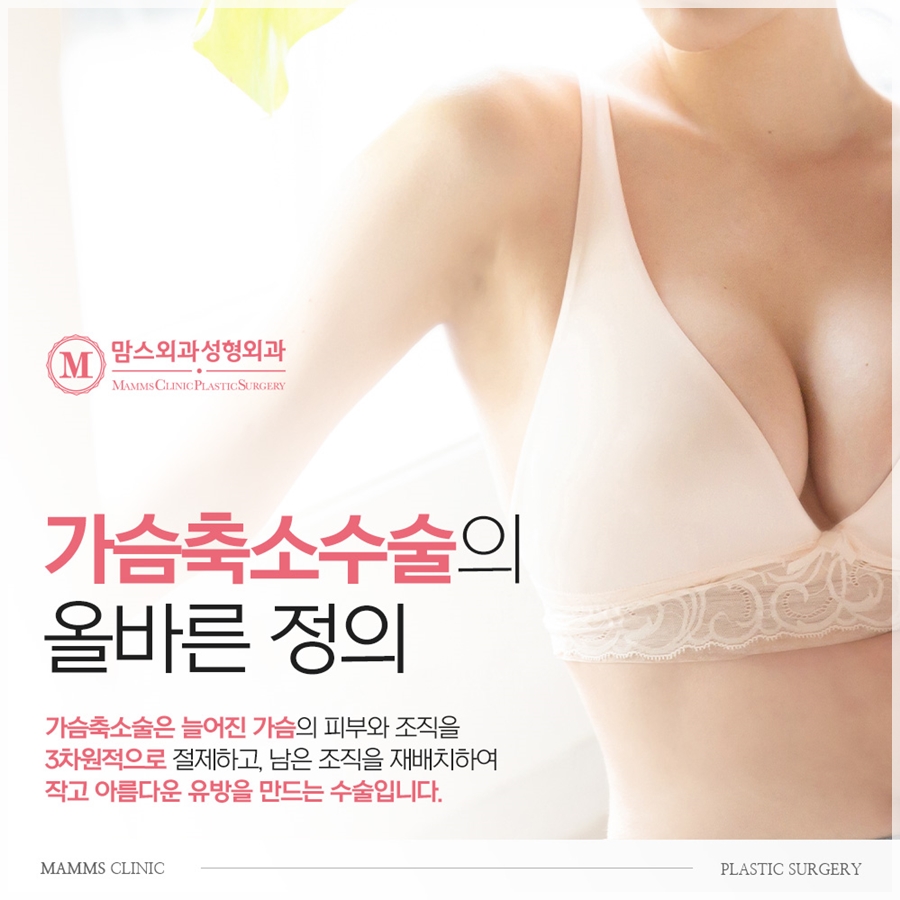
When problems arise even in functional aspects like this, actively reducing the size is better from a health perspective. That does not mean simply cutting off part of it. This approach involves a process of three-dimensionally excising the stretched skin and tissue by an appropriate amount, and then reorganizing the remaining tissue to create breasts that are smaller and also look beautiful and natural.
When we say breast surgery, what usually comes to mind first is an enlargement procedure in which implants are used to increase the size for people who are unhappy because their breasts are small and their body line feels flat.
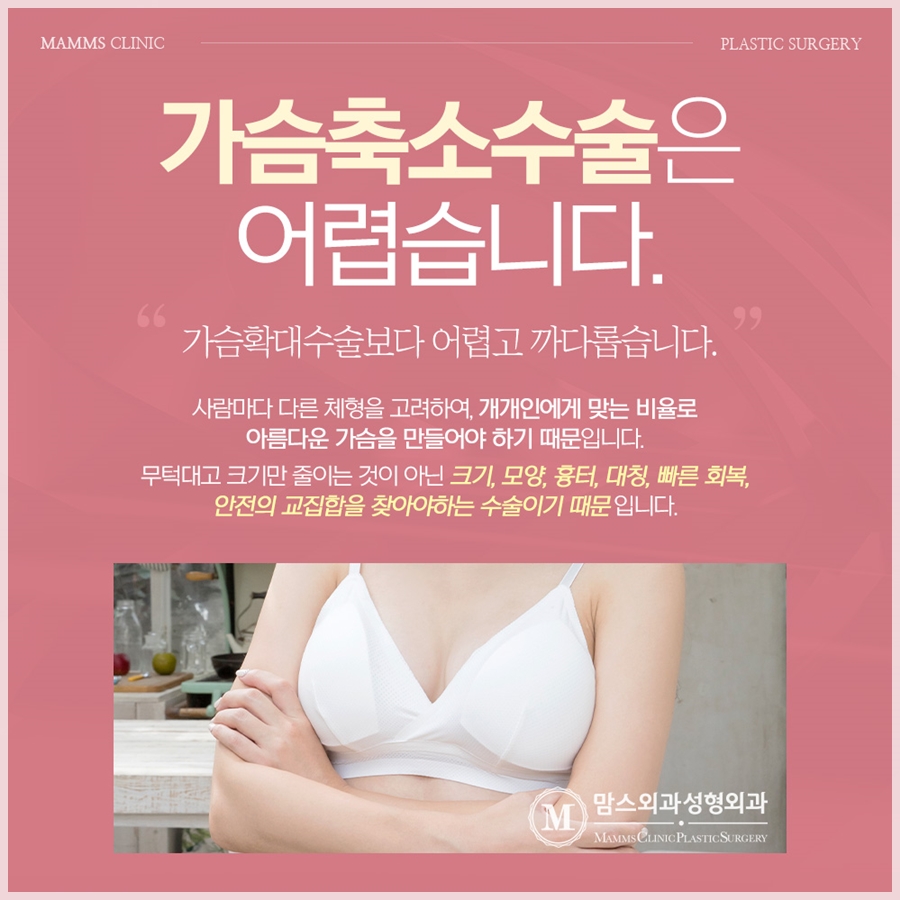
In fact, there are quite a number of people who undergo this type of implant procedure. But if we compare it side by side with breast reduction surgery, it becomes clear that reducing size is a more difficult and delicate task than increasing it.
To use a very simple and intuitive comparison, stuffing cotton back into a deflated and flattened stuffed doll is not very difficult, but making a stuffed doll that is already full of cotton smaller can make your head spin just from imagining it. If you try to make the stuffed doll smaller by simply taking the cotton out, the shape will become wrinkled and collapsed, and if you then try to fix it by simply cutting away the excess and sewing it up, you would not be able to preserve the original shape of the doll.
Breasts are the same. In order to create a natural and beautiful breast shape that fits the body line and proportions, many things must be considered. And unlike a doll, this is our own body, so scars and the recovery process must also be taken into account. That is why it is difficult.
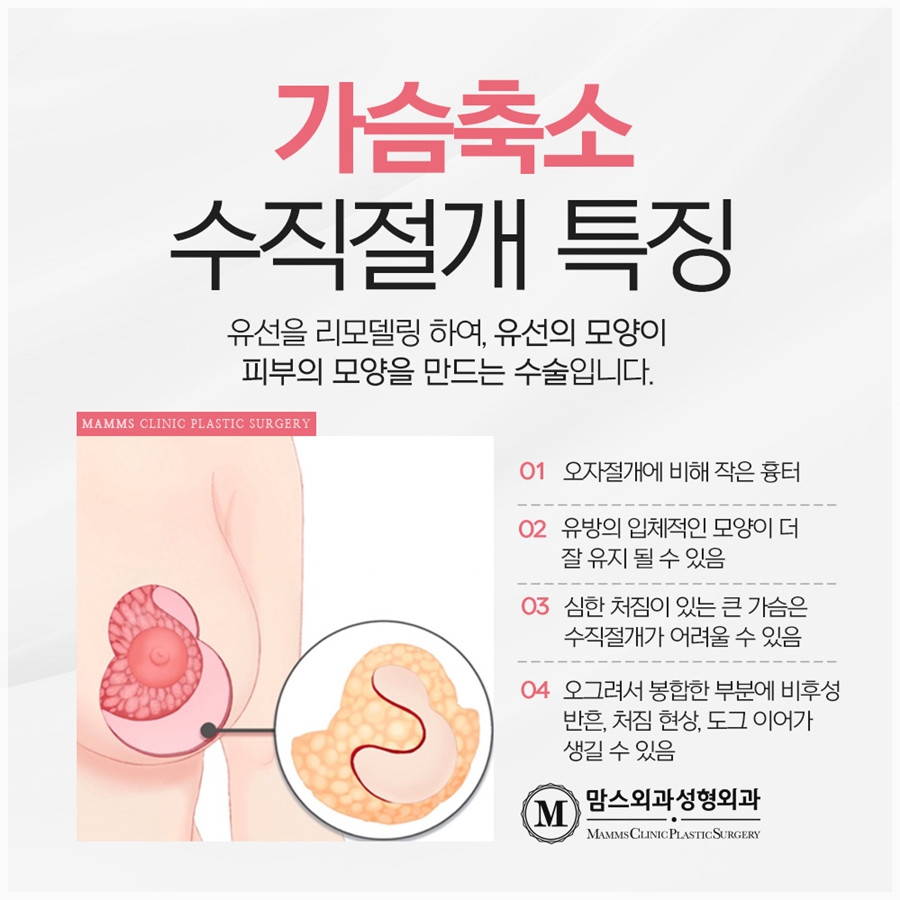
Figuring out how to make the shape as pretty and small as possible while leaving as little scarring as possible and helping wounds heal more quickly has always been a challenge that came with performing this kind of procedure. It was also part of the process when reducing breast size. Originally, this procedure was performed through fairly large incisions: around the areola, a vertical line down from there, and a horizontal line along the lower fold. This is called an inverted-T incision.
The problem with this method was that it left larger wounds, which could mean more scarring and a longer recovery time, and that over time after the procedure, the breast shape tended to become boxy. To reduce the size of the wound, lower the burden of scarring, make recovery smoother, and better preserve a lifted, three-dimensional shape, the vertical incision was developed by removing the horizontal line along the lower fold. In that way, it became the trend. Of course, there were drawbacks here as well.
If the sagging is severe and the breasts are very large, there can be cases where the improvement is not sufficient. Also, there was the possibility that traces would remain at the part where the skin was gathered and stitched.
Still, there were always people who needed this option. From the perspective of those who need it, of course they want results that are more satisfying and more aesthetically pleasing in many ways. Breast reduction surgery costs also require a fairly large investment, so that makes it even more important. So the thinking started again: how can the results be made more satisfying?
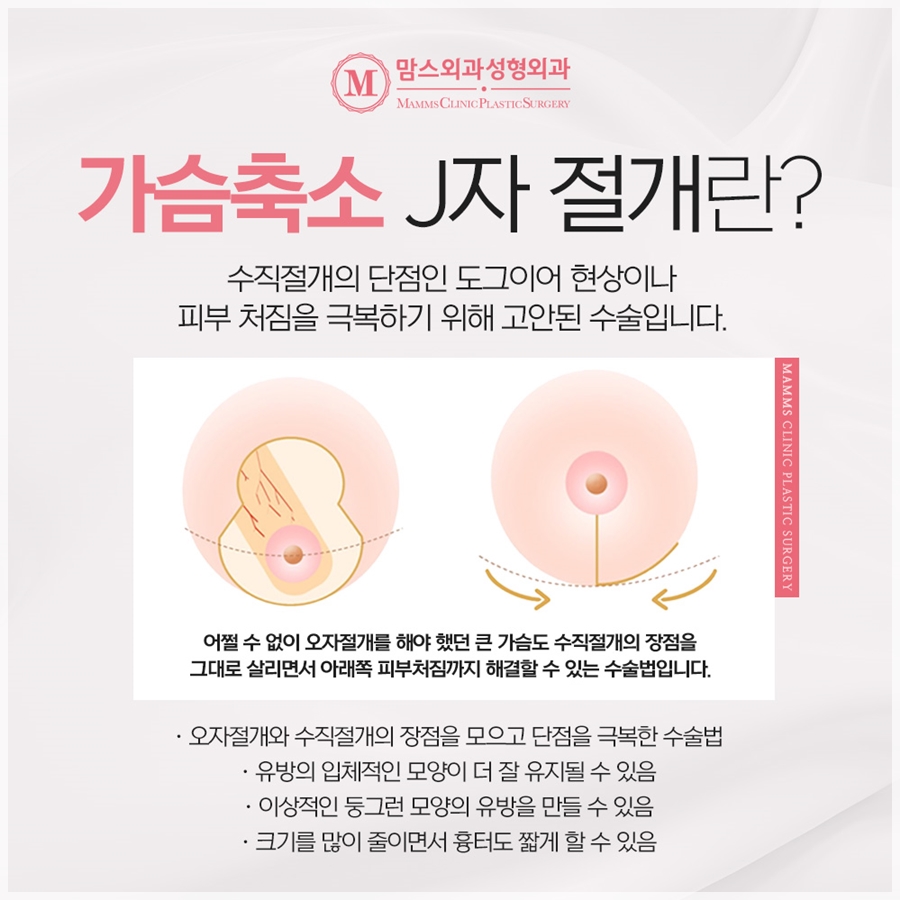
That is how the J-shaped incision came about.
Since this was a new technique that had not existed before, it may sound a little unfamiliar. When the vertical incision alone was not quite enough or felt somewhat lacking, and the inverted-T incision was something you wanted to avoid because of concerns about scarring, the line was extended just a little further sideways from the vertical line.
By doing this, you can combine the advantages of the vertical incision—less scarring and better maintenance of a beautiful breast shape—with the advantages of the inverted-T incision, such as better improvement of sagging and the ability to reduce a slightly larger amount. In this way, the drawbacks of each method, such as scarring and disappointment, can be overcome. And so, another technique was added for meeting a more satisfying version of oneself.
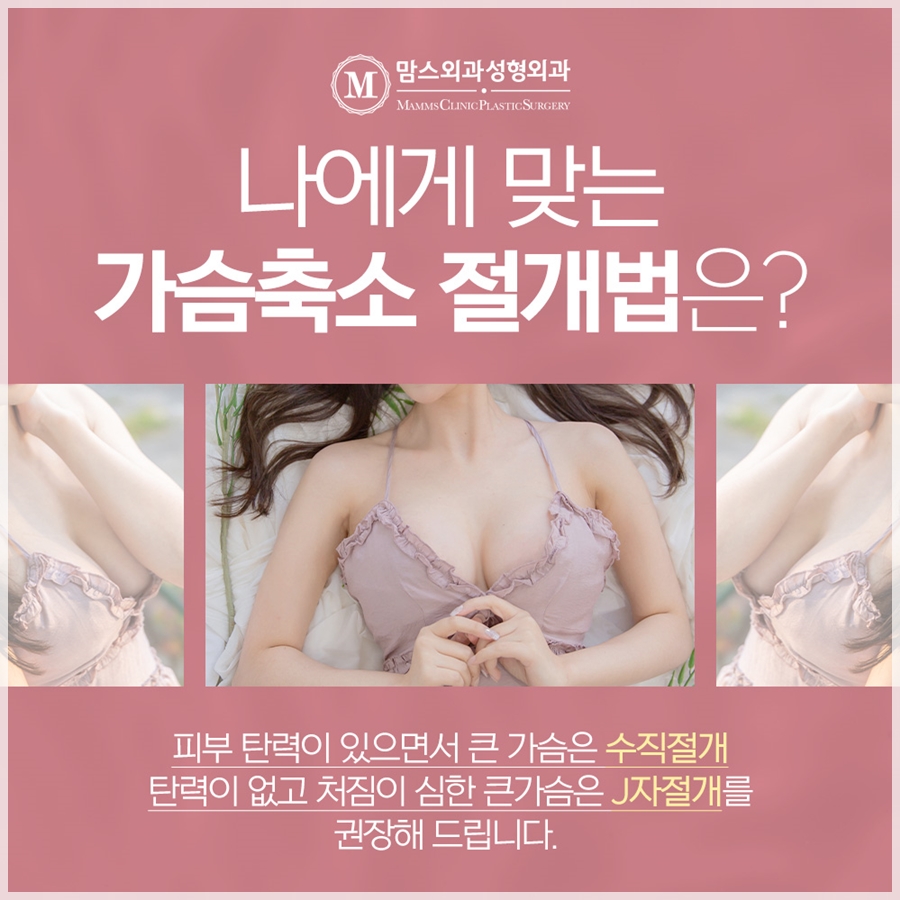
With an average cost of about 3 million to 10 million KRW for breast reduction surgery, it is worth looking more carefully at which method would be the best fit. For people whose skin still has some elasticity and whose breasts are large, a vertical incision may be enough to create a beautiful, appropriately sized result. If elasticity is lacking or reduced, sagging is severe, and the breasts are also on the larger side, then a J-shaped incision may be needed to properly address the issues. In the past, one had to accept a larger wound and undergo an inverted-T incision, but now it is possible with a J-shaped incision that leaves much less of a wound and allows for easier recovery.
Some people may feel 부담스러운 about breast reduction surgery costs or the reduction surgery method itself.
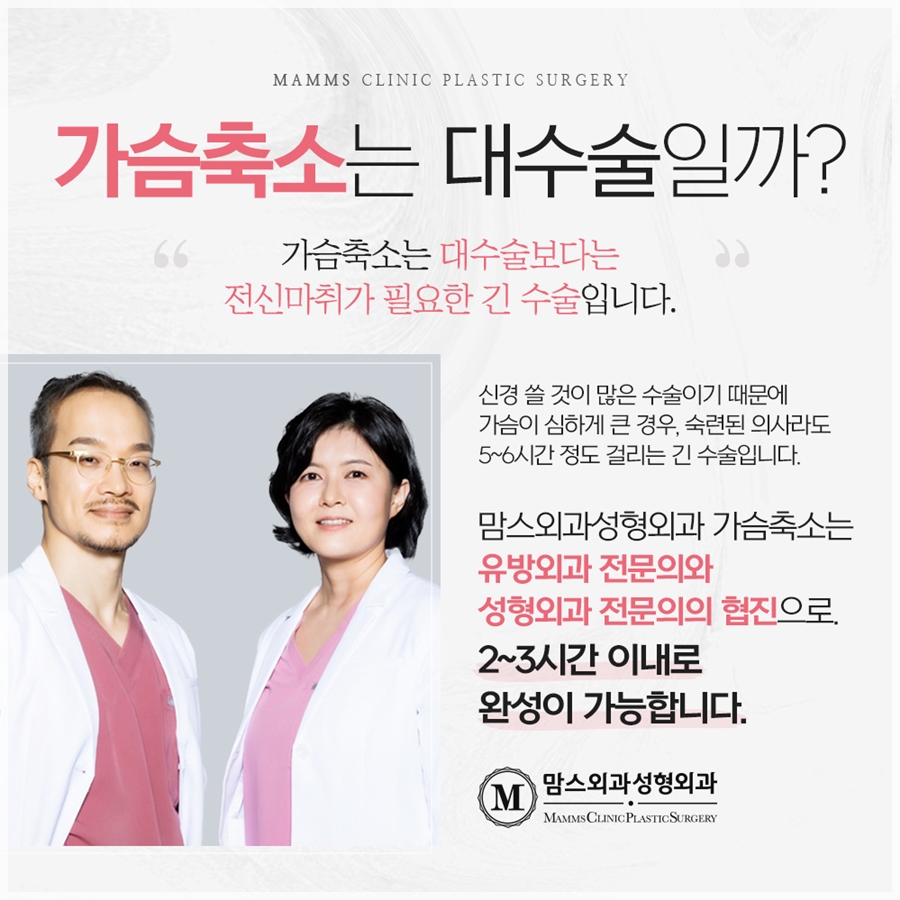
There is the issue of cost, but concerns about whether something large and difficult might also have a negative effect on health add to the burden as well. So it is understandable that worry comes first. However, this method of reducing breast size is less like a major event and more like something that takes a long time and makes the body work harder.
Because there are so many things to pay attention to and the process is so delicate, if the breasts are very large, even skilled hands may need a fairly long time of 5 to 6 hours.
That can certainly feel burdensome. Because of this, there was also thought about whether there might be a way to ease that burden a little more. If a hand that understands women’s breasts in detail and a hand that has a sense of balanced beauty work together in agreement, that burdensome and long time could be reduced. Step by step, the effort to find a better direction was invaluable.
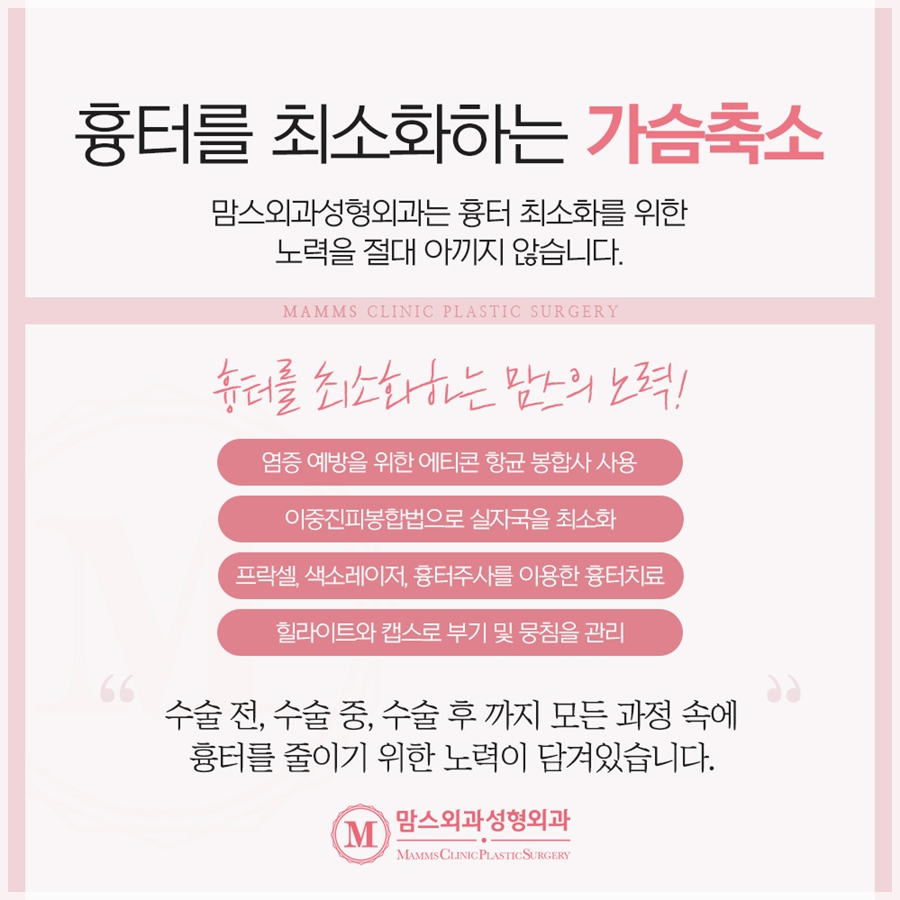
When considering breast reduction surgery costs, which parts to place more weight on can differ from person to person.
Everyone has different circumstances and environments, so there is also no single fixed answer here. But it is also very important to see the process through to the end and stay with it throughout, so I would say it is better to consider that point as well.
Naturally, since the procedure involves making incisions in the skin, there will be concerns about scars and worries about recovery afterward. Because of the anxious feelings that come from that, it may feel even harder. So it can help to look at how much effort is being put into minimizing scars as much as possible. In reality, once a deep wound has formed and a scar remains, it cannot be completely returned to the way it was before.
That is why care must be taken from the beginning to reduce the size of the wound and make sure it is neatly joined only as much as necessary. If thorough aftercare follows as well, satisfaction will be even higher. It would be good to think carefully in many different ways before deciding and choosing.