Why does my armpit hurt? Why does my armpit hurt? Why does my armpit hurt? Why does my armpit hurt? Why does my armpit hurt? Why does my armpit hurt?
Why does my armpit hurt?Why does my armpit hurt?Why does my armpit hurt?Why does my armpit hurt?Why does my armpit hurt?Why does my armpit hurt?
Our bodies can hurt in different places at any time. Pain always comes unexpectedly, and people naturally begin to wonder why they suddenly feel pain. Among these cases, some people complain that their armpit hurts and mention pain in a specific area.
Of course, there can be many causes of pain, but when talking about this kind of pain, many people guess that there may be a problem with the lymph nodes hidden inside, or that it is caused by muscle strain.
That is because these are the easiest and most common causes to think of. While these reasons can certainly be worrying, it is also worth considering whether there may be a cause that has not been thought about much. In particular, for women, if the pain appears according to the menstrual cycle, the presence of an accessory breast should be considered at least once.
What Is an Accessory Breast?
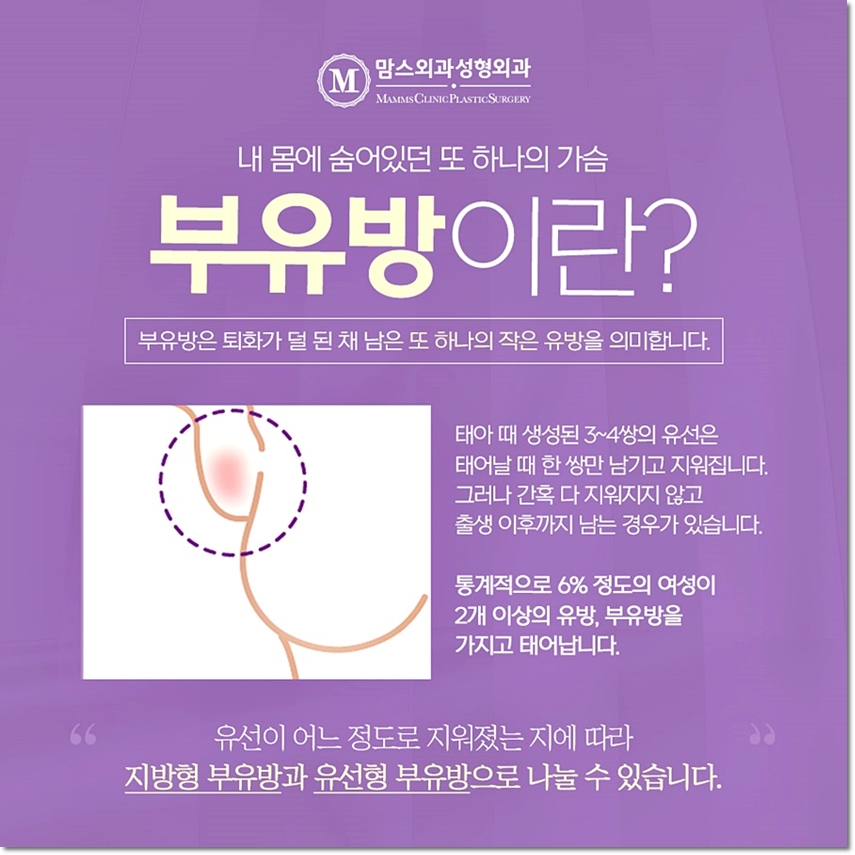
The thing people usually know about an accessory breast is probably the so-called "armpit fat," meaning fatty tissue in the armpit area. That is not entirely wrong, but in the case of an accessory breast, it is also important to know that it cannot simply be seen as just being fat in the way we normally think of it. Saying someone has gained weight means that fat has accumulated and made the area thicker.
Of course, accessory breasts can also contain fat, but that is not all, so it is important to understand them correctly. An accessory breast can be interpreted as an additional breast. In other words, it is not just fatty tissue, but an area similar to the breast or chest. Because of that, it may contain glandular tissue inside, and that is why a sharp, tingling pain is often felt more strongly according to the menstrual cycle.
This happens because, during fetal development, several mammary glands form and then one pair remains at birth while the others disappear; in some cases, not all of them disappear and some remain.
The Key Is an Accurate Diagnosis!

Here, differences arise depending on each person's situation. The treatment approach changes according to how much glandular tissue remains without disappearing completely. Making an accurate diagnosis of this situation became an important factor. Even if someone has never said, "My armpit hurts," it does not mean there is little glandular tissue; conversely, even if someone feels pain easily, it does not necessarily mean there is a lot of glandular tissue inside.
The size does not vary greatly depending on this structure either. Therefore, it is difficult to know accurately just by looking with the naked eye or by symptoms and sensations.
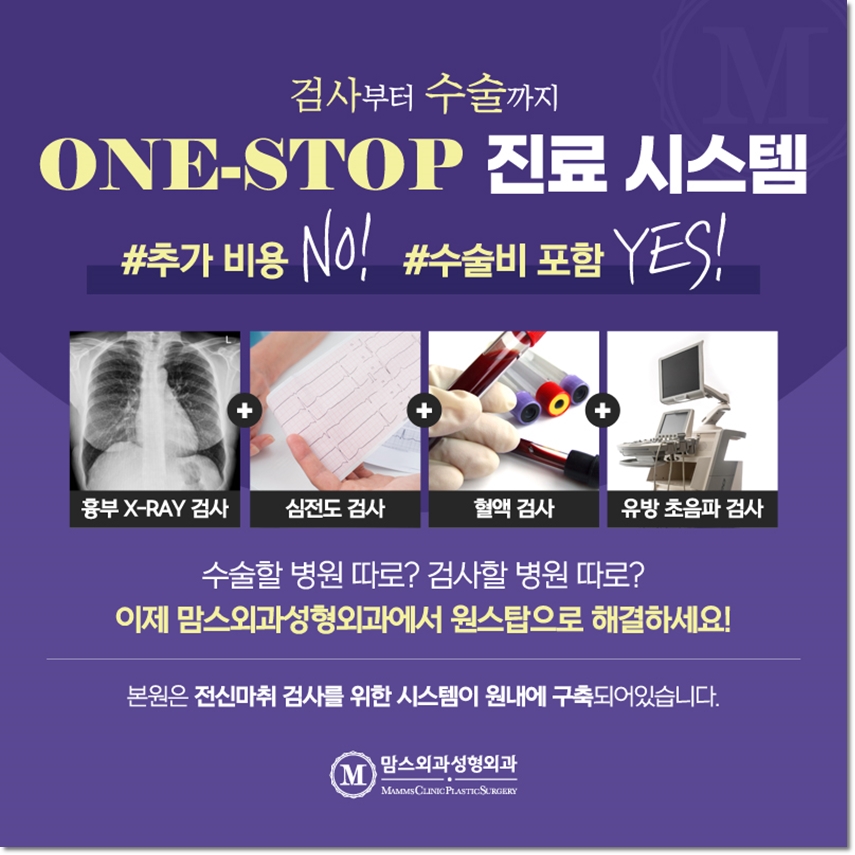
If you want to know the exact situation, you should undergo an X-ray examination. People often ask whether ultrasound can be used instead, but ultrasound results and opinions can vary depending on the person interpreting them, whereas X-rays are an objective method that clearly shows which part is which tissue and what shape it has, so they may be necessary.
Surgical Methods by Accessory Breast Type
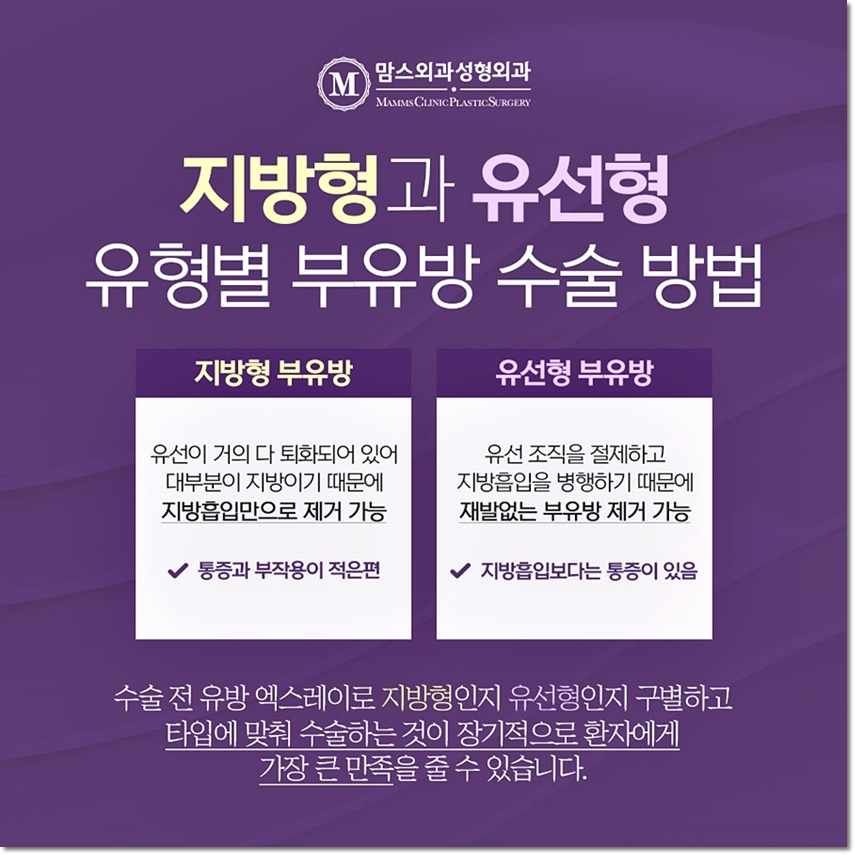
If you take an X-ray and examine it, you can distinguish between a fatty accessory breast and a glandular accessory breast. These two different types require different approaches when deciding on a solution for improvement. If the glandular tissue has almost completely regressed and remains only in a very small amount, then improvement can be achieved sufficiently by liposuction alone, so choosing the liposuction method is better.
The liposuction method tends to involve less pain and risk, and if there is almost no glandular tissue, attempting gland removal unnecessarily would only create more wounds. On the other hand, in a glandular accessory breast, where glandular tissue is densely present inside even if it is not clearly visible on the outside, removing the glandular tissue is essential.
A glandular accessory breast has the characteristic of growing back and recurring if the glandular tissue at its root is not properly removed. Therefore, even if it is slightly more painful than liposuction, it must be clearly treated to achieve satisfying long-term results, so this should be carefully considered.
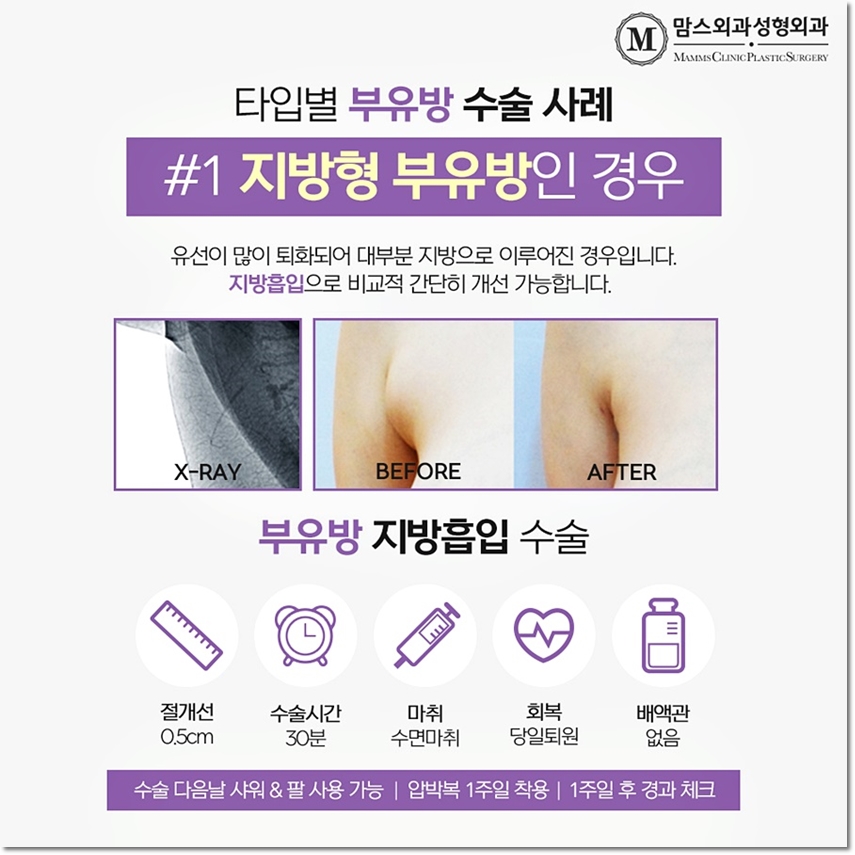
Now, let us go over the improvement methods for each type once more. For the fatty type, treatment is performed through suction. People are born with leftover glandular tissue, but in this case the amount is close to negligible and fat makes up most of it, so improving only the fat that creates the bulging shape can produce fairly good results, which is why suction is recommended.
Because liposuction is a relatively simple solution, the burden felt by the patient is also lighter. That is why it can be a much better choice than unnecessarily making an incision just to remove glandular tissue that is almost nonexistent. The incision is very small at 0.5 cm, it does not take long, and recovery is faster, which are clear advantages. Since the cause of "my armpit hurts" does not necessarily have to be a large amount of glandular tissue, you should not think about it only in simple terms such as symptoms, but rather place importance on receiving an accurate diagnosis.
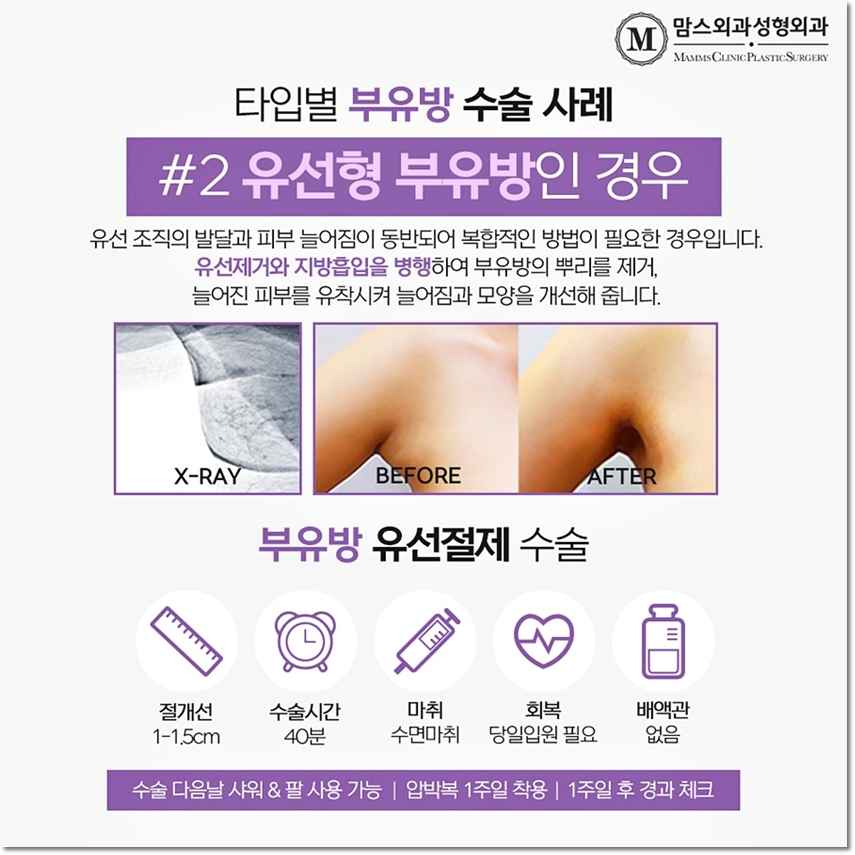
For a glandular accessory breast, gland removal is said to be essential. There are also several different cases within this type. If the glandular tissue is full but there is little fat and it is not visible from the outside, improvement is possible simply by carefully removing the glandular tissue as one mass. However, if loose skin is visible, both gland removal and liposuction may need to be performed together.
Here, suction is used to draw in the loose skin and create adhesion to improve the shape. Gland removal is not an especially complicated or time-consuming solution either. An incision of about 1.5 cm may be made, but this is still quite short, and there is know-how for hiding it well in the armpit crease so it is not noticeable. If you want a definite result, it is worth considering carefully.
Reasons the Surgical Methods Differ
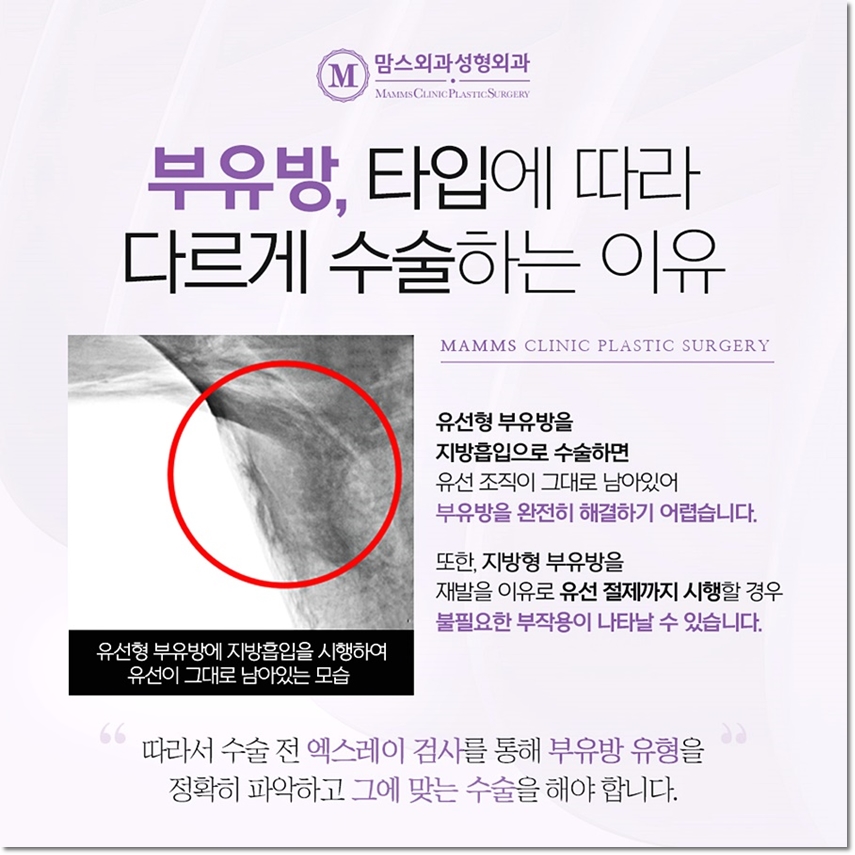
Even so, there may still be cases where people wonder whether it is really necessary to use different methods depending on the type. It seems understandable that if liposuction is attempted for a glandular accessory breast, the glandular tissue cannot be removed and the risk of recurrence increases. But if that is the case, one might also think that a fatty accessory breast still contains at least a little glandular tissue, so it would likewise carry a chance of recurrence.
Of course, that idea would not be completely wrong. However, the reason for reconsideration is that it becomes an unnecessarily excessive method.
Even if a very small amount of glandular tissue remains, it is judged that it will not have much effect, and rather than creating more wounds and touching deeper spaces inside the body, it is better to focus on improving the visible bulge. In this way, treating it with suction alone can actually help prevent various additional troubles.
Where Should Accessory Breast Surgery Be Done?
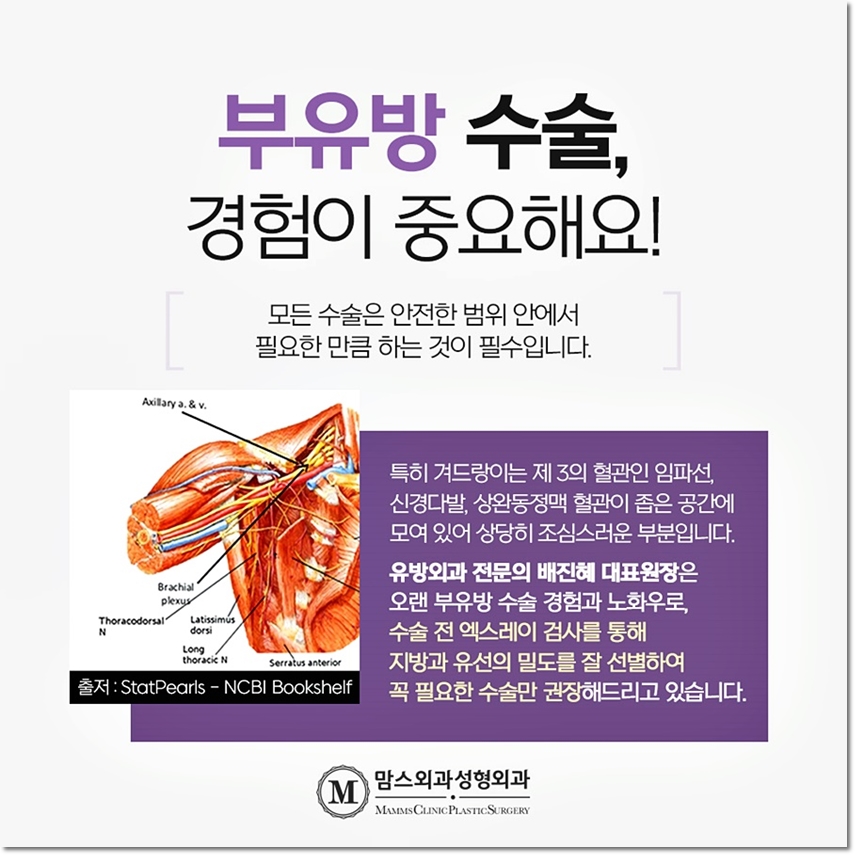
Lastly, even if it does not seem especially difficult or complicated, it is important to remember that because of the characteristics of the area, it is better to have the procedure performed at a place with sufficient experience. People who say, "My armpit hurts," often think the pain is coming from lymph nodes or muscles inside. That is because the inside of the armpit contains not only lymph nodes, but also nerve bundles and major important blood vessels gathered closely together in a narrow space. You need to know a method that can proceed very carefully without touching these structures. Do not forget to check whether they have solid experience and know-how.











 Previous image
Next image
Previous image
Next image






Previous image
Next image







Previous image
Next image