

Among those who have undergone
breast reduction or lift surgery,
there are also people who consider revision surgery.

There are many reasons for this concern,
but one of the representative reasons
is that the areola becomes larger and wider after surgery.
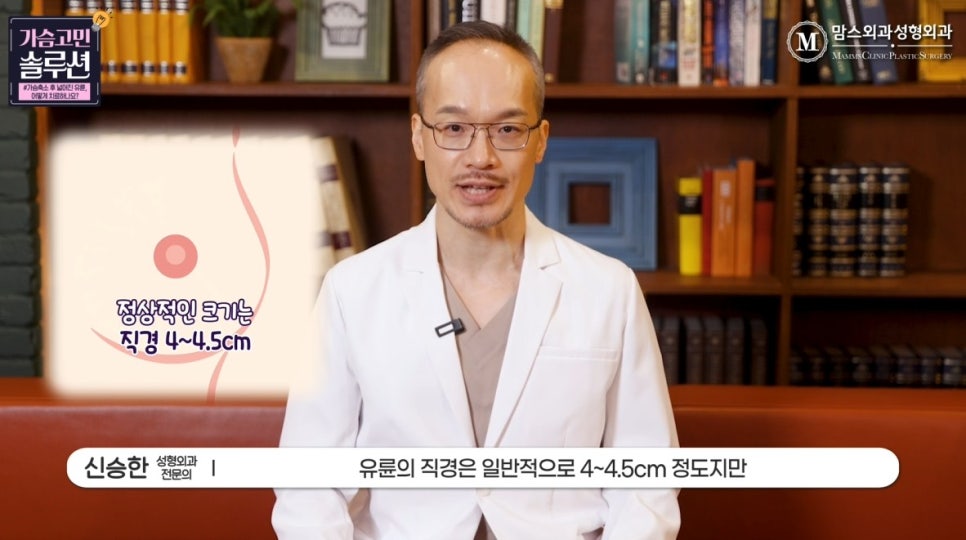

Generally, the normal size of an areola
is considered to be about 4 to 4.5 cm in diameter,
because after reduction surgery it can
increase by about 2 to 3 times.
People who undergo breast reduction surgery
usually decide after a very long period of
physical and mental stress and much thought,
so immediately afterward they are often satisfied
just with the fact that the size has been reduced.
However, as time passes, if the areola widens significantly,
it can even take up half of the breast,
and satisfaction often decreases.


The reason this happens is usually that,
after excising the skin around the areola,
the surrounding skin is pulled toward the areola
and gathered before being sutured.
This also means it can occur in cases where
reduction or lift surgery is performed using
the areolar incision method.


This process involves cutting the skin and tissue
around the areola in a donut shape,
pulling the surrounding skin together,
and securing the inside with non-absorbable sutures.
At this time, if the skin near the areola gathers
like the opening of a pouch, wrinkled folds form,
but these usually become smoother over time.
However, it is said that it is difficult to explain
the clear reason why these wrinkles disappear.


It can be thought to be due to the difference
in elasticity between the surrounding skin
and the areolar skin.
The areolar skin stretches easily,
while the thick skin around the areola does not stretch easily.
If the surrounding thick skin is gathered and sutured,
it is not that it heals in that position;
the surrounding thick skin returns to its original position,
and the areolar skin, which has good elasticity,
stretches and smooths out.


Therefore, the wrinkles disappear,
but a deformity occurs in which the areola
becomes excessively enlarged.
Of course, to prevent this, Gore-Tex sutures
or nylon sutures are used to try to keep it
from stretching again,
but the effect is difficult to maintain for long.
The reason is that it is difficult to secure soft tissue
with firm sutures.


The important point is how to restore this
enlarged areola to its original state.
Usually, it is often improved with revision surgery
using the same method,
but in the end, there is a high possibility
that the same phenomenon will repeat.
No matter how many times the wrong method is repeated,
the underlying cause remains the same.


The reason the areola became wider is ultimately
a mismatch in the lengths of the two sides that need to be sutured.
Therefore, only when the lengths of the two sides
being sutured are similar can widening of the areola
be prevented.


However, in this case, a vertical scar may also form
below the areola.
In such cases, it is important to make the scar
less noticeable.
Also, even if such a scar is taken into account,
it is important to create an attractive breast shape.

To summarize, in order to improve an excessively
enlarged areola, it can be said that the approach
is to convert from the areolar incision method
to the vertical incision method.