
Whether revision surgery is needed after breast reduction surgery should be determined carefully, based not only on appearance but also on the anatomical structure of the surgical area, the patient’s overall health, and especially the condition of the blood vessels leading to the nipple.

The most crucial part of determining whether revision surgery is possible is evaluating from which direction the blood vessels supplying blood to the nipple enter, and how stably that blood flow is maintained.
This can be considered an essential factor in preventing serious complications such as nipple necrosis.

However, the location of the pedicle selected by each surgeon to preserve blood supply to the nipple during surgery differs, and each patient’s anatomical structure and vascular distribution also vary.
Because of this, it is especially important to accurately assess the condition of blood flow to the nipple before revision surgery.
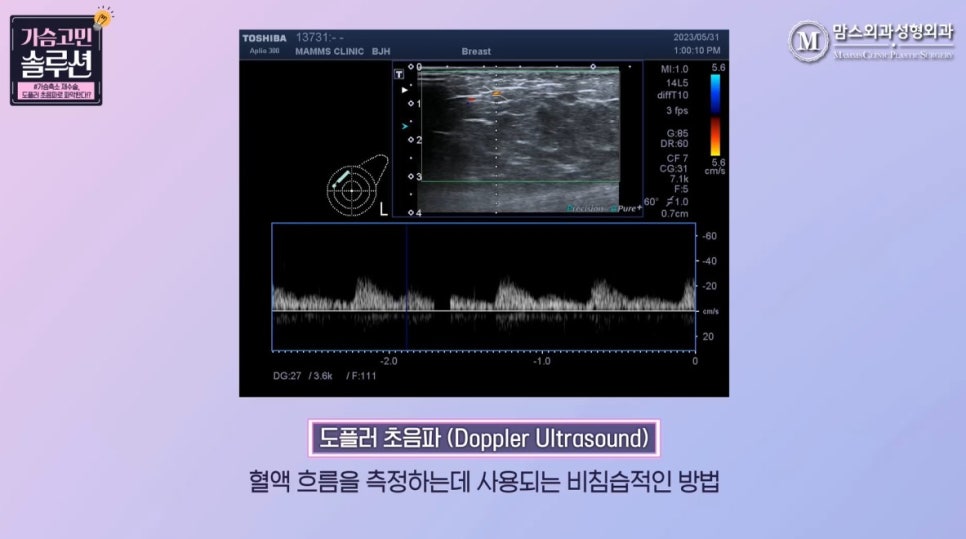
Representative methods for evaluating these vascular conditions include Doppler ultrasound and angiography.
Doppler ultrasound is noninvasive and can visualize blood flow in real time, making it advantageous for precisely checking whether the vessels around the nipple remain open, the speed of blood flow, and the possibility of thrombosis.

On the other hand, angiography is an examination in which a contrast agent is injected into a vein and the blood vessels are visualized with CT or MRI.
It allows for more detailed imaging, but it also involves exposure to radiation and the use of contrast agents.

However, clinically, Doppler ultrasound alone can sufficiently identify the location of the main vessels supplying the nipple and the state of blood flow, which is the basis for omitting angiography that requires contrast agent use.
In particular, if Doppler confirms that blood flow to the nipple is being maintained stably, the necessary information for confirming the safety of revision surgery can be obtained.
In conclusion, Doppler ultrasound is a method that can reliably perform a preliminary assessment of the vascular structure of the nipple, and this information can be used to determine the possibility and level of risk of breast reduction revision surgery.