
"Breast reduction surgery takes
as long as 5 hours?"
When people hear this for the first time,
they are usually surprised.
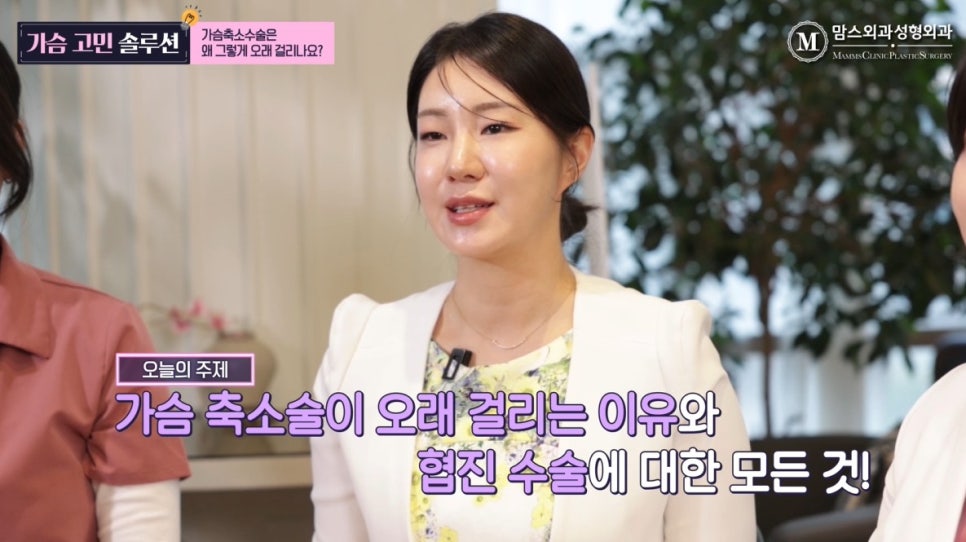
Today, we will look at why breast reduction surgery
takes a long time,
and also take a look at combined surgery,
which many people are curious about these days.

When people think about reducing the breasts,
many assume you can simply remove and cut away tissue.
However, this is not just a surgery that reduces size.
It is a highly complex reduction procedure that includes
design, symmetry, nipple position,
suturing, and scar management.

Because everyone has different amounts of fat, glandular tissue,
and skin structure,
the tissue must be removed in a balanced way.
Most people have some degree of breast asymmetry,
so correcting asymmetry also takes
a considerable amount of time.
In other words, since the aesthetic aspect is also involved,
not only the overall shape but also the scar line and
suture line must end up clean and neat.

The suture line is especially important.
Meticulous suturing is essential.
The wound must be sewn layer by layer, from the inside out,
so that the scar heals more neatly and stability
is also improved.
In addition, these days many people prefer an overall body line,
so more patients are combining liposuction with
breast reduction surgery.
If the arms or abdomen are also treated,
the surgery time can become even longer.

Now, let’s also look at the advantages of combined surgery.
First, combined surgery can significantly reduce the
overall operation time.
Usually, you can think of it as finishing in about
two and a half hours.
Because it is a collaboration between breast surgery and plastic surgery,
it also has the advantage of addressing both safety and aesthetics
at the same time.

You may be wondering what the secret is behind
saving time.
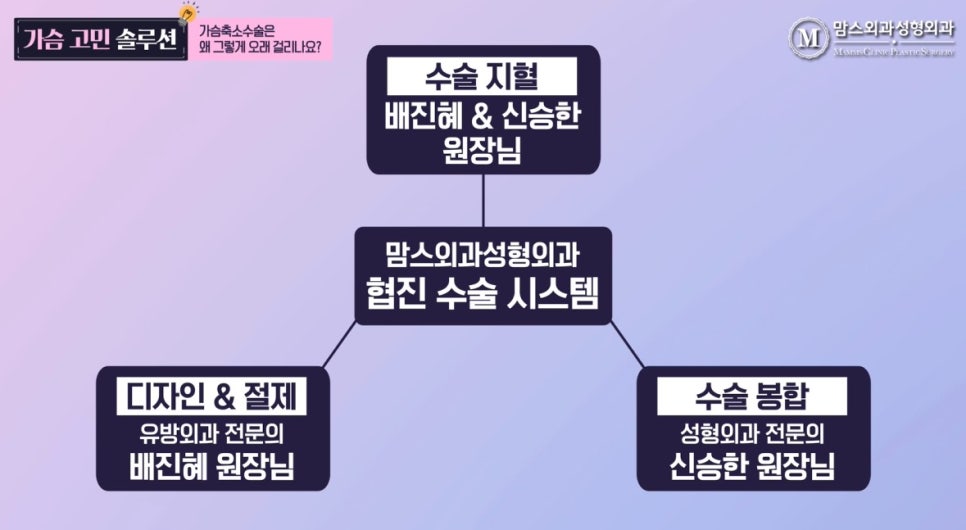
The design and resection process are handled by
a breast surgery specialist,
the surgical suturing is handled by
a plastic surgery specialist,
and hemostasis is done together.
The design and resection parts are like an
architect's blueprint,
while surgical hemostasis and suturing are like
an interior designer.

Because the surgical design is carefully planned in advance,
and the blueprint is established before surgery,
and because the team is divided by process,
the teamwork is faster, which also means the surgery
can finish sooner.

Compared with operating alone,
combined surgery distributes expertise,
which can lead to a higher level of completion.
A trusted partner takes over the next step,
so the procedure can proceed more accurately
and with more ease.

In the end, a shorter surgery time also means
a shorter anesthesia time.
As a result, recovery after surgery also tends to be faster.
Most of all, because the medical team becomes less fatigued,
postoperative treatment and laser care can also be
delivered with greater attention.

Postoperative care is also carried out jointly.
If we divide it into preoperative and postoperative care,
plans are made based on preoperative X-rays and photos,
and sometimes the director’s perspective becomes
the patient’s perspective,
which can also become an opportunity for a double check.
Laser treatment and follow-up care after surgery are also
divided by role.
This kind of cross-checking seems to provide
an even greater sense of trust.

To summarize today’s discussion,
breast reduction surgery is not simply about
reducing size,
but rather a complex process that includes
design + function + aesthetics.
It is a surgery that requires time investment to achieve
precise results,
and please remember that combined surgery also affects
both recovery speed and overall completion.