
Today, let’s talk about breasts that may not look large enough to need reduction surgery,
but are significantly sagging and stretched.

When people think about improving breast sagging,
what procedure comes to mind first?
Some may think of reduction surgery in cases like this,
but in actual clinical practice,
breast augmentation is performed more often than breast reduction surgery.

There may be many reasons for that,
but perhaps it is because many patients think breast augmentation surgery is simpler.
The incision is smaller and the surgery time is shorter,
so that may be why.

You may think, “My breasts were firm and full when I was younger, but now they have sagged and stretched. If I fill them with an implant to reverse this situation, won’t they become firm and lifted again like before?”

This idea is half correct and half incorrect.

To improve breast sagging with an implant,
you need to carefully assess the positional relationship between the nipple and the inframammary fold.
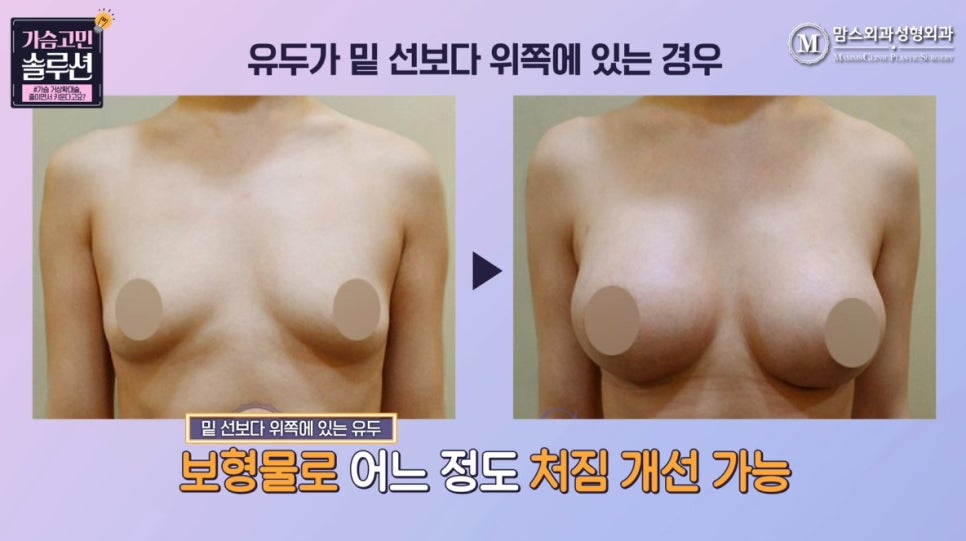
If the nipple is positioned above the inframammary fold, then an implant can improve sagging to some extent.
As the implant is inserted, the skin between the nipple and the inframammary fold stretches,
so the breasts appear lifted overall and the skin also looks firmer.

However, if the nipple is positioned below the inframammary fold,
then sagging is difficult to improve even with an implant.
In such cases, if only an implant is inserted,
the upper part becomes fuller while the lower part remains saggy,
creating an awkward breast shape.
So in these cases, it is better to perform augmentation and lifting at the same time.

In other words, if you want improved sagging along with fuller upper breasts,
you would undergo a breast lift with augmentation.

A lift is a surgery that removes excess skin or tissue,
and augmentation is a surgery that increases size with an implant,
so at first glance it may seem like a contradictory situation.
However, there are reasons for doing these seemingly contradictory procedures.

A lift does raise sagging breasts,
but it does have one drawback.
That is,
'it cannot fill the upper part of the breast!'
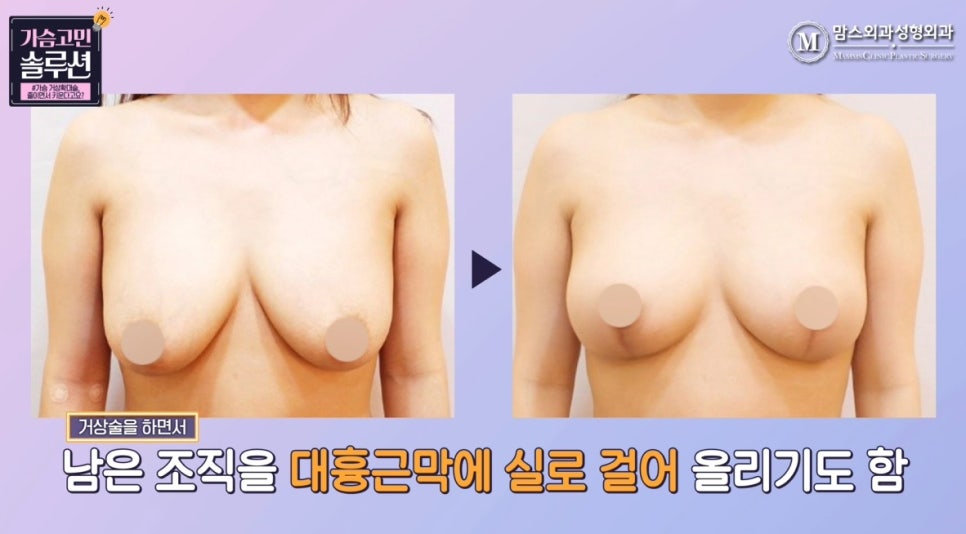
Many people find this quite disappointing.
To address this, during a lift, some surgeons try to use sutures to pull the remaining tissue upward and attach it to the pectoralis fascia.
However, no method can beat time and gravity,
so the effect is only temporary.
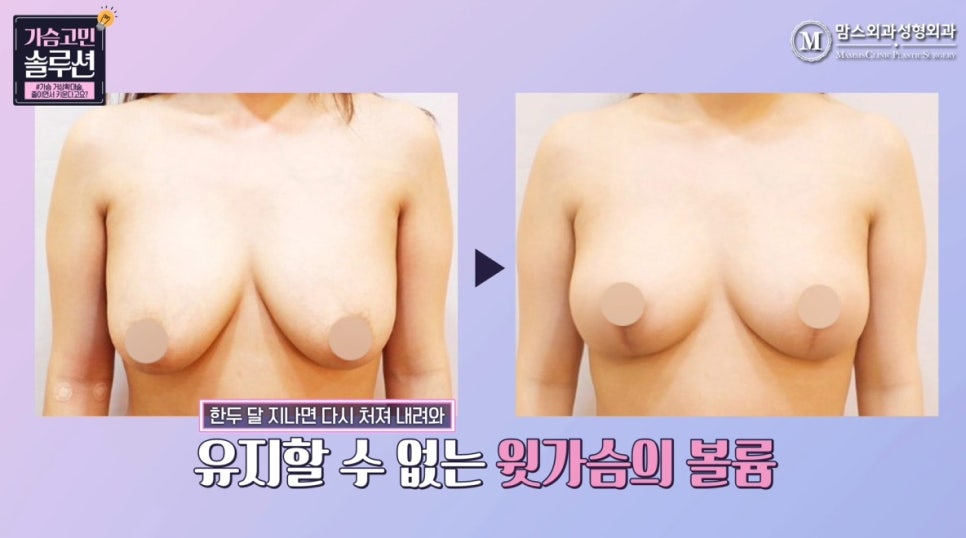
No matter how firmly the upper area is fixed,
heavy breast tissue cannot be held in place by sutures in the long term,
and after one or two months,
it will sag again, making it impossible to maintain upper-breast volume.

Ultimately, the only ways to fill the upper breast are with fat grafting or an implant.
However, fat grafting can form cysts or calcify,
which can interfere with breast cancer screening,
so in practice an implant is the more reliable way to fill the upper breast.

Therefore, for breasts with little volume and sagging,
performing a lift and augmentation at the same time is the approach used,
and this is how both sagging and insufficient volume can be improved.
There is some debate over whether it is better to have augmentation and lift at the same time,
or to have the lift first and the augmentation later in two separate surgeries.

If done all at once, the advantage is that the overall treatment period can be shortened,
but the drawback is that blood flow to the nipple may become unstable.

From the patient’s perspective, having it done all at once is probably better in terms of time and cost,
but for a breast lift with augmentation, it is important to ensure stable blood flow.
In addition, because the amount of skin to be removed for the lift must be predicted accurately,
it is best to have the procedure done at a clinic with extensive experience and expertise.