For those preparing for surgery, the biggest concern is naturally the issue of side effects.
Today’s topic is not about side effects themselves,
but about the factors that increase the side effects of breast reduction surgery.

Representative examples of such factors include
obesity, medications,
or existing medical conditions,
among several others.
Among them, today we will talk about the most common
and the most clearly proven cause-and-effect factor:
‘smoking.’

Looking at recent smoking-related statistics,
the smoking rate, which had been declining for 10 years,
has started to rise again.
In particular, the smoking rate among women
is also continuing to increase.
The recently popularized
e-cigarette is also contributing to this.
It has the same negative impact on surgery
as regular smoking,
so you should never feel reassured about it.
The causal relationship between surgical complications and smoking
is already well known.
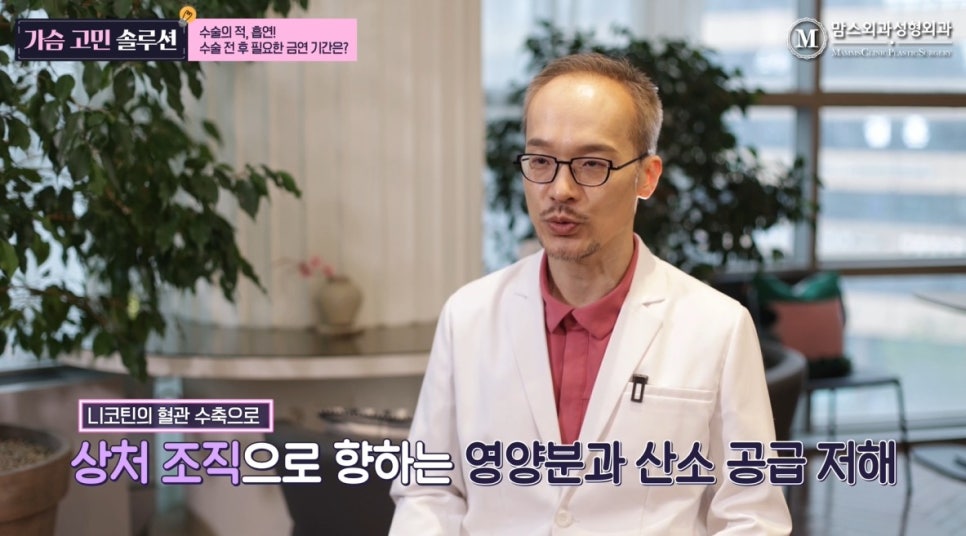
Because nicotine causes blood vessels to constrict,
its delivery of nutrients and oxygen to wound tissue is hindered,
and this is known to delay wound healing
and promote inflammation.

There is also the point that the mixed substances in cigarette smoke
decrease the mobility of regenerative cells.
In breast reduction surgery as well,
there has been research on the relationship
between reduction surgery complications and smoking.

For smokers, complications after reduction surgery
have been reported to increase by about three times
compared with non-smokers.
In particular, in breast reduction surgery,
the most common complication
is delayed wound healing.
Since smoking clearly worsens this,
quitting smoking before and after surgery is extremely important
in the recovery process after reduction surgery.

For this reason, we strongly recommend
that people undergoing breast reduction surgery
quit smoking.
But as you might expect, it is not easy to quit smoking all at once.

So many patients ask,
“When should I stop smoking?”
In fact, there are no exact research findings
about the relationship between delayed wound healing
and the length of smoking cessation.
The most reliable study available
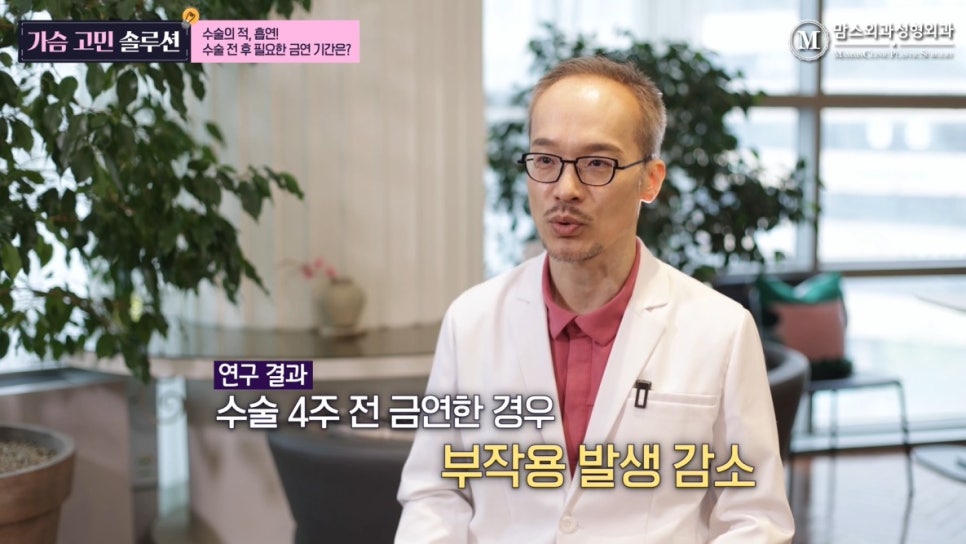
reports that quitting smoking 4 weeks before surgery
significantly reduces the occurrence of complications.

However, quitting before surgery is not the only important thing.
Since quitting smoking is also an important factor
during the healing process after surgery,
we recommend quitting for a total of two months:
4 weeks before surgery
and 4 weeks after surgery.

Even when recommending a total of two months of smoking cessation,
you may also wonder,
“Is that really realistic?”
So, to talk about a more relaxed smoking cessation period
that smokers may hope for,
there was a survey in which several medical professionals were asked,
“What is the usual period you recommend for quitting smoking?”
The largest number of doctors said
to quit smoking starting 2 weeks before surgery.

Although there is no definitive scientific research result,
from the perspective of medical professionals’ clinical experience,
the majority opinion was that quitting smoking
2 weeks before surgery and 2 weeks after surgery
would be necessary.
So this can also be used as a reference point.
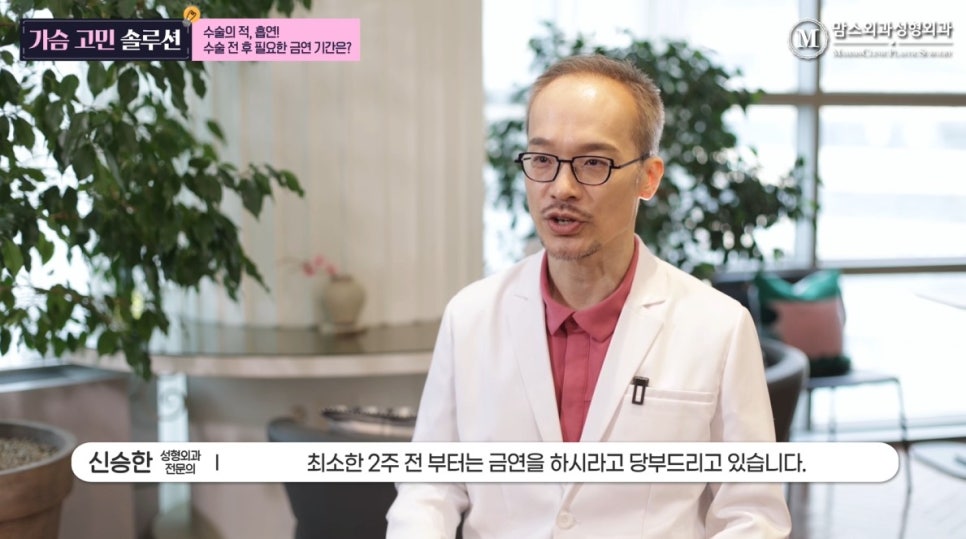
Personally, I tell patients to quit smoking
starting one month before surgery,
but if they say that is absolutely impossible,
I at least urge them to quit
starting 2 weeks before surgery.

Many people who undergo breast reduction surgery
think about it for a long time before finally deciding.
Since you have made such a difficult decision,
you should aim for a good surgical result without complications, right?
Quitting smoking before surgery—
if you are a smoker, please keep this in mind.
At this opportunity, I hope you will also succeed
in becoming a permanent non-smoker.