
Hello.
This is Moms Plastic Surgery Clinic.
The 대표적인 way to improve sagging breasts is
'breast lift surgery'.
However, when people worry too much about scars,
they sometimes make the wrong choice.
A typical example is
doing breast augmentation surgery
in order to improve sagging.
Today, I would like to talk about the problems with this method
and how to deal with them.
Why breast augmentation surgery is performed for sagging breasts
For people with sagging breasts,
especially those in their 30s and 40s,
this is what they often think.
First of all, the fact that sagging has occurred means
that they had a certain amount of breast volume,
so in most cases, these people had full and beautiful breasts
in their 20s.
What these people often think is that,
as they get older, it is as if air is slowly leaking out of a balloon,
leaving the breasts deflated and hanging down.
It feels like the breasts need to be lifted somehow,
but since lift surgery is said to leave a long scar,
if volume is filled back in with implants,
the hollow upper breast will be filled,
and the sagging nipples will be lifted,
and the beautiful, firm breasts of the past
can be restored.
With this thought, people visit a clinic to get implants,
and from the clinic's perspective as well,
compared with breast lift surgery, breast augmentation surgery
is less difficult and takes less time,
so it is recommended.
Can this method restore the old breast shape?
Basically, breast implants
should be positioned centered around the nipple.
In the case of sagging breasts,
if the implants are placed centered around the nipple,
the breasts as a whole end up looking as if they are hanging too low,
so surgery cannot be done this way.
Therefore,
the nipple is left lower down,
and the implant is placed above the nipple.
When this happens,
- the upper breast becomes bulging
- the nipple ends up even lower
and a strange shape, almost like Snoopy's nose, is created.
After spending so much time and money on surgery,
of course you would not be satisfied with this shape.
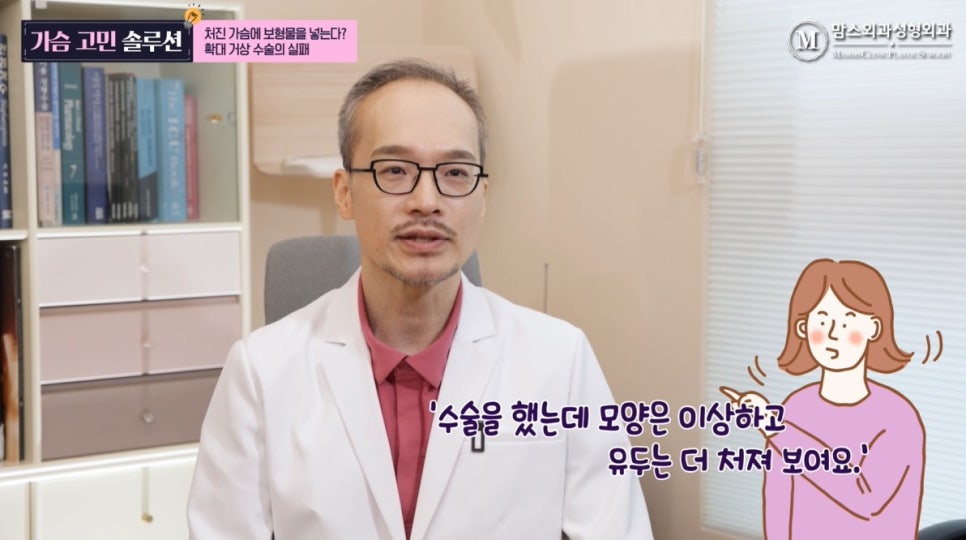
'The shape after surgery is strange, and the nipples look even more saggy.'
If you say this,
'The nipples are too low,
so let's correct the nipple position upward.'
That is what they say.
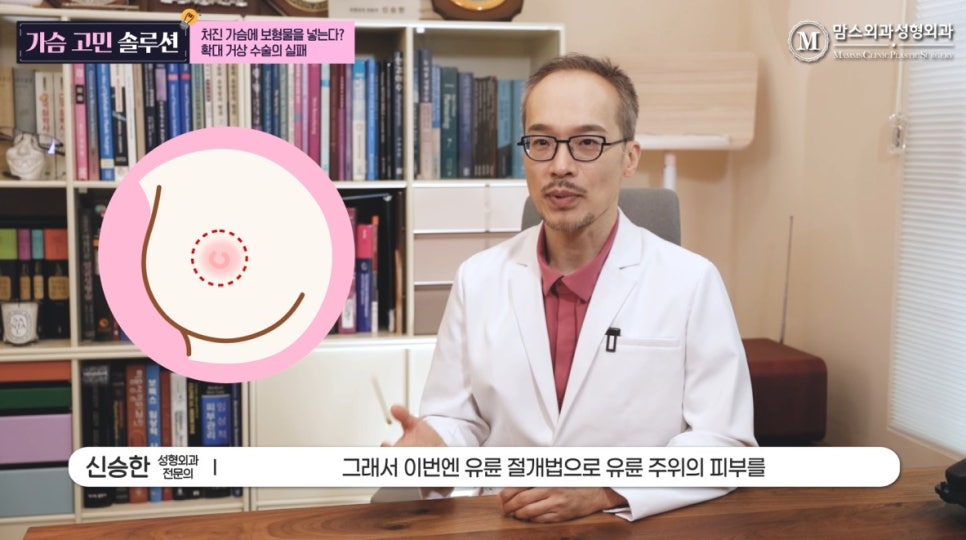
So this time, with a periareolar incision,
the skin around the areola is cut out in a donut shape,
the sagging nipple is pulled upward,
and then sutured.
At this point, because there is inevitably a large difference between
the diameter of the excised surrounding skin and the diameter of the areola,
the wide surrounding skin is gathered and tightened around the areola
as if cinching the opening of a drawstring pouch, and then sutured.
As a result,
wrinkled skin folds form around the areola.
You are told to wait because they will smooth out on their own over time.
But no matter how much one talks about the body's adaptability
or the use of Gore-Tex thread,
these wrinkles do not disappear without a cost.
Because of the difference in elasticity between the skin of the areola and the surrounding skin,
the surrounding skin does not gather toward the areola;
instead, the areola becomes abnormally enlarged
and the wrinkles disappear.
As a result of this series of surgeries,
the nipple is lifted upward,
but
- excessive areola diameter
- sagging tissue below the nipple
lead to these poor surgical results.
Then what should be done about a breast that has changed this way?
For all surgeries, after identifying the cause,
choosing the appropriate surgical method
is what matters.
For those who have undergone this process of surgery,
the size of the original breasts was probably never small.
If the breasts had been small, they would not have sagged.
Therefore, it is better to remove implants that add unnecessary weight.
The shape is not natural,
and the extra weight added by the implants
only makes the sagging worse.
The fundamental cause of sagging is
heavy tissue concentrated in the lower part of the breast.
- reduce the weight of the glandular tissue
- reposition some of it upward
Only by proceeding this way can the problem be improved.
In the end, the nipple and tissue must be lifted,
and the lower breast tissue must be removed,
so
scarring around the areola and on the lower breast
is inevitable.
Of course, since they disliked scars so much that they were hesitant,
they went ahead and had augmentation surgery anyway,
but now they are told that the implants must be removed
and a new lift surgery must be done.
For people in this situation,
it is true that this would be very upsetting.
However, only by accepting that the initial approach
was wrong,
and finding and improving the cause of the problem,
can the situation be turned around and good results be obtained.
Thank you.